Yusril and Sjafrie Discuss Accelerating State Defense Law Revision
Coordinating Minister Yusril Ihza Mahendra met Defense Minister Sjafrie Sjamsoeddin to discuss accelerating the revision of the State Defense Law, which is seen as needing to adapt to cyber threats and artificial intelligence.
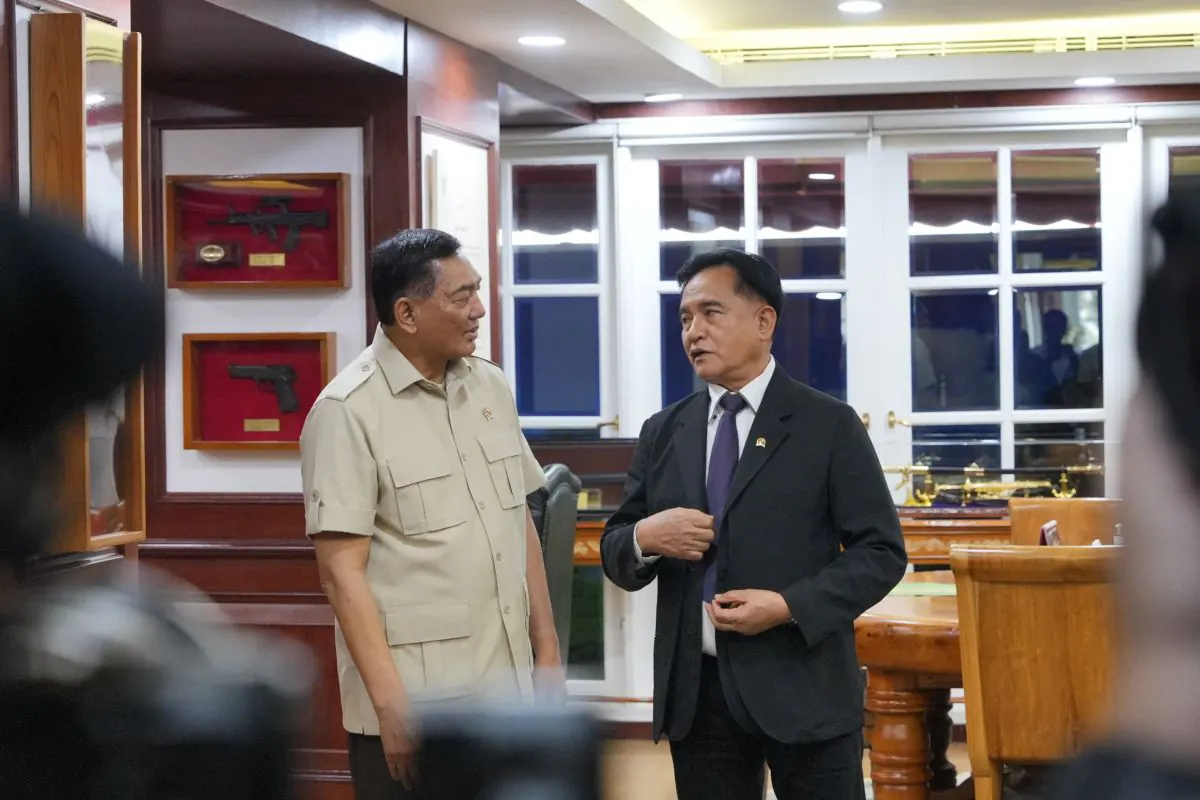
Coordinating Minister for Law, Human Rights, Immigration and Corrections Yusril Ihza Mahendra met Defense Minister Sjafrie Sjamsoeddin in Jakarta on Friday, 20 November, to discuss accelerating a revision of the State Defense Law, as reported by ANTARA.
According to ANTARA, the revision of Law No. 3 of 2002 is being prepared by the Ministry of Defense together with Commission I of the House of Representatives (DPR) and is expected to be submitted as a bill in early 2027. Yusril said changes were needed because the strategic defense environment had changed over almost a quarter century, including the emergence of cyber threats, artificial intelligence and developments in military technology.
Yusril said, "The State Defense Law also needs to be amended." He added that the adjustment was in line with changes to other defense regulations, including the law on the Indonesian National Armed Forces (TNI), so the content of the State Defense Law needed to be aligned with current needs.
In the meeting, Yusril said the main agenda was legislation and maintaining friendly ties, not hot political or legal issues such as wiretapping and treason. Sjafrie invited Yusril to help prepare the bill because he had been involved when Law No. 3 of 2002 was submitted during President Megawati's term. The meeting also served as a chance to renew ties, as the two have known each other since the 1990s, when Yusril was an assistant to the minister secretary of state and Sjafrie was commander of the Jakarta Military Region (Pangdam Jaya). Yusril said they did not discuss vice presidential candidates, wiretapping or treason. Sjafrie also understood that wiretapping and treason fell under police authority.
Legal framework for state defense
The State Defense Law is one of the legal pillars regulating how national defense is organized, including the relationship between the civilian government, the legislature and the armed forces. In Indonesia's system, defense is not solely a military affair but involves all national resources under the principle of total defense. Revisions to the law therefore usually touch many aspects, from command, duties and budgets to coordination among the TNI, ministries and agencies, and local governments.
Its drafting follows the national legislative process. A draft bill can be discussed after it enters the legislative program, is refined across agencies, and is then deliberated with the DPR. In defense matters, coordination among the Ministry of Defense, the TNI, the Ministry of Law and Commission I of the DPR is important because the material concerns national security and public spending. Technological change makes the discussion more complex, because lawmakers must translate cyber threats, data use and modern weapons systems into norms that remain auditable and do not conflict with citizens' constitutional rights.
The revision also needs to be read as an effort to align defense law with developments in other legislation. When regulations on the TNI, intelligence, cyberspace or the defense industry are updated, the State Defense Law must remain an aligned reference to avoid overlapping authority. In government practice, such harmonization is important to provide legal certainty for soldiers, civilian officials, domestic industry and communities affected by defense policy. The update is not merely a matter of replacing terms, but of adjusting authority, coordination mechanisms and accountability.
Terms frequently raised in the discussion, such as hybrid threats, cyber warfare and artificial intelligence, also need careful translation into legal language. Without clear definitions, new norms risk being too broad or difficult to implement in the field. An academic paper, public testing and input from defense experts and civil society are therefore important parts of the legislative process.
Impact on budget and citizens
For readers in Indonesia, accelerating the revision of the State Defense Law is not only about a legal document but also about policy choices that touch public budgets and citizen protection. If new rules regulate cyber threats, resource mobilization or the defense industry more closely, the effects may be visible in spending priorities, job opportunities in technology and manufacturing, and the government's readiness to deal with digital disruptions to public services.
The key issues to watch are transparency in the deliberations and oversight by the DPR. The public has a right to know whether the revision strengthens military accountability, protects citizens' rights and ensures that defense spending is directed at real threats. Until the draft bill is formally submitted and openly discussed, readers should wait for the official text before assessing its specific impact on prices, jobs or everyday security policy.
In everyday life, changes to defense regulations can also affect how people access information, for example through digital literacy campaigns, personal data security and preparedness against hoaxes that may sow division. The impact may not be immediate, but it matters because modern defense is measured not only by weapons strength but also by social resilience and public trust.
Related news
Coordinating Ministry for Law, Human Rights, Immigration and Corrections and Ministry of Human Rights Discuss 46 Agendas
Taj Yasin Asks Government Programs to Drive Central Java Local Economy
Bangladesh Hopes ICJ Ruling Speeds Return of Rohingya