Pati village heads association urges DPRD ethics body to probe alleged council member violation
Pasopati and Sukoharjo residents visit the Pati DPRD, demanding the Honorary Body follow up an alleged ethics violation after village head Suparjo died following a debt mediation.
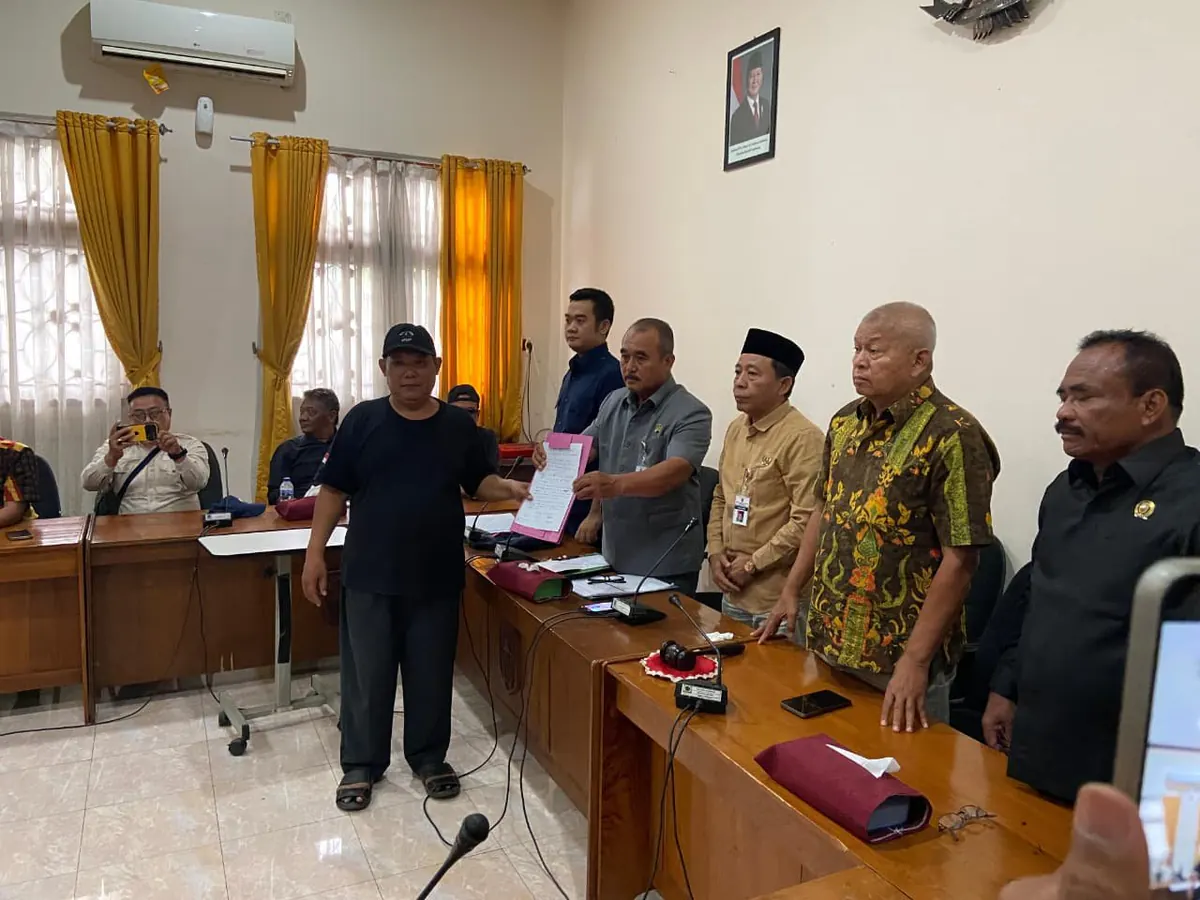
Residents of Sukoharjo village in Wedarijaksa subdistrict, together with the Pati Regency Village Heads and Village Officials Solidarity Association (Pasopati), went to the Pati Regional House of Representatives (DPRD) on Thursday, 19 November 2026. They pressed the DPRD’s Honorary Body (Badan Kehormatan), its internal ethics committee, to follow up an alleged ethics violation involving one of the council’s members. The action came after Sukoharjo village head Suparjo, 68, died following a tense debt mediation at the village office on Wednesday, 18 November 2026.
Their demand was received in the joint meeting room of the Pati DPRD by First Deputy Speaker Hardi, Second Deputy Speaker Bambang Susilo, Honorary Body chair Kamari and several members of the body, according to a report by Jateng Pos.
Bambang Susilo said the complaint’s details, including the name of the reported council member, could not yet be disclosed. He said two processes were running in parallel: an ethics review by the Honorary Body and a legal process at Pati Police (Polres Pati), after Suparjo’s family and representatives of the village head filed a report.
He said the Honorary Body was waiting for the complaint file to be completed by 14.00 Western Indonesian Time (WIB). Bambang said possible sanctions could range from a verbal warning, a written warning, removal from a leadership post in a DPRD working body, temporary suspension, to a proposal to dismiss the member from the DPRD.
The severity of any sanction would depend on the findings of the ethics examination, he said. “The heaviest sanction can go as far as dismissal,” Bambang said.
The role of the Honorary Body and the limits of ethics review
The Honorary Body is an internal working organ of the DPRD tasked with safeguarding council members’ conduct against their oath of office, the DPRD’s rules of procedure and its code of ethics. It is separate from the DPRD’s commissions, which deal with policy and budget matters. Its focus is examining alleged ethical breaches, not criminal investigation. Its output is an ethical assessment and internal sanction, while suspected crimes remain the responsibility of law enforcement.
In many regions, public complaints usually begin with recording, a request for complete documents and a review of whether the report falls within the Honorary Body’s authority. After that, people named in the complaint may be asked for statements. The process requires caution because DPRD members hold a constitutional position and are protected by the presumption of innocence. A decision is taken only after sufficient examination, not under crowd pressure. Transparent stages are important so the public does not judge the outcome before the process is finished. The public is also entitled to know which stage is underway, provided the rights of the person being examined are not violated.
When an incident triggers both an ethics complaint and a criminal report, the two tracks can run side by side. The ethics track assesses a council member’s behavior, words or actions against the norms of the office. The criminal track assesses whether there are elements of unlawful conduct that police can process. They do not cancel one another, but they do not automatically reach the same conclusion. An ethics review may be delayed or continued depending on the evidence needed and internal rules.
In village settings, mediation over debts is often used to resolve disputes among residents. Village heads or village officials frequently act as mediators, so tension in such forums can have a broad impact. When an incident ends in death, public attention is usually split between the community’s grief, the search for legal certainty and demands that officials or elected representatives involved explain their positions openly.
What it means for Pati residents and nearby villages
For people in Pati, the case touches two issues close to daily life: how debts are settled in villages and how accountable local representatives are. Village heads and village officials are the first point of contact for administration, mediation and the settlement of minor disputes. If a village forum is seen as failing to protect residents’ safety, confidence in local mechanisms can weaken.
For readers outside Pati, the lesson is that ethics complaints should not end with a mass demonstration. The public needs to monitor whether the Honorary Body receives a complete file, summons the relevant parties and announces the outcome in line with procedure. At the same time, the police process must proceed without either track overtaking the other. If both paths are opened clearly, residents have a fairer basis for judgment than speculation.
No direct effect on prices, employment or health is visible from this report. But attention ahead should focus on protecting residents during mediation, clarifying the role of the reported DPRD member, and whether ethics sanctions and criminal proceedings produce an answer that the victim’s family and the public can understand. Village governments can also review mediation protocols so dispute-resolution forums do not turn into dangerous situations.