Yusril says choosing Gibran's vice-presidential replacement is President Prabowo's authority
Yusril Ihza Mahendra said determining a vice-presidential replacement for Gibran Rakabuming Raka is the authority of President Prabowo Subianto.
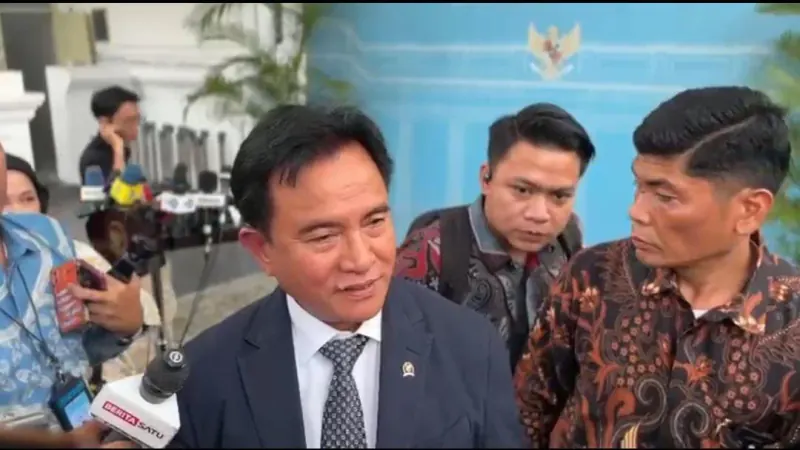
According to a report by state radio RRI (Radio Republik Indonesia), Coordinating Minister for Law, Human Rights, Immigration and Corrections Yusril Ihza Mahendra said determining a vice-presidential replacement for Gibran Rakabuming Raka is the authority of President Prabowo Subianto. He made the remarks to journalists at the Presidential Palace on Thursday.
Yusril said there is no explicit prohibition against a replacement candidate coming from the nominating parties, but the process must consider the MD3 Law, which governs the People's Consultative Assembly (MPR), the House of Representatives (DPR), the Regional Representative Council (DPD) and regional legislatures, and the election law. Under the MD3 Law, the proposal of a vice-presidential candidate must be discussed with the coalition parties that originally nominated the presidential and vice-presidential pair.
He said he expected Prabowo to hold a meeting with the chairmen of the parties that nominated the pair in the 2024 presidential election, which he said were 10 parties. Nevertheless, Yusril said, "the final decision is in the President's hands."
Rules for filling the vice-presidential post
In Indonesia, the vice president is elected together with the president as one pair, so replacing the position is not as simple as replacing a minister. The Constitution generally distinguishes between temporary and permanent circumstances. If the vice president is temporarily unable to carry out duties, the president may take over those tasks. If the post becomes permanently vacant, the constitutional mechanism directs the president to submit a candidate to the institution empowered to choose. The process requires the readiness of state institutions, political consensus and sufficient time.
Those provisions are the background to Yusril's reference to the role of the nominating parties. In a presidential system, the presidential and vice-presidential pair is nominated by a party or coalition of parties. After they are elected, the relationship among the president, the vice president and the coalition remains political capital for running the government. Discussions with coalition parties are therefore not only a matter of political ethics, but also part of a process regulated by law.
The MD3 Law and the election law are the references cited by Yusril. In broad terms, election rules govern nominations, while institutional rules govern the relationship among the president, the MPR and parties in the replacement process. The term "nominating parties" also needs to be understood: it refers to the parties that jointly submitted the pair in the election, not all parties that support the government after inauguration. That distinction determines who must be consulted when the vice-presidential seat needs to be filled. The general public often struggles to separate the president's authority, the role of the MPR and the position of the parties. Yet the three elements work within one process: the president determines the choice to be submitted, coalition parties form the political base, and the electing institution runs the constitutional mechanism.
The vice president's role also needs to be viewed from the practice of government. The post often serves as a link between the palace, parliament and coalition parties. In many cases, the choice of vice president is not only about personal capacity but also about balancing political support. Therefore, when the seat is vacant, the question of who is submitted to the electing institution will affect the government's image, coalition solidarity and the policy agenda underway.
What it means for Indonesian readers
For the public, a vice-presidential replacement may look like an elite affair, but its effects reach everyday policy. A new vice president can change the division of duties, the style of political communication and the priorities of programs overseen by ministries or agencies. If the process proceeds in an orderly manner and in accordance with the rules, readers can judge that democratic mechanisms are working. Conversely, if coalition talks drag on, uncertainty can emerge in markets, bureaucracy and government programs. If the proposed candidate is judged to lack political legitimacy or competence, the government may face coordination obstacles.
What needs to be watched is whether the candidate is truly chosen through an open and accountable process, rather than through mere elite compromise. The public has the right to know the legal basis, the role of the parties and the timing of the appointment. Transparency is also important to prevent the perception that the post is only a tool for power-sharing. In the short term, the development has more effect on the political map. In the medium term, the quality of the vice president will be seen in contributions to law enforcement, public services and policy coordination that directly affect people's lives.
Citizens can also monitor whether the replacement candidate has a track record relevant to the issues facing the government. In a presidential system, the vice president does not work alone but is part of a team that must maintain parliamentary and public trust. The process of filling the post therefore becomes a test of the maturity of the nominating parties and the president in applying the rules in force.