Taj Yasin Urges Government Programs to Drive Central Java's Local Economy
Central Java Deputy Governor Taj Yasin Maimoen urged government programs to reach local businesses through better access to financing, warning that economic benefits should not be captured by outside firms using local addresses.
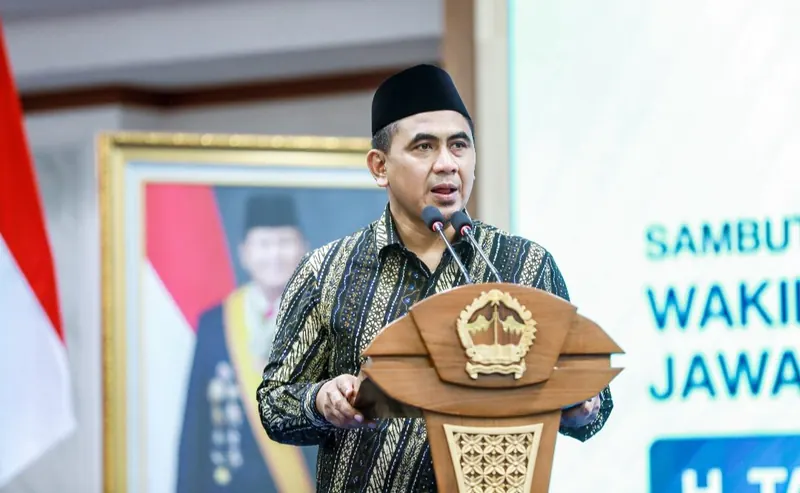
Central Java Deputy Governor Taj Yasin Maimoen urged high-value government programs to reach local businesses, according to a report by Jateng Pos, while opening a workshop in Semarang on Thursday, 19 November 2026 to strengthen the capacity of regional economic potential analysts for the Regional Financial Access Acceleration Teams (TPAKD) across Central Java and the Yogyakarta Special Region (DIY).
He highlighted access to capital so regional entrepreneurs can seize opportunities from government programs. He said economic circulation should not be captured by outside businesses that merely use local addresses.
Taj Yasin cited demand for eggs and chicken for the Nutrition Fulfillment Service Units (SPPG). The Central Java provincial government wants that supply met by local livestock farmers, but many local businesses face capital constraints, making it hard to raise production capacity.
He asked TPAKD to actively support businesses that have potential but are not yet known to financial institutions. That support can encourage them to form groups or consortia to strengthen their business capacity.
At the same workshop, the head of the Financial Services Authority (OJK) in Central Java, Hidayat Prabowo, said mapping regional potential should cover growth, competitiveness, productivity, production continuity and market opportunities. A regional economic development cooperation agreement was also signed for Magelang Regency, covering rice and chicken eggs among other commodities.
TPAKD's Role in Local Financing Ecosystems
TPAKD is essentially a coordination forum among local governments, OJK and financial services providers. The forum aims to accelerate access to formal finance in the regions, especially for micro, small and medium enterprises (MSMEs) that have long struggled to reach banks or official financing institutions. With TPAKD, local governments are not only regulators but also connectors between community financing needs and the capacity of the financial industry.
Classic MSME financing constraints usually involve collateral, bookkeeping, business scale and credit history. Many local businesses actually have market opportunities because government programs create demand, such as local procurement of goods and services, infrastructure projects or nutrition fulfillment services. But without support, they find it hard to meet the administrative and technical requirements set by financial institutions or project partners.
That is why an ecosystem approach matters. Financing should not be limited to a single business, but viewed as a chain from upstream to downstream: raw material suppliers, producers, processors, distributors and final buyers. When a commodity has a clear market partner and is backed by a business group, financial institutions can assess risk more effectively. Guarantees, insurance and credit schemes can be designed to fit the sector.
In Central Java, the food and livestock sectors hold a strategic position in the local economy. Demand for eggs, chicken meat, rice and other commodities can give livestock farmers and crop farmers room to grow. But the success of local government programs also depends on the quality of economic potential data, the ability of regional analysts to map priority sectors, and the willingness of the financial industry to channel financing with measured risk. Without clear mapping, market opportunities risk being captured only by established firms. Accurate data also helps local governments decide which commodities are most ready to be financed.
What It Means for Food Prices and Job Opportunities
For readers in Indonesia, the issue touches two concerns close to daily life: food prices and local business opportunities. When government programs require eggs, chicken, rice or other inputs, supply chains involving local livestock farmers and crop farmers can shorten distribution distances. The effect is not always immediate, but it can make supply more stable and keep more value added in the area. Routine supply means local businesses need to be well prepared from the start.
The relevance is also visible in job creation. MSMEs and farmer groups that gain financing access, support and market certainty are usually better able to raise production capacity. In that way, government programs become not only spending, but also engines of economic circulation that absorb local labor.
What needs attention ahead is accountability in supplier selection and the quality of support. If verification of local businesses is weak, large programs can still be captured by outside firms through nominal addresses. Conversely, if TPAKD and the financial industry consistently map risk, financing is more likely to reach businesses that genuinely produce in the region.