Surabaya protesters urge DPR to impeach Vice President Gibran
Dozens of protesters in Surabaya urged the House of Representatives (DPR) to impeach Vice President Gibran Rakabuming Raka, citing Constitutional Court and Supreme Court rulings on his education qualifications.
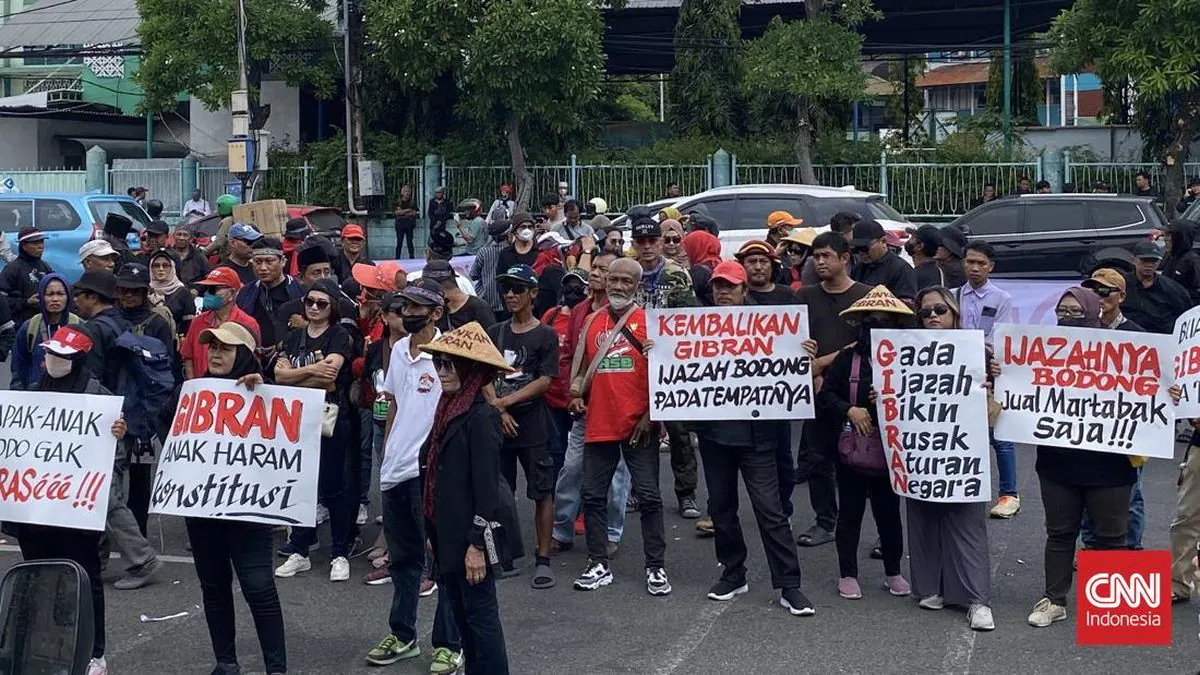
Dozens of protesters calling themselves Pergerakan Eksponen Nasionalis 96 packed the front of the East Java Regional House of Representatives (DPRD Jatim) building in Surabaya on Tuesday, 10 November, urging the House of Representatives (DPR) to impeach Vice President Gibran Rakabuming Raka. The protest targeted Gibran's candidacy requirements, which they deemed flawed.
The crowd comprised senior cadres of the Indonesian Democratic Party of Struggle (PDIP) and a group calling itself Pro Megawati Soekarnoputri. They displayed posters highlighting alleged violations of Gibran's vice presidential candidacy requirements, as reported by CNN Indonesia.
Protest coordinator Saleh Ismail Mukadar asked the East Java DPRD to relay the demand so that the DPR could exercise its constitutional right. He said the demand was based on Constitutional Court (MK) decision No. 01/PHPU.PRES-XXIV/2026 dated 6 October 2026 and Supreme Court (MA) decision No. 742 K/TUN/2026 dated 30 October 2026.
The MK ruling stated it did not find convincing evidence that Gibran held a foreign diploma equivalent to senior high school education, while the MA ruling annulled the education equivalency certificate that was the object of the dispute. Ismail argued that the MA ruling was binding, meaning Gibran was considered to no longer meet the formal requirements. Through the protest, he asked the DPR to use its right to impeach Gibran. The crowd also defaced a photo of Gibran and threatened sustained protests.
Constitutional path to removing a vice president
The impeachment demand voiced by the Surabaya crowd touches on a mechanism regulated in the 1945 Constitution. The president and vice president can only be removed from office during their term through a lengthy process involving three institutions at once: the DPR, the Constitutional Court, and the People's Consultative Assembly (MPR). This chain is deliberately layered so that directly elected offices are not easily toppled by street pressure.
The first stage is usually a DPR proposal alleging that the head of state or vice president committed a legal violation such as treason, corruption, bribery, a serious crime, a disgraceful act, or no longer meeting the requirements for the office. The proposal arises from the right to express an opinion, one of three collective DPR powers alongside interpellation and inquiry. But the DPR cannot decide alone; the opinion must be tested by the Constitutional Court, which has authority to examine whether the grounds for removal are legally valid.
Only after the Constitutional Court declares the grounds for removal proven does the MPR have authority to decide on removal. This means any court ruling, including an education administration dispute, does not automatically shake the vice president's seat. The impression that a single verdict can directly topple a state official is a misunderstanding that often appears in public debate. What applies is that the ruling can become material for consideration in a highly multi-tiered political process. In practice, such a political process also requires majority support in parliament, so mass pressure alone is rarely enough.
The education requirements for vice presidential candidates are themselves regulated in the election law, which sets a minimum education level of senior high school or equivalent. For foreign diplomas, the equivalency process usually goes through the ministry responsible for basic and secondary education. It is this dispute over the equivalency document that has recently dragged Gibran's name into the legal realm, although its status has not yet resulted in a final and binding ruling against him personally.
What the public should watch
For readers in Indonesia, the action at the East Java DPRD is more a barometer of political tension than an event that directly changes commodity prices or electricity tariffs. But it signals that the issue of vice presidential candidacy requirements remains alive in the public sphere and could trigger the next wave of demonstrations. When constitutional issues meet party sentiment, space for inter-elite dialogue narrows and the risk of polarization rises.
The most tangible impact for citizens is uncertainty. Impeachment pushed forward without a clear legal basis can disrupt the government's focus, especially on ongoing economic programs and public services. Therefore, readers need to distinguish between political demands on the streets and ongoing legal processes. As long as there is no final and binding court ruling, everyone mentioned in the dispute must be presumed innocent.
What deserves attention going forward is whether the DPR will actually process the right to express an opinion, and whether the Constitutional Court will examine the grounds for removal according to procedure. Answers to those two questions will determine whether the crowd's demands lead to constitutional change or remain unfulfilled aspirations.