Roy Suryo Questions UGM Dean's Signature on Legalised Jokowi Diploma
Roy Suryo questioned who signed a 2012 legalisation of President Joko Widodo's diploma and pointed to the absence of a date during a trial at Jakarta Timur District Court.
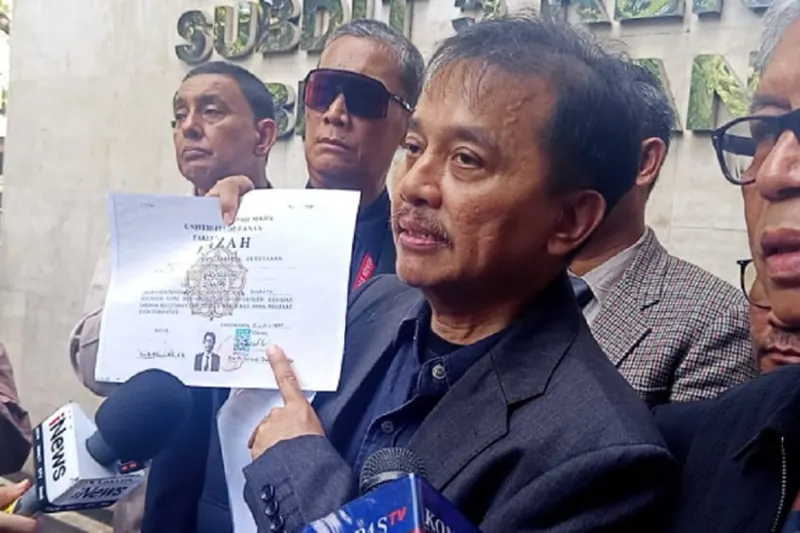
Roy Suryo, the defendant in the case concerning the diploma of the seventh President Joko Widodo, questioned the signature of the dean of the Faculty of Forestry at Universitas Gadjah Mada (UGM) on a legalised copy of the diploma at the Jakarta Timur District Court (Pengadilan Negeri Jakarta Timur) on Wednesday, 18 November 2026.
According to SINDOnews, the question was put to Binsar ST. Siagian, the former head of the technical election implementation and law division at the Jakarta provincial office of the General Elections Commission (KPU DKI Jakarta), who was called by public prosecutors.
Roy asked who had signed the 2012 legalisation and noted the absence of a date. Binsar replied that the dean at the time was Prof. Dr. Ir. Mohammad Na`iem, M.Agr.Sc.
Diploma Trial and Candidate Document Verification
The case in which Roy Suryo is the defendant shows that a head of state's diploma is not only academic evidence but also a legal object when its validity is publicly questioned. In Indonesia's election system, education documents are often included in candidacy files and can be verified by election organisers, educational institutions and relevant parties. Questions about signatures, dates or legalisation are therefore not merely administrative matters; they touch the bureaucratic trail used to prove a claim. This also makes campus archives and officials' records sought by investigators, prosecutors and lawyers.
In the courtroom, evidentiary mechanisms usually treat documents as evidence that can be tested for authenticity, integrity and the circumstances of their creation. Witnesses who took part in document verification can be asked about the process, the authorised officials and why a document was considered valid. Roy Suryo's question to Binsar ST. Siagian, as reported by SINDOnews, showed a focus on one small point: who was the dean that signed the legalisation and when the signing took place. Such small points often become the entry point for testing whether an administrative chain followed procedure.
The diploma issue also touches the reputation of the educational institution. Universitas Gadjah Mada, as a public university, has faculty structures, deans and official document practices that become reference points when academic documents are questioned. In legal cases, statements from campus officials or official archives are usually needed to explain whether a dean in a given year truly had the authority to sign a legalisation. The trial therefore seeks not only who signed, but also whether the signature came from the person authorised at the right time.
The presumption of innocence remains an important marker in reporting this case. Roy Suryo is the defendant, while Joko Widodo is the seventh president whose name appears as the subject of the case. Testimony in court can strengthen or weaken arguments by the parties, but a legal conclusion is valid only after a verdict becomes final and binding. For readers, understanding that status helps separate facts tested in court from opinion circulating outside the courtroom.
What Diploma Verification Means for the Public
For readers in Indonesia, cases like this show that documents tied to public office are not the private property of one person but part of political accountability. When a president's diploma is questioned, the public assesses not only one signature but also whether the state has verification mechanisms that can be tested. At this point, parliament, election organisers and educational institutions play a role in safeguarding public trust: they need to ensure that candidacy files, academic archives and official statements can be traced openly without violating the rights of parties not yet proven guilty.
The practical impact also touches the everyday habits of citizens in dealing with political issues on social media. Circulating documents are often cropped into screenshots, an empty date is immediately treated as proof of forgery, and the names of campus officials are used for accusations. Yet in court, witness testimony, archives and signing authority must be read as one chain. Critical readers will wait for official evidence rather than repeated allegations. In this way, the courtroom becomes a place for weighing evidence, not a viral arena.
Going forward, the course of the legal process and the positions of parties mentioned in the case need to be watched. If there are denials, clarifications or verdicts that are not yet final and binding, coverage must state that status clearly. In this way, the diploma issue can be understood as a test of state administrative transparency, not merely a tool to attack or defend particular political figures.