Indonesian Young Researcher Nathasya Christien Wins Shafi Prize 2026
Nathasya Abenita Christien, a young researcher from Sumatera Utara, won the Shafi Prize 2026 from Italy's ICTP for climate and Earth system research.
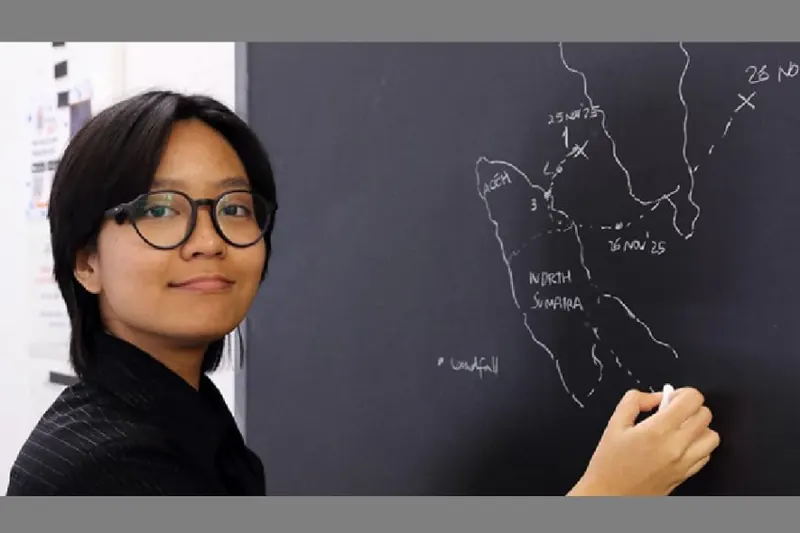
Nathasya Abenita Christien, a young researcher from Sumatera Utara, received the Shafi Prize 2026 from The Abdus Salam International Centre for Theoretical Physics (ICTP) in Italy in August 2026, as reported by the Indonesian news outlet SINDOnews.
The award was given for scientific research achievements and the highest academic accomplishments in Earth System Physics. According to SINDOnews, Nathasya has experience in studies of climate change, Earth systems and disaster risk.
She completed a mathematics degree at Institut Teknologi Bandung (Bandung Institute of Technology, ITB) in seven semesters with a GPA of 3.91 and was recorded as the fastest graduate in her department.
SINDOnews also noted that Nathasya is the daughter of Mayjen TNI Purnawirawan Christianus Halomoan Sidabutar, a retired major general of the Indonesian National Armed Forces (TNI), from Detasemen 81 Kopassus, the Indonesian Army Special Forces Command, who is buried at Taman Makam Pahlawan Kalibata (Kalibata Heroes Cemetery).
Climate research and disaster risk in Indonesia
Indonesia lives at the intersection of climate and geological threats. As a tropical archipelago, the country receives strong monsoon rains, experiences dry seasons that can trigger drought, and has coastal areas vulnerable to tidal waves. At the same time, its position along seismic paths makes earthquakes, tsunamis and landslides part of the risks it must manage daily. Studies of climate change, Earth systems and disaster risk are therefore not distant from public life.
Research of this kind works on layers often invisible to the public: rainfall modelling, reading temperature anomalies, mapping land vulnerability and estimating disaster impacts on food, water and settlements. The results can form the basis for early warning, spatial planning, infrastructure design and emergency response decisions. Yet there is always a gap from laboratory to policy. Data must be collected consistently, read together with meteorology, disaster management, agriculture, maritime and regional government agencies, and translated into actionable measures.
One institution long known for training scientists is the theoretical physics research centre in Trieste, Italy. Institutions such as this usually act as a bridge for researchers from developing countries to access seminars, collaborations and global science networks. In Indonesia, involvement in such networks can help accelerate mastery of methods that are not yet widely available domestically, including high-resolution climate modelling, multi-hazard risk analysis and integration of satellite data with field observations.
In many countries, including Indonesia, climate research challenges are also linked to human resource capacity. The field requires cross-disciplinary collaboration because climate is not only an atmospheric issue but also involves oceans, soils, forests, economies and human behaviour. A young researcher gaining international recognition can signal that the national academic ecosystem is still able to produce cadres with relevant competence. Such recognition matters, but it matters more if it opens access to data networks, training and cross-country cooperation. Successes like this can also encourage students to see climate science as a promising career rather than merely a difficult subject.
Impact on prices and disaster mitigation
For general readers, the achievement of a climate researcher may sound abstract, but its effects can touch everyday concerns. When forecasts of rain, floods, drought or tidal waves are more accurate, farmers can plan planting seasons, regional governments can prepare pumps and evacuations, and companies can anticipate supply chain disruptions. In the long term, the quality of climate prediction is also related to food prices, insurance costs, health impacts from hot air or diseases after floods, and decisions on building homes in hazard-prone areas. In cities, tidal flooding and extreme heat can disrupt mobility, electricity and work productivity.
What needs to be watched in the future is whether recognition of young researchers is followed by strengthening the domestic research system. Indonesia needs more open data, maintained field instrumentation, stable budgets and career paths that do not force scientists to seek recognition from abroad to feel meaningful. If that happens, climate research will not only be a story of individual achievement but a collective national capability to reduce disaster risk.
For the public, the practical message is simple: follow official warnings, know the risks in the place where you live and support data-based policies. The international achievement of a researcher can serve as a reminder that science is not a luxury but a tool to protect lives, livelihoods and living space. News like this is therefore worth reading not only as pride, but as a marker of a direction that needs to be strengthened together.
Related news
The People's Consultative Assembly (MPR) schedules a vice presidential election to replace Gibran on 2 December 2026; Irfan Maulana leads SP JICT 2026-2029 with a focus on port transformation; Fahira Idris supports Sufmi Dasco Ahmad as vice president.