Sultan Najamudin Seen as Young Figure in Prabowo Vice-Presidential Race
A constitutional law expert at Hasanuddin University has named Regional Representative Council chair Sultan Baktiar Najamudin as one of the young figures in the contest for President Prabowo Subianto's vice-presidential running mate.
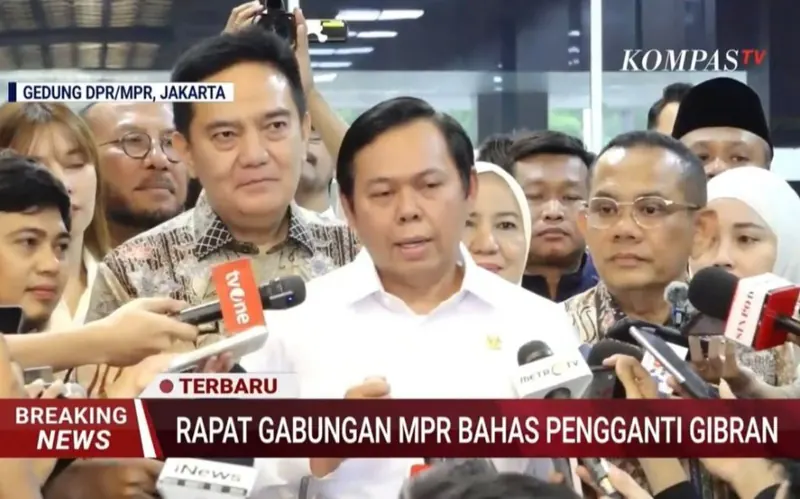
Sultan Baktiar Najamudin, chair of Indonesia's Regional Representative Council (DPD RI), has been described as one of the young figures in the contest to become President Prabowo Subianto's vice-presidential running mate, according to a report by Jateng Pos from Jakarta on Saturday 14 November 2026. The view was expressed by Prof. Andi Pangerang, a constitutional law professor at Hasanuddin University (Unhas), after Vice President Gibran Rakabuming Raka resigned.
Andi Pangerang said Sultan had a record in government, national leadership and representation of the regions. He said Sultan was now 47 years old, had served as deputy governor of Bengkulu, had twice been elected to the DPD RI and was leading the council for the 2024–2029 period.
In the report quoted by Jateng Pos, he said Sultan's position differed from that of party political figures because seats in the DPD RI come through an individual route rather than party membership.
Besides Sultan, Andi Pangerang named figures from five background groups: nonpartisan, political parties, the military, businesspeople and the bureaucracy. The nonpartisan group included Anies Baswedan; party figures included Sufmi Dasco Ahmad, Yusril Ihza Mahendra and Zulkifli Hasan; the military group included Sjafrie Sjamsoeddin; the business group included Andi Amran Sulaiman; and the bureaucracy group included Mahfud MD. He also mentioned AHY and Bahlil Lahadalia. The list, he said, was an academic view and not an official proposal from President Prabowo to the People's Consultative Assembly (MPR).
Regional political channels and the vice-presidential race
Choosing a vice-presidential candidate does not happen in a vacuum. In Indonesia's presidential system, a ticket must be read as a political package: who can add votes, who can steady a coalition, who can project representation and who can work with the elected president. The term young figure therefore does not refer only to age. It is often used to signal renewal, political stamina and the ability to appear in a public space that is changing rapidly.
The DPD RI occupies a distinctive place in that map. The council is filled through an individual route rather than through political parties, so its members are often read as representatives of the regions. In constitutional practice, the DPD RI does not have the same law-making power as the House of Representatives (DPR), but it acts as a channel for provincial aspirations, especially outside Java. When the chair of the DPD RI is mentioned in a vice-presidential race, the question is not only the formal office, but whether a regional background can add value to national leadership.
The constitution also sets rules for a vice-presidential vacancy. The president submits two replacement candidates to the MPR, and the assembly chooses one in a session. That rule makes every discussion about vice-presidential candidates both legal and political: a candidate must have legitimacy, be acceptable to the MPR and not disturb the coalition balance supporting the government.
Debate over vice-presidential candidates is usually divided into background groups such as the bureaucracy, the military, political parties, businesspeople and nonpartisan figures. The grouping is not a fixed formula, but a way of reading a candidate's record. Each group carries different risks and advantages: the bureaucracy offers technical experience, parties offer political machines, the military offers an impression of discipline, businesspeople offer an economic image, while nonpartisan figures offer distance from old conflicts.
What it means for voters and coalitions
For Indonesian readers, discussion of vice-presidential candidates is not only about who will occupy the number two position. The choice can shape the direction of the government's political communication, especially if the selected figure carries a regional, generational or nonparty message. Voters in the regions, for example, may watch whether their provincial interests gain a stronger channel to the center.
The issue also bears on coalition balance. A vice president is not merely a symbol; the choice helps determine who can bridge the president, parties and other state institutions. If a candidate comes from an individual route such as the DPD RI, the public may interpret it as an attempt to keep distance from party pressures. But without sufficient political support, that position can also make it harder for the government to move its agenda through parliament.
What matters next is whether this academic discussion turns into an official proposal. Until there is a decision by the president and a session of the MPR, the list of names should be read as discourse rather than certainty. For citizens, the most consequential question is the stability of national leadership: whoever the candidate is, the public will judge by work programs, track record and the ability to maintain trust after being elected.
Related news
Legal expert: four requirements for Gibran's vice-presidential replacement, Sultan on radar
Pati police suspect subsidized diesel misuse via fishermen's barcode
Central Java builds clean water supply system (SPAM) to tackle Kalikebo Klaten clean water crisis