Social Affairs Ministry and Jakarta Plan Sekolah Rakyat on Universitas Indonesia Land
The Ministry of Social Affairs and Jakarta provincial government are discussing plans to build a Sekolah Rakyat, or People's School, on Universitas Indonesia land and to update Perlindungan Sosial Digital data.
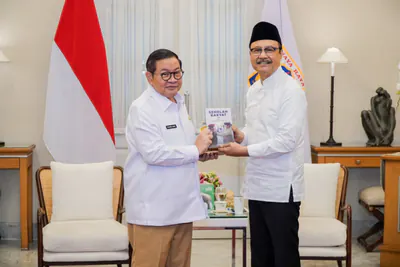
The Ministry of Social Affairs (Kementerian Sosial) and the Jakarta provincial government (Pemerintah Provinsi DKI Jakarta, the special capital region government) are preparing a plan to build a Sekolah Rakyat, or People's School, on about 8 hectares of land at Universitas Indonesia (UI), a site described as being on the side of the UI urban forest (Hutan Kota UI). The plan emerged from a meeting between Social Affairs Minister Saifullah Yusuf, widely known as Gus Ipul, and Jakarta Governor Pramono Anung at Jakarta City Hall (Balai Kota DKI Jakarta) on Monday, 16 November 2026, according to TVRI News.
According to the report, the discussion went beyond securing land and turned to administrative coordination and a Cooperation Agreement (Perjanjian Kerja Sama, or PKS) between the Jakarta provincial government and UI. Gus Ipul said the site had already been processed and was awaiting a PKS between the governor and the rector. The meeting also raised the expansion of Sekolah Rakyat Terintegrasi 4, an integrated People's School, in Jakarta Selatan, or South Jakarta, including the idea of relocating provincial social care facilities so their land could be used for schooling. The officials also discussed updates to Perlindungan Sosial Digital (Digital Social Protection) data and a trial of Government Regulation (Peraturan Pemerintah, or PP) No. 31 of 2026 on concessions for persons with disabilities.
Sekolah Rakyat programs in Indonesia's social policy
In Indonesian policy, Sekolah Rakyat programs are generally understood as efforts to widen access to learning for groups that formal education has struggled to reach. Such schemes often overlap with social assistance, family empowerment and spatial planning, because the children involved typically come from households with limited incomes, unstable housing, or dense and slum neighbourhoods. Their success therefore depends not only on buildings, but also on secure land tenure, use permits, financing, teaching staff and clear rules for selecting beneficiaries.
Using campus land as a People's School site adds a distinct layer of issues. Universities combine academic functions, open space and governance of state or public-institution assets that usually have strict use rules. If the land comes from an urban forest area, any construction plan must balance education needs, ecological functions and the rights of surrounding communities to green space. In Jakarta, where land is scarce, cross-institutional use of public assets can be important, but it also requires accountability so that state assets are not used without a clear legal basis and agreement.
The PKS, or cooperation agreement, is central to plans of this kind. It is not merely an administrative document: it sets out scope, responsibilities, duration, financing and monitoring. In partnerships among a ministry, a provincial government and a university, the agreement also helps ensure that social objectives do not conflict with the campus's academic mission. The term integrated People's School signals that education services can be linked with other social facilities, such as care homes, training or family protection, so beneficiaries receive more comprehensive support.
Impact for Jakarta residents and students
For Jakarta residents, the plan touches two issues that are rarely discussed together: access to education and the certainty of data-based social services. If a People's School is built on campus land, low-income families could gain a closer, more organised option connected to state facilities. But that benefit will only be felt if the site is not merely available physically, but also accompanied by official announcements on capacity, admission requirements, curriculum and support for students who had been disconnected from schooling.
The Perlindungan Sosial Digital component also affects everyday administrative practices. Updating social assistance (bansos) data with help from neighbourhood units (RT), sub-neighbourhood units (RW), village heads (lurah), subdistrict heads (camat) and volunteers can speed corrections to recipient records, but it also demands careful handling of personal information. Residents need to understand that re-registration is not a formality: inaccurate data can cause someone to lose aid, while leaked data can create further problems. Complaint channels, clear explanations of why data are collected and limits on data access therefore need to be communicated openly.
The planned trial of the disability concession policy adds another dimension for the city. If implemented effectively, residents with disabilities could gain more equal access to services, particularly in transport and health. But the success of such programs depends on field oversight, not only on signed documents. For readers in Indonesia, the next points to watch are whether the PKS is actually signed, whether the land remains green, and whether social data updates make assistance more targeted without undermining privacy.
Related news
Related coverage: Maruarar says free land certificates provide legal certainty for residents; the National Civil Service Agency (BKN) says talent management accelerates the filling of civil service (ASN) positions; and the Ministry of Public Works (Kementerian PU) is building an emergency embankment for floods in Subulussalam.