Salatiga urges civil servants to reject office-linked gratification
The Salatiga city government urged civil servants to reject gifts tied to official duties during a 2026 Anti-Corruption Day outreach.
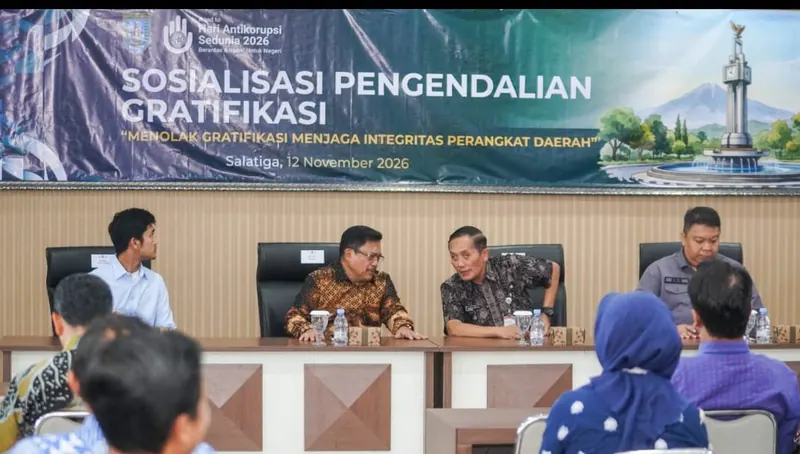
The Salatiga city government has called on all civil servants to be willing to reject gratification — gifts or favours linked to their positions and official duties. The appeal was made by Salatiga Mayor Dr. Robby Hernawan when he opened the Salatiga City Government’s gratification-control outreach as part of Anti-Corruption Day (Hakordia) 2026 on Thursday, 12 November 2026, in the Plumpungan Room of the Salatiga Regional Secretariat (Setda) building.
The event, organised by the Regional Inspectorate (Inspektorat Daerah), the city’s internal oversight office, was attended by heads of local government agencies, directors of regional state-owned enterprises (BUMD), and invited guests. According to Jateng Pos, Robby praised the Salatiga City Gratification Control Unit (UPG), which won the national TOP UPG award in 2022 and 2024.
From 2019 to 2026, the UPG facilitated 147 gratification reports worth Rp36,425,000 and three cash reports worth Rp4,000,000. Of those reports, 105 gift parcels were distributed to orphanages, sanitation workers and scavengers; 31 items were handed over to the Corruption Eradication Commission (KPK) to be designated as state property; and nine items were designated for educational use.
“Do not make a habit of accepting gifts related to your position and official duties,” he said firmly. He asked local government agencies to identify gratification-prone points in their work units. Robby also said the achievement should serve as motivation to strengthen anti-corruption commitment within the government.
Siti Andjajanah, secretary of the Regional Inspectorate, said she hoped the outreach would improve understanding of the principles of accountability, transparency, policy fairness and policy control. Speakers came from the local police headquarters (Polres), the district prosecutor’s office (Kejaksaan Negeri), and the Regional Inspectorate.
Gratification rules for civil servants
Gratification is not merely a small gift considered polite. In office settings, the line between a present, a thank-you and gratification is often unclear. Under Indonesia’s anti-corruption law framework, gratification is understood as giving in a broad sense, ranging from money and goods to discounts, commissions, interest-free loans, travel tickets, accommodation facilities and other facilities. Such gifts become a problem when they are linked to a position and conflict with the recipient’s duties.
The law on the eradication of corruption crimes treats job-related gratification as a form of bribery. Therefore, civil servants must not only personally reject such gifts; they also need to understand reporting and internal control. At the national level, reporting gratification to the KPK is part of the prevention system. Reporting helps the state determine whether goods or money should be returned, confiscated or used for the public interest. In many agencies, the Gratification Control Unit serves as the entry point for consultations, records reports and follows up on gifts that cannot or should not be rejected.
The treatment of gratification also relates to civil service ethics. Regulations on state civil servants require government employees to maintain neutrality, not abuse authority and not accept gifts that could influence decisions. This applies to employees at all levels, not only structural officials. When gratification is allowed to persist, it can shift public services from what should be fair to covert transactions.
The commemoration of International Anti-Corruption Day gives local governments a space to reassess the readiness of their control systems. Outreach of this kind usually does not stop at ceremony. It touches vulnerable points such as licensing, procurement, staff transfers, social assistance and direct services at village or subdistrict offices. Local governments also need to ensure reporting channels are easy to access and do not expose those who report to risk. Without clear mechanisms, rejecting gratification remains a moral appeal that is difficult to test.
What residents should watch for
For residents of Salatiga and other areas, rejecting gratification is directly linked to the quality of services they receive. Residents can also assess whether officials ask for unofficial payments to speed up matters. Giving gifts to staff can make queues unfair, allow permits to be issued faster for those able to pay, or distribute public assistance based on closeness. When civil servants are willing to refuse, the public receives the message that official procedures remain the main route.
The impact is also felt in regional budgets. Gratification that is left unchecked can raise transaction costs for businesses, especially small enterprises that depend on licensing, procurement and basic services. If bureaucracy becomes cleaner, compliance costs for the public and businesses can fall, while trust in local government rises. Declining public trust can make people reluctant to report suspected irregularities.
What needs to be watched going forward is consistency in follow-up. Outreach must be followed by clear mechanisms: vulnerable points are mapped, reports are processed and sanctions are applied without regard to status. The government needs to inform new employees of reporting deadlines and procedures. For residents, simple steps include refusing to give, asking through official channels, and reporting in writing if they feel harmed, without fear.
Related news
- Malang mayor links Heroes Day 2026 with welfare collaboration
- Central Java women and child protection reaches 576 districts
- Jember police help residents affected by windstorm