Alleged school illegal levies and meal quality draw scrutiny at East Java DPRD recess
East Java legislator Cahyo Harjo Prakoso hears residents' complaints about alleged illegal school levies and free nutritious meal quality in Simokerto, Surabaya.
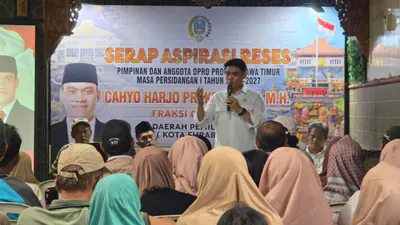
Cahyo Harjo Prakoso, a member of Commission E of the East Java Regional House of Representatives (DPRD), highlighted alleged illegal levies at schools and complaints about the quality of the Free Nutritious Meal programme (Makan Bergizi Gratis, or MBG) while listening to residents in Simokerto subdistrict, Surabaya, on Wednesday, 18 November 2026, as reported by TVRI News.
During the first recess of the 2026-2027 legislative session at neighbourhood unit RT 02/RW 05 in Simokerto, hundreds of residents raised education and public service issues. Complaints included alleged illegal levies at public senior high schools or equivalent institutions and MBG food that residents said was substandard.
The host of the recess, Haji Ahmad Stiokarno, said some residents found MBG meals unappetising, not as expected, and in some cases allegedly spoiled. He also said the Koperasi Merah Putih (Red and White Cooperative) programme was not yet available in Simokerto, so residents hoped for a more even distribution of government services.
Cahyo said the alleged illegal levies still needed to be investigated, but he stressed that such practices must not be tolerated if proven. He said he had coordinated with the head of the East Java Education Office for prevention and urged safe complaint channels for residents.
The role of recess and school complaints
A legislative recess is a period when DPRD members return to their electoral districts to hear residents' concerns. Complaints received during a recess are not automatically official findings, but they can be used for oversight, questions to the executive and policy recommendations. Under Indonesia's constitutional system, DPRD oversight can take the form of public hearings, field visits or written recommendations to government agencies. The qualifier alleged is important because illegal school levies can be declared violations only after review by the inspectorate (Inspektorat), the education office or law enforcement, according to their authority.
For public senior high schools and equivalent institutions, management authority lies with the provincial government. The East Java Education Office (Dinas Pendidikan Jawa Timur) is most responsible for student admission policy, school operations and supervision of principals. In Surabaya, that role matters because many senior high students come from families dependent on education assistance, so levies with an unclear legal basis can burden parents. The East Java DPRD, including Commission E, which handles education, plays a role in ensuring residents' complaints do not stop as social media news or neighbourhood meetings.
Complaints about MBG also touch a broader issue, the food supply chain. A mass nutrition programme depends on menu standards, kitchen hygiene, distribution and mechanisms for returning unsuitable food. If meals are judged spoiled or unappetising, residents need quick channels so schools are not merely passive recipients of supplies without bargaining power. In that context, oversight is not just about taste but about ensuring food safety and proper targeting. Nutritional standards should also be understood as health targets, not just flavour; a menu that is nutritionally correct can still be rejected if it is presented unappealingly or distributed late.
The Koperasi Merah Putih and Cek Kesehatan Gratis (Free Health Check) programmes show a direction in government efforts to integrate basic services: nutrition, health and the local economy. The main challenges are outreach and equitable distribution. Residents in Simokerto, for example, may experience programme benefits differently from residents in other subdistricts if information, service schedules or the cooperative's presence has not reached the RT level. Recess sessions that record complaints by RT can therefore become a small map for assessing whether programmes are reaching people evenly or appearing only in selected spots.
What parents should watch for
For parents in Surabaya and other cities, these complaints are a reminder that school costs are not only official school fees (SPP), but also additional levies sometimes packaged as donations, uniforms, activities or administration. While allegations remain unexamined, parents should keep evidence, ask for the legal basis of every payment and use official channels of the education office. Such transparency is important so public schools remain fair spaces for families with different financial capacities.
MBG complaints also have practical meaning for households. If children receive food in unsuitable condition, parents can report it through schools, community health centres (Puskesmas) or programme complaint channels, rather than only complaining in their neighbourhood. Children's nutrition affects concentration in learning and long-term health, so oversight of taste, hygiene and timely distribution is as important as the state budget spent.
Meanwhile, the absence of Koperasi Merah Putih in a subdistrict can signal that economic services are not yet evenly distributed. Residents need to monitor whether the cooperative has been established, who is eligible to access it and how its service mechanism works. That way, priority programmes are not only known through posters or news, but truly felt in daily life: children receive suitable food, pregnant women's nutrition is monitored, and families have clear access to services.