Palangka Raya earns special distinction in KPK Ber-AKSI model city assessment
Palangka Raya Mayor Fairid Naparin said the city scored 92.9 and received a special distinction in the Corruption Eradication Commission 2026 Ber-AKSI model city and regency assessment.
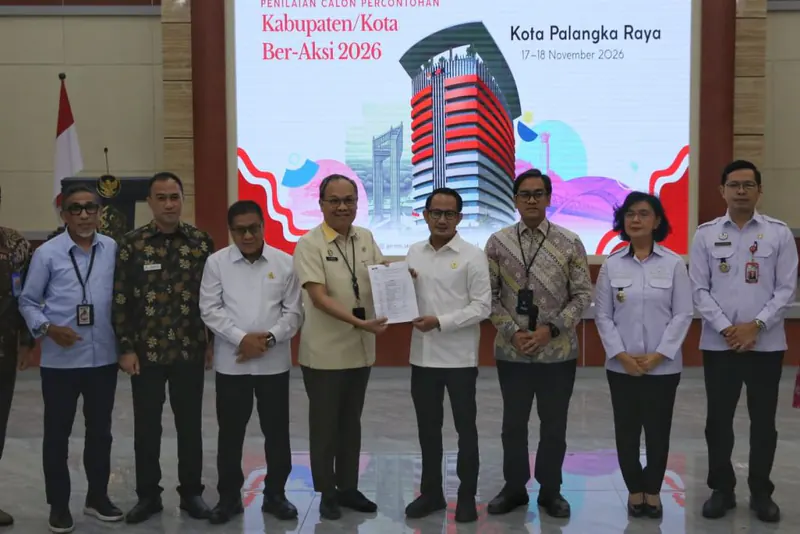
Palangka Raya scored 92.9 and received a special distinction in the 2026 Ber-AKSI model city and regency assessment conducted by the Corruption Eradication Commission (KPK), a programme that evaluates regencies and cities on anti-corruption governance. Palangka Raya Mayor Fairid Naparin announced the result at the hall of the Palangka Raya Education Office on Wednesday, 18 November 2026.
According to a report by the government public information portal InfoPublik, Fairid said the achievement was the result of joint work by the entire city government and residents in supporting an integrity-based administration. He explained that Palangka Raya completed indicator requirements and observation over about six months before being named among the top three with a score of 92.9.
The KPK assessed the completeness of documents, government data and legal issues affecting regional governance. During the process, the Palangka Raya city government made its data available for inspection and evaluation.
Fairid said recommendations from the assessment would be followed up, including updates to regional regulations and mayoral regulations. He also said consistency in the Monitoring, Controlling, Surveillance for Prevention system was part of the process before the in-depth observation.
As the capital of Central Kalimantan province, he said the distinction carried greater responsibility.
What the anti-corruption model region distinction means
Anti-corruption model region assessments usually do not stop at the ceremony that confers the distinction. At city government level, such results reflect whether the prevention system is working consistently, from budget planning, goods and services procurement and licensing to internal oversight. In that context, a special distinction can be read as a signal that a region is considered capable of maintaining governance in a more measurable way than many others.
Palangka Raya is administratively the capital of Central Kalimantan province. The city is a centre for public services, economic activity and public interaction. For that reason, the quality of its bureaucracy affects not only residents but also the image of regional governance across Central Kalimantan. When a city is judged to be serious about strengthening integrity, the effect can extend to public trust in services, from population administration and business licensing to the management of regional assets.
A credible assessment process is also important to understand. Such assessments usually demand layered evidence, document consistency and the ability of regional officials to explain policies. That goes beyond simply filling in administrative indicators. Regions judged to be serious generally must show that anti-corruption prevention does not depend on a single leadership period, but has become a working habit within the bureaucracy. In government practice, such consistency often separates cities that genuinely improve systems from those that merely chase assessments.
For other regions, Palangka Raya's achievement can serve as a reference that governance improvement can be carried out in stages. However, a special distinction does not automatically erase corruption risk. Integrity must still be safeguarded through oversight, budget transparency, safe complaint mechanisms and a work culture that rejects gratuities. Without sustained maintenance, a good assessment may become only an annual achievement record rather than real change in public services.
Impact on public services in Palangka Raya
For residents of Palangka Raya, the distinction is relevant insofar as it drives service improvements they can feel day to day. Updates to regional regulations and mayoral regulations, as noted in the report, can affect the speed of licensing, the clarity of administrative procedures and the certainty of public services. If recommendations are followed up, residents should receive more transparent processes that do not depend on informal channels.
For readers in Indonesia, the achievement shows that competition to improve regional governance is moving. Other cities can use Palangka Raya as a comparison, but also need to assess whether a special distinction is followed by better services. What should be watched going forward is budget consistency, internal oversight and responsiveness to public complaints. Without those, a high score would remain only a bureaucratic achievement rather than a real public benefit.
Another impact to monitor is the habit of civil servants in rejecting gratuities and maintaining service neutrality. Residents can judge success from simple things: whether service queues are more orderly, official fees are clearer and complaints are handled without the need for intermediaries. By that measure, an anti-corruption distinction does not stop in an assessment room, but appears in district offices, agencies and everyday public services.
In addition, success in maintaining integrity can reduce potential hidden costs for small businesses because clearer procedures reduce the space for unofficial charges.
Related news
- MAKI presses for Riza Chalid to be tried in absentia
- Sentong Bridge in Bondowoso inaugurated after collapse
- Lampung governor urges residents to safeguard tolerance and cultural diversity