Prosperous Justice Party Lawmaker Unfurls Poster Demanding Vice President Gibran Step Down
A Prosperous Justice Party lawmaker displayed a poster calling for Vice President Gibran Rakabuming Raka to resign or be removed outside a plenary session of Indonesia’s House of Representatives.
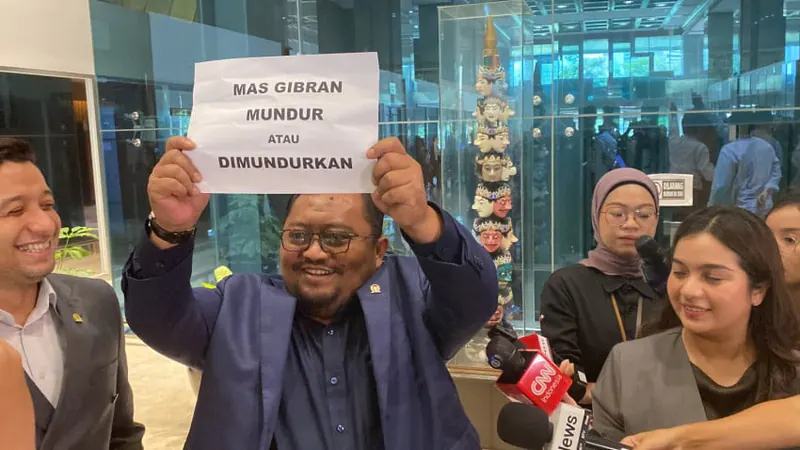
Yanuar Arif Wibowo, a member of Indonesia’s House of Representatives (DPR) from the Prosperous Justice Party (PKS) faction, unfurled a poster reading “Mas Gibran Mundur atau Dimundurkan” — “Gibran must step down or be removed,” using the Javanese honorific Mas — at the parliamentary complex in Senayan, Jakarta, on Tuesday, 10 November 2026, as he was about to attend a plenary session.
According to SINDOnews, the poster demanded that Vice President Gibran Rakabuming Raka resign from the vice presidency. Yanuar displayed it on the second floor of the Nusantara II Building before going up to the plenary chamber, and repeated the gesture to journalists after the session. The moment drew attention and went viral.
Yanuar said the poster voiced the aspirations of people in his electoral district over the controversy surrounding the validity of Gibran’s diploma. He described the gesture as a representation of public aspiration and part of a lawmaker’s right to express an opinion.
“Singkat, padat, jelas,” Yanuar said — “short, concise and clear.” He said lengthy explanations were no longer necessary because all sides already understood the issue.
How political expression works in parliament
A plenary session is the highest decision-making forum in the DPR. In parliamentary practice, members usually voice views through points of order, interpellations (formal questions to the government), inquiries, or expressions of opinion. A poster displayed outside the chamber is a simpler form of political expression, but it still takes place within the parliamentary environment. The presiding officer controls the speaking order, so members who want to send a message outside the rules of procedure often choose visual gestures. Posters, banners and other props are a quick way to attract cameras and media attention.
The right to express an opinion is a constitutional right of the DPR to assess government policy or extraordinary events. It differs from the right to conduct an inquiry, which examines the implementation of a specific policy, and from the mechanism for removing a president or vice president, which involves the People’s Consultative Assembly (MPR) and the Constitutional Court. Under the DPR’s rules of procedure, the right to express an opinion does not stand alone. It is usually preceded by an assessment that a government policy is considered contrary to the public interest or the constitution. After a proposal is approved in the DPR, the political process in the MPR still requires evidence and legal argument.
In Indonesia, the vice presidency is attached to the elected presidential ticket. It cannot be removed solely because of public pressure. The constitution allows the DPR to submit a removal proposal to the MPR if there are allegations of legal violations or if the officeholder no longer meets eligibility requirements, subject to a strict review process. The demand that Gibran step down or be removed is therefore more accurately read as political pressure. It can shape public image, coalition dynamics and the oversight agenda, but it does not automatically change his status as vice president.
The lawmaker’s action can also be read as part of the DPR’s political oversight function. Factions, including PKS, may use symbolic gestures to keep an issue alive in public debate. In parliamentary politics, symbols often bridge formal procedures and pressure from public opinion. The episode shows that Indonesian politics still leaves room for symbolic action. A small gesture in a parliamentary lobby can become major news when it touches a public figure and an issue already under dispute.
What the public should watch
For readers in Indonesia, a poster display does not directly change prices, wages or public services. Its impact is mainly on the political climate: whether state institutions continue to resolve differences through procedure, or whether symbolic pressure narrows the space for deliberation. Government stability can affect market confidence, investment plans and the implementation of programs that touch regional budgets and social assistance. If a debate drags on without official evidence, the public can grow weary and trust in elected representatives can decline.
The next steps to watch are the DPR’s official follow-up, the positions of parliamentary factions and the government’s response. The controversy over Gibran’s diploma should be read by distinguishing political opinion, allegations and rulings by authorized institutions. The public should also assess whether a lawmaker’s action represents his electoral district or is merely a gesture aimed at the media. Without clear and transparent procedures, symbolic actions add only noise.
For voters, the episode is a reminder that oversight does not always happen inside the chamber. It can appear through posters, press statements or content that goes viral on mobile devices. Its political effect becomes measurable only when it enters the official agenda, working meetings or constitutional mechanisms. The public is entitled to demand more concrete and open explanations from parties and lawmakers.
Related coverage
Related articles: 50 DPR members reportedly sign a proposal to exercise the House’s right to express an opinion on Gibran; a crowd in Surabaya urges the DPR to impeach Vice President Gibran; the Presidential Palace respects the DPR’s proposal to use the right to express an opinion in the impeachment of Vice President Gibran.