Prabowo Urges Indonesians Not to Feel Inferior About Singapore Education
President Prabowo Subianto urged Indonesians not to feel inferior about Singapore's education quality, saying the comparison overlooked the scale of Indonesia's education system.
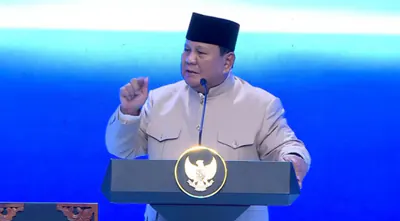
President Prabowo Subianto urged Indonesians not to feel inferior to other countries' achievements, particularly the quality of Singapore's education, while speaking at the 15th anniversary of NasDem Party, a major Indonesian political party, at NasDem Tower in Jakarta on Wednesday night, 11 November 2026. According to Indonesian broadcaster TVRI News, Prabowo said excessive admiration for foreign achievements obscured Indonesia's great potential.
Prabowo referred to the habit of some members of the public who quickly praise Singapore's education system. He cautioned that the comparison was not equal because the city-state manages only about 300 schools, from kindergarten through senior high school. Indonesia, by contrast, has to serve roughly 300,000 educational units spread from major cities to remote areas.
The burden, as quoted by TVRI News, did not include madrasah, or Islamic schools, and other religious schools overseen by the Ministry of Religious Affairs. He also referred to the attitude of some citizens who frequently insult their own country, linking it to a colonial legacy that left an inferiority complex. Prabowo acknowledged that admiration for other countries was not forbidden, but it should not turn into a sense of defeat.
He urged the public to treat other countries' achievements as lessons rather than reasons to downplay national capability.
Indonesia's Geographic Education Challenges
Comparisons between Indonesia and Singapore on education often overlook a fundamental difference in national scale. Singapore is a city-state with a relatively small territory and a concentrated population, allowing schools to be managed in a more centralized pattern. Indonesia, by contrast, is an archipelago with thousands of islands, mountainous terrain and settlements scattered to the most remote areas. This means every national education policy must account for teacher distribution, road access, electricity and communications networks.
Indonesia's education system also does not operate under a single command. General schools fall under the Ministry of Basic and Secondary Education, while madrasah and other religious schools are overseen by the Ministry of Religious Affairs. Both are part of one national system, but they have different curricula, resources and operational challenges. When the number of educational units to be served reaches hundreds of thousands, the problems are not only about quality but also infrastructure availability and service equity.
In public discourse, feelings of inferiority toward other countries have long appeared in Indonesian intellectual conversations. Some observers call it a remnant of colonial mentality, a tendency to view foreign achievements as a higher standard without considering context. Criticism of the national education system is often made by comparing international survey results or school experiences in developed countries. Prabowo touched on that habit in his speech without denying that other countries do have certain advantages.
In the political context, a speech at a party forum is also a way for a leader to convey messages to supporters and elites. NasDem, as one of the major parties, has a broad network in the regions, so a message about national confidence can spread to branch officials and supporters. But the core of Prabowo's argument remained a critique of how the public judges itself.
Message for Parents and Education Debate
The appeal touches a daily habit when judging education quality. Parents often compare public schools with international-standard schools or even with the education system of a neighboring country before choosing a path for their children. The message that Indonesia's scale of management is different can serve as a reminder that the success of a system cannot always be measured by direct comparison with a smaller country.
Another relevance is visible in public discourse on social media. Criticism of teachers, curricula or school facilities is necessary, but it is often wrapped in a tone that demeans the country itself. In that context, Prabowo's speech can be read as encouragement for society to separate constructive evaluation from excessive feelings of inferiority. Readers can observe whether criticism circulating in public spaces is truly accompanied by solutions, or merely praises other countries without understanding the complexity of domestic problems.
Looking ahead, the message also relates to the direction of national education policy. The government needs to show that improving quality does not mean copying another country's system wholesale, but adapting it to Indonesia's geographic, cultural and resource conditions. For the public, confidence does not mean closing oneself off from learning, but judging one's own achievements with a fair standard.