Prabowo Says National Wealth Must Benefit the People
Speaking in Palu, President Prabowo Subianto said Indonesia’s natural resources must be managed so their benefits are enjoyed by the people, not taken abroad.
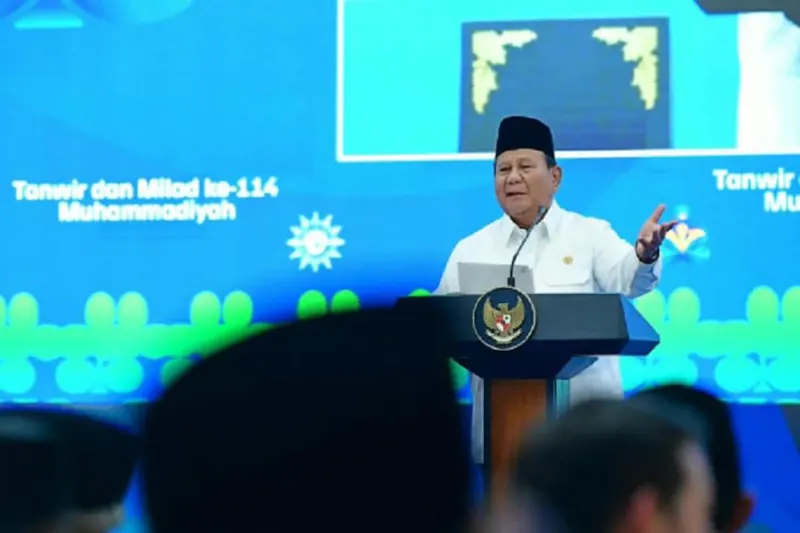
President Prabowo Subianto said the government was committed to reforming the national economic system so that Indonesia’s natural wealth is enjoyed by the people. He made the remarks while opening the 2026 Tanwir, the national consultative assembly of the Islamic organisation Muhammadiyah, and the 114th anniversary of Muhammadiyah at Universitas Muhammadiyah Palu in Central Sulawesi on Saturday, 14 November 2026, as reported by the Indonesian news site SINDOnews.
Prabowo said the country’s abundant natural resource potential must be managed so that its results become real benefits for the nation. He pointed to practices that deliver large profits to certain parties while the proceeds are taken abroad. According to SINDOnews, he said foreign nations had come to the Nusantara archipelago for hundreds of years because of the mineral and commodity wealth needed by the world. In the speech, he asked the professors present, “What system is this?”
Parliament’s Role in Natural Resource Governance
The idea that natural wealth should return to the people is not new in Indonesian politics. The 1945 Constitution places the earth, water and natural resources contained within them under state control and requires that they be used for the greatest prosperity of the people. That norm guides discussions among the government, the House of Representatives (DPR) and regional authorities on mining, energy, forestry, plantation and fiscal policy.
In Indonesia’s constitutional system, parliament is involved through three functions: legislation, budgeting and oversight. Through legislation, the DPR works with the government to pass laws governing business permits, royalties, share divestment, downstream processing and sanctions for violations. Through budgeting, parliament sets the size of state spending, transfers to regions and village funds, which can broaden the benefits of natural resources. Regions, meanwhile, need assurance that transfer funds are not merely numbers in budget documents. Through oversight, the DPR can summon ministers, examine reports and follow up complaints from resource-producing areas that feel they have not received a fair share.
The debate over natural resources also touches regional autonomy and fiscal decentralisation. Many regions rich in minerals, coal, palm oil or fisheries feel that the proceeds of exploitation are enjoyed more by the central government and corporations. Prabowo’s remarks therefore struck at a question that often arises in public hearings at Senayan, Jakarta’s parliamentary complex: how the state can ensure added value does not stop at raw material exports but becomes industry, jobs and accountable revenue.
Politically, the question “What system is this?” also implies criticism of an economic model seen as favouring capital owners over ordinary citizens. In practice, the state can rely on taxes, royalties, profit sharing, equity ownership or obligations to process resources domestically. These policy choices are always a negotiation among investment needs, legal certainty, economic sovereignty and public pressure. It is at this point that parliament is tested. The public is watching whether DPR oversight can bridge the interests of producing regions, the centre and businesses. In recent years, policy direction has also been tested by the need to attract investors while safeguarding sovereignty over strategic commodities such as nickel, tin, coal and critical minerals.
Impact for the People and Producing Regions
For Indonesian readers, the statement is relevant because natural resources affect the cost of living. Fuel, electricity, food and logistics costs are shaped by energy policy, fiscal policy and the distribution of state revenue. If natural wealth is managed to create added value at home, the impact can include jobs in industrial estates, higher regional income and wider fiscal space for social programmes. Local governments, for example, can use revenue-sharing funds for roads, irrigation, schools and puskesmas, or community health centres.
Yet a promise of benefits for the people does not automatically become reality. The public needs to see whether revenue truly enters the state treasury, how much returns to the regions and how far affected communities can access basic services. Only then can people judge whether the benefits reach villages, cities and areas that have long hosted mining operations. Parliament has a role in ensuring that policy does not stop at speeches but is tested through financial reports, audits and programme evaluations.
For the medium term, consistency in downstream processing regulations, environmental protection and transparency in business permits will matter. Without oversight, exploitation can trigger land disputes, pollution and a fragile economy. Criticism of such economic models usually emerges when commodity prices rise but households still feel little benefit. Prabowo’s message in Palu can therefore be read as a call to honour a constitutional promise: national wealth must lead to the people’s prosperity.
Related coverage
Prabowo Guarantees Scholarships for Children of Volunteers Who Died in Forest and Land Fires; Prabowo Awards Bintang Jasa Pratama to 15 Volunteers; Denny: Prabowo’s Polite Stance Is Not Permission for Gibran to Stay.