Prabowo invokes Javanese proverb at NasDem 15th anniversary
President Prabowo Subianto used a Javanese proverb about good and bad deeds becoming visible to underscore moral choices at the 15th anniversary of the NasDem Party in Jakarta.
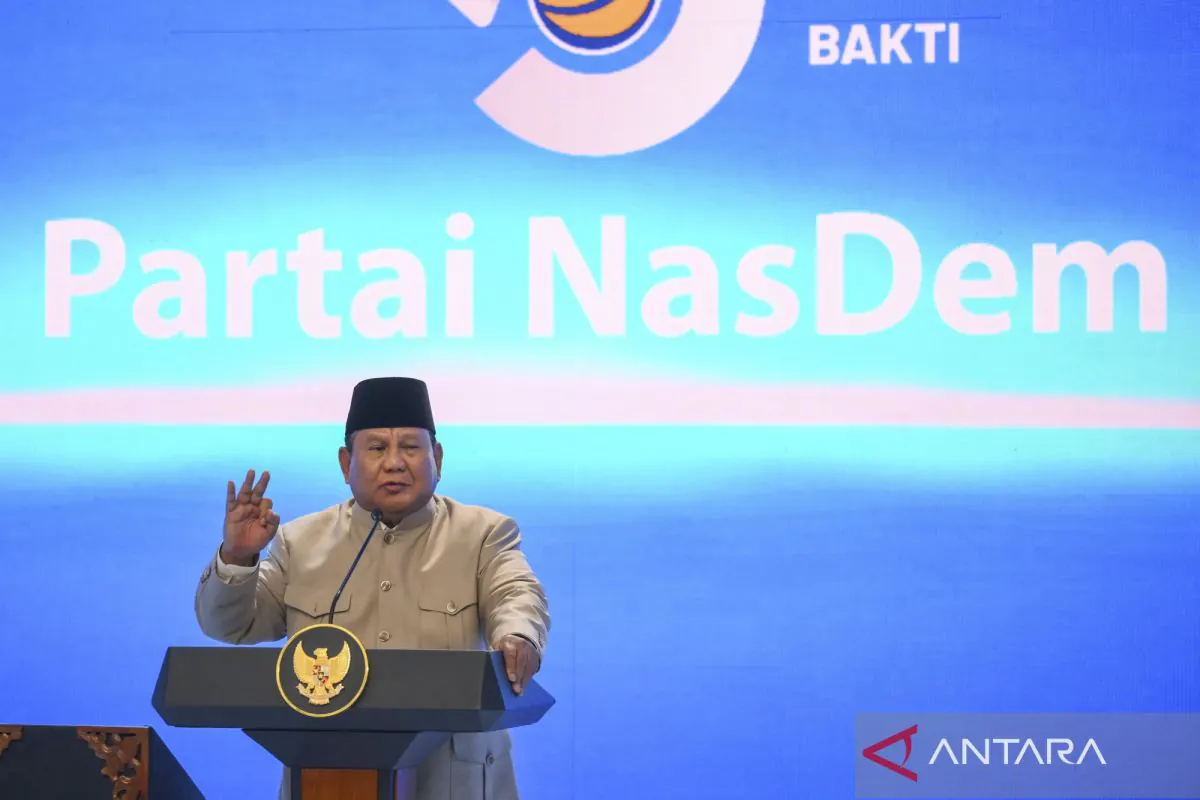
President Prabowo Subianto invoked the Javanese proverb “Sing Becik Ketitik, Sing Olo Ketoro” at the culmination of the NasDem Party’s 15th-anniversary celebrations in Jakarta on Wednesday night, 11 November 2026, as reported by ANTARA, Indonesia’s state news agency.
In a political speech at NasDem Tower, Prabowo said the proverb means good deeds will become visible and bad deeds will also eventually be exposed. He linked the message to “shirotol mustaqim”, the straight path, to stress that people always face choices, including choosing the right path even when it is difficult.
He said he was determined to choose the right path and urged others to have the courage to distinguish right from wrong. Prabowo acknowledged that he had received much harsh criticism, but said he continued to work for the people and for the future of children.
“What is right will be seen, and what is wrong will be seen too,” Prabowo said.
The anniversary gathering was attended by party leaders from inside and outside the governing coalition, including Golkar Party chairman-general Bahlil Lahadalia, National Mandate Party (PAN) chairman-general Zulkifli Hasan, People’s Consultative Assembly (MPR) chairman Ahmad Muzani, and House of Representatives (DPR) deputy speaker Sufmi Dasco Ahmad.
Javanese proverb and the straight path in the speech
Using Javanese proverbs in political speeches is not new in Indonesia. The phrase “sing becik ketitik, sing olo ketoro” is commonly used to say that a leader’s actions cannot be hidden forever. The value it promotes is accountability: the merits and flaws of policies will be judged by the public, while a person’s moral record will be visible through consistent behaviour. In Indonesian political tradition, noble values are often used as a way to check power. This approach is considered subtler than direct accusations and more acceptable across groups.
The reference to “shirotol mustaqim” is also common in Indonesian political communication, especially when a speaker wants to ground a moral message in a religious source. In Surah Al-Fatihah, an opening chapter of the Quran, the phrase is understood as a request for guidance to the straight path. In a political forum, its meaning can be broadened into an appeal to choose a correct, honest policy direction that serves the people’s interests. The use of religious wording can also reach religious voters without naming a particular party.
A political party’s anniversary can easily be read as a signal. The presence of state officials, ministers and elites from other parties may be interpreted as reaffirming coalition ties, testing communication across rival camps, or simply maintaining good relations. As a result, a moral message delivered by a president at a party event is often read not only as personal advice, but also as a reflection of the pressures facing the government. That gives speeches at party gatherings two layers: a moral message and a political message.
At the same time, using religious terms in politics requires sensitivity. Speakers must ensure the message does not become a forced symbol. When a leader speaks of the straight path, the public usually waits to see whether words and policies align: whether the government’s direction truly favours justice, or is merely rhetoric to blunt criticism.
What the message means for the public
For readers in Indonesia, such a speech matters because it touches a familiar national political habit: leaders often wrap policy messages in moral values. The public can use it as a reminder that campaign promises and government actions should be measured by real results, not by symbols or quotations. When a head of state speaks of the right path, the practical question is whether fiscal policy, social assistance, law enforcement and bureaucratic governance move in the same direction as the message.
The relevance also extends to public conversation. Social media makes speech snippets easy to go viral, but context is often lost. Readers therefore need to look at the full message, including who attended the event, what forum was used and what issues the government is facing. That way, moral advice does not stop at a slogan but can be tested through performance that people can feel.
In fast-changing politics, such a message can also be read as a way for the government to maintain moral legitimacy. Readers in Indonesia need to watch whether the values invoked by leaders are translated into policies that protect vulnerable groups, improve public services and keep the space for criticism healthy. Without that, advice becomes only rhetorical decoration.