Prabowo Acknowledges Indonesia Still Faces Corruption, Illegal Economy and Drugs at APEC
Prabowo acknowledged that Indonesia still faces governance problems, corruption, the illegal economy and drugs at the APEC forum in Shenzhen, China.
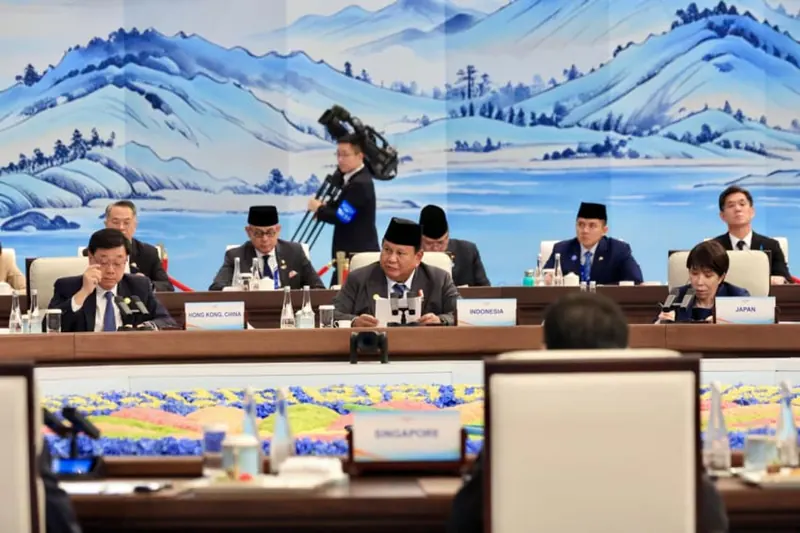
Indonesian President Prabowo Subianto acknowledged that the country still faces problems in governance, corruption, the illegal economy and drugs while speaking at the APEC 33rd Economic Leaders’ Meeting, a summit of Asia-Pacific Economic Cooperation (APEC), at the Shenzhen International Communication Center in China on Thursday, 19 November 2026, as reported by SINDOnews.
The forum was attended by Chinese President Xi Jinping as host, US President Donald Trump and Russian President Vladimir Putin. Leaders of several other APEC member countries were also present.
Prabowo said the government was continuing its efforts to eliminate poverty and hunger in society. He said the theme of this year’s APEC meeting was relevant and inspiring for countries in the region.
“We are still facing enormous challenges,” Prabowo said.
APEC’s role in governance discussions
APEC, established in 1989, is an Asia-Pacific economic cooperation forum that regularly holds leader-level meetings. It facilitates dialogue on trade, investment, connectivity and more inclusive growth. For Indonesia, participation in the forum provides space to raise domestic issues while absorbing ideas for regional cooperation. When a head of state mentions corruption, the illegal economy and drugs at an economic forum, the message is that governance is not merely a legal matter but a foundation for the business climate and investor confidence.
Governance issues usually cover legal certainty, the integrity of public officials, public services and the prevention of abuse of authority. In economic practice, weak governance can raise the cost of doing business, slow projects and open gaps for practices that harm the state. In Indonesia, improving governance is also linked to bureaucratic reform, digitalisation of services and internal oversight so that licensing processes are more transparent. Therefore, discussions of corruption in multilateral forums are often tied to competitiveness, not only domestic law enforcement.
The illegal economy also draws cross-border attention because it can move through supply chains, digital transactions and transnational networks. It can take many forms, from smuggling and counterfeiting to money laundering. Meanwhile, drug trafficking burdens the health system, law enforcement and human resource productivity. Both issues require intelligence cooperation, law enforcement and faster information sharing.
The mention of poverty and hunger at an economic forum is also relevant because uneven growth can trigger social vulnerability. In forums such as APEC, commitments are usually implemented through cooperation projects, policy exchanges and coordination among technical agencies, rather than through binding agreements. APEC often positions economic cooperation as a tool to strengthen regional resilience. In that context, Prabowo’s remarks can be read as an effort to place Indonesia’s domestic agenda within a regional framework: the country wants to improve governance, curb the illegal economy and expand social protection while remaining engaged in Asia-Pacific economic conversations.
What Indonesian readers should watch
For readers in Indonesia, the acknowledgment matters because corruption and the illegal economy are not merely elite news. Both can affect living costs, the quality of public services and job opportunities. For consumers, the illegal economy can offer cheap goods but pose risks to safety and health. When governance is weak, projects can be delayed, illegal goods can circulate more easily and honest business space becomes more expensive. In the short term, the impact may not be immediately visible in prices, but in the medium term it affects investment, job creation and state revenue used for education, health and social assistance.
Drug issues also have clear social relevance. Prevention, rehabilitation and law enforcement require large costs and coordination across agencies. Families also need to be alert to drug distribution methods that exploit digital spaces and surrounding environments. The public can watch whether the government follows up its statements at international forums with measurable steps: strengthening bureaucratic integrity, clarifying the handling of the illegal economy and increasing community- and health-service-based drug prevention programs.
Therefore, what should be monitored going forward is policy consistency, data transparency and oversight mechanisms. The public can demand periodic reports from relevant institutions so that diplomatic promises are linked to clear performance indicators. Without that follow-through, the acknowledgment at the APEC forum risks becoming only a diplomatic note. With clear follow-up, governance, corruption, the illegal economy and drugs can become an agenda that the public can measure more easily.