PALI corruption trial: witness says Rp1 million handed to Utari
In the Penukal Abab Lematang Ilir corruption trial at the Palembang Corruption Court, witness Putra testified that he handed Rp1 million received from defendant Yusrizal to Utari.
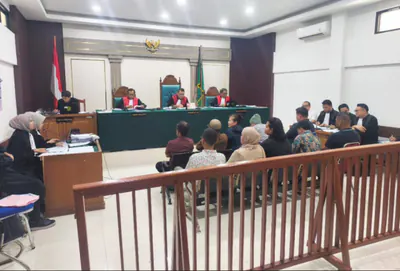
The trial over alleged bid-rigging corruption in 10 construction project packages in Penukal Abab Lematang Ilir regency (PALI), South Sumatra, has again exposed suspected money flows in the preparation of bid documents. According to state broadcaster TVRI News, witness Putra admitted at the Palembang Corruption Court (Pengadilan Tipikor Palembang) on Thursday, 12 November 2026, that he had received Rp1 million from defendant Yusrizal as payment for preparing the documents and then handed the money to Utari, the wife of defendant Ardi.
Putra said the documents he prepared included data cover letters and SKP documents. After Utari checked them, the documents were declared complete. He said he received only Rp300,000 back from the Rp1 million to buy supplies such as ink and paper.
Another witness, Reza, said he was asked to prepare bid documents for eight work packages. He said the request came from contractors and from Yusrizal. Reza also said the laptop used to prepare and upload the documents had been secured by the PALI District Attorney's Office (Kejaksaan Negeri PALI).
Utari, who was questioned as a witness, denied receiving a fee from Yusrizal. She said the packages in dispute were linked to Budi Hoiru, a member of the PALI Regional Legislative Council (DPRD). According to her testimony, the head of the agency asked her to confirm the implementation of the work through the commitment-making officer (PPK) Ardi, after which Ardi contacted Budi Hoiru, who directed the implementer to Yusrizal.
Public prosecutors have charged five people: Sephy Hendika, Ardi and Arif Gunawan, described as civil servants (ASN), and Subela and Yusrizal, who are from the private sector. Subela is also suspected of forging the signature of the director of the company CV Nengkoda Jaya to carry out six packages. The indictment alleges total state losses of more than Rp904 million across the 10 packages.
Bid rigging as a risk in regional projects
In government procurement, bid documents become vulnerable when the same person, or people acting under the direction of a particular party, prepare, check and upload them. The practice locally described as pengondisian usually refers to attempts to arrange prospective suppliers, prices or documents so that one party appears to meet the requirements from the outset. That is why witness testimony about who prepared, checked and handed over documents often becomes the starting point for proof in court.
The role of the commitment-making officer (PPK) is also important in government contracts. The PPK is responsible for carrying out the activities under their authority, including supervising the work, checking progress and signing documents related to payment. If a PPK is alleged to have received payment from a supplier, cases often develop into suspected abuse of authority or collusion between state officials and private parties. All such allegations still have to be proven with evidence in court.
The state loss figure in the indictment should be read as an initial estimate based on an audit, not a final verdict. Regional inspectorates often calculate the difference between the contract value and the work actually performed, such as insufficient volume, substandard quality or packages that were not carried out. The figure can change after defendants, experts and evidence are examined. Under Indonesia's judicial system, a person charged as a defendant is not guilty until a final, legally binding verdict is issued.
Cases heard at the Palembang Corruption Court usually come from South Sumatra, including regencies with relatively large infrastructure spending. Handling such cases also touches internal oversight, the budget role of regional legislatures and the possible involvement of council members as project users or directors. That makes witness testimony about who directed the implementation of work important for tracing the chain of decisions.
Impact on public services in PALI
For residents, the case involves two types of projects directly tied to basic services: drainage and classroom rehabilitation. Drainage that does not function can increase the risk of flooding or damage to neighborhood roads, while classrooms that are not fit for use can disrupt learning. If the work does not meet the contract, the benefits intended for the public are delayed even though the budget has already been paid.
Cases like this also remind regional budget users that procurement documents are not just administrative paperwork. Every signature, upload or verbal instruction can be tested in court. For readers, the key questions are whether further investigation reveals the flow of money, who decided the winning provider, and whether state losses can be recovered through legal mechanisms.
Recovering state losses does not automatically mean the projects are completed. The local government needs to ensure that problematic work can be followed up under the rules without punishing people who have not been proven guilty. The public should wait for court verdicts and audited findings that have been tested, rather than concluding someone's involvement from one side's testimony.