Maluku Tenggara regent stresses corruption prevention through budget oversight
Maluku Tenggara Regent Muhammad Thaher Hanubun said anti-corruption commitments must be enforced through oversight of budget planning, spending, procurement and public services.
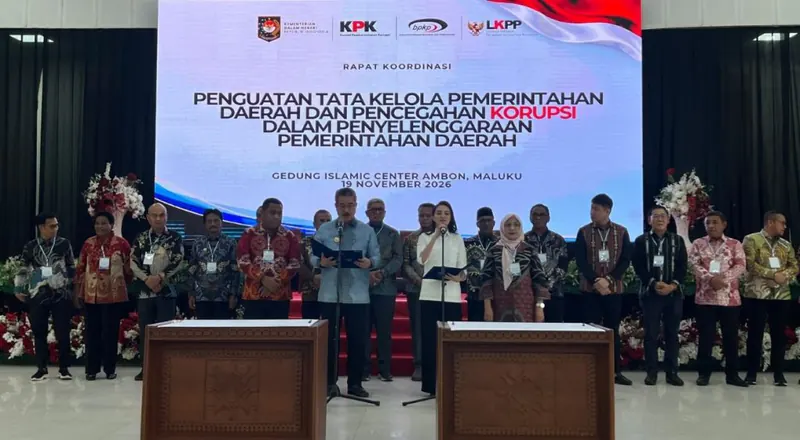
Maluku Tenggara Regent Muhammad Thaher Hanubun said corruption prevention in local government must not stop at ceremonies while attending a coordination meeting on corruption prevention for regional governments in Maluku and Maluku Utara in Ambon on Thursday, 19 November 2026. As reported by the government public information portal InfoPublik, Hanubun stressed that anti-corruption commitments must be translated into strict oversight of planning, spending, procurement and public services.
The meeting was organised by the Maluku provincial government together with the Corruption Eradication Commission (KPK) and the Directorate General of Regional Autonomy at the Ministry of Home Affairs. Hanubun attended after Governor of Maluku Hendrik Lewerissa invited regional heads (district and city leaders) to be present in person rather than through representatives.
He said transparency and accountability must apply from programme formulation through implementation of development. Internal oversight, he added, is important for detecting potential irregularities before they become legal problems. Every rupiah of regional funds must be effective, efficient and oriented toward the public interest, not merely aimed at absorbing budget allocations.
Corruption prevention as everyday governance
The concerns raised by Hanubun are not new in local governance. Corruption at regency and city level rarely stems from a single large case; it accumulates through small habits, such as procurement documents shaped to favour one bidder, spending rushed to exhaust budget allocations, or staff transfers carried out without openness. Prevention therefore means fixing routine processes rather than waiting for cases to emerge before acting.
This is where internal oversight matters. Regional inspectorates, which nationally form part of the Government Internal Audit Apparatus (APIP), are tasked with checking compliance from planning to accountability. Their role differs from that of the Audit Board of Indonesia (BPK): BPK assesses the reasonableness of financial reports after a fiscal year has run, while internal oversight should catch gaps before transactions take place. The KPK, in turn, works on systemic prevention and enforcement, so the three bodies complement one another. Regional legislatures (DPRD) also have an important role because they discuss budgets with executives; without that function, oversight becomes one-sided.
Practice in many regions shows that declarations, the signing of integrity pacts and the completeness of administrative documents often remain annual rituals. Without real changes in procurement, budgeting and public service mechanisms, such commitments do not reduce risk. The invitation for regional heads to attend directly, instead of sending representatives, can be read as an effort to close the gap between policy statements and implementation on the ground. Forums like this are usually used to align steps among provincial, regency and city governments so that reforms do not proceed separately.
Terms such as transparency, accountability and targeted spending also need operational meaning. Transparency means budget and procurement documents can be accessed by the public; accountability means every expenditure has a trail and a person responsible; targeted spending tests whether outlays truly reach residents' needs, not merely exhaust budget ceilings. When these three are applied consistently, regional funds stop being numbers on balance sheets and become services that people can feel.
What Maluku Tenggara residents should watch
For readers in the region, the message on corruption prevention is most felt not in speeches but in everyday services: issuing letters at village offices, queues at community health centres (puskesmas), road quality and the accuracy of social assistance. When budgets are directed toward public benefit, the room for unnecessary spending shrinks, helping protect fiscal space for basic services. For a regency with limited fiscal capacity like Maluku Tenggara, budget efficiency determines whether spending on education and health can be sustained. Conversely, if internal oversight is weak, gaps remain open even when commitment documents are signed.
The relevance also extends to local businesses. Transparent procurement gives suppliers in Maluku Tenggara a more equal chance to compete, rather than relying on closeness to officials. For workers, better governance reduces the risk of stalled projects or delayed payments, two problems that often lead to lost daily income.
One statement by a regional head, of course, will not automatically change bureaucratic practice. What matters going forward is whether inspectorates are truly given the mandate and resources to audit, whether budget information is published, and whether residents have channels to report irregularities. Without those mechanisms, corruption prevention will remain at the level of intent.
Related news
- Demak regent urges women to be technology-adaptive and empowered
- Pati police suspect subsidised diesel was misused through fishermen's barcodes
- Jawa Tengah deputy governor invites state-owned enterprises (BUMN) to strengthen disaster mitigation through recovery