LRP survey puts Puan Maharani and Sultan Najamudin ahead in race to replace Gibran as vice president
A Lembaga Riset Publik survey ranks Puan Maharani and Sultan Baktiar Najamudin as the leading names to replace Gibran Rakabuming Raka as vice president, according to a report by Jateng Pos.
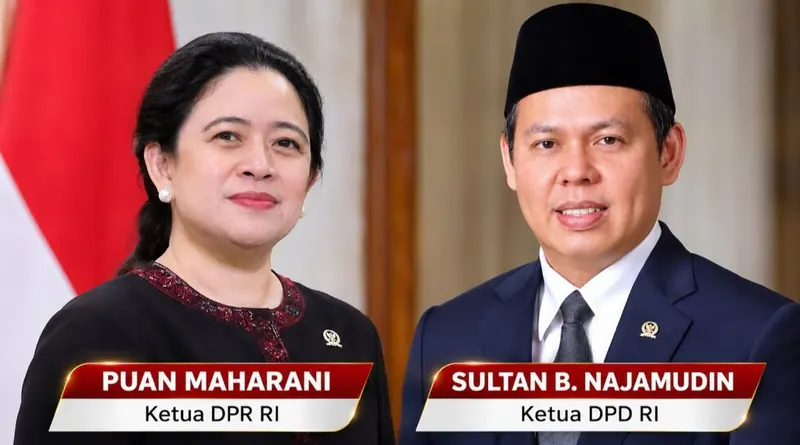
A survey by Lembaga Riset Publik (Public Research Institute, LRP) placed Puan Maharani, chair of the House of Representatives (DPR RI), and Sultan Baktiar Najamudin, chair of the Regional Representative Council (DPD RI), as the two leading names in vice-presidential preferences within the state institution leadership cluster, according to a report by Jateng Pos. Puan received 21.4 percent, followed by Sultan with 17.8 percent. The findings were presented by LRP researcher Arwan Pranata in Jakarta on Friday, 13 November 2026.
Besides Puan and Sultan, Ahmad Muzani, chair of the People's Consultative Assembly (MPR RI), came third with 14.2 percent. Arwan said support for Puan was linked to her experience leading the DPR, her political family background and her position in PDI Perjuangan (the Indonesian Democratic Party of Struggle, PDI-P). Sultan was seen as representing regional interests, carrying the image of a younger figure and having a business background.
Arwan said Muzani was assessed as close to President Prabowo and Gerindra (the Great Indonesia Movement Party). The presentation was held at Hotel Sofyan in Central Jakarta. LRP also mapped figures from six clusters: ministers in President Prabowo's Red-and-White Cabinet, leaders of state institutions, leaders of parties supporting the government, former candidates in the 2024 presidential election, President Prabowo's closest circle and regional leaders. In the regional leaders cluster, Dedi Mulyadi led with 33.7 percent; among former 2024 presidential candidates, Anies Baswedan recorded 22.4 percent. The report stressed that the figures are not yet official nominations.
The role of the DPD and DPR in the vice-presidential race
In Indonesia's presidential system, the vice presidency is not merely a ceremonial accessory. Presidential tickets are proposed jointly by a party or coalition of parties, elected by the people as a single package, and can help determine political balance, regional representation and government continuity. If the vice-presidential post becomes vacant, the constitution sets out a filling mechanism involving the president and the MPR. For that reason, speculation about Gibran Rakabuming Raka's replacement as vice president is always read as a political signal, not merely as names appearing in surveys. The vice president can also act as a mediator when relations between the executive and legislature become tense.
Potential figures are usually mapped according to sources of legitimacy: posts in state institutions, cabinet positions, party strength, presidential election experience, closeness to the president and regional leadership. That approach shows the public weighs different kinds of political capital. The DPR chair is associated with legislative experience, budgeting, oversight and a large party base. The DPD chair carries the symbol of regional representation, especially when issues such as autonomy, development outside Java and regional fiscal capacity come into focus. The two represent different doors to legitimacy: parliamentary strength and regional aspiration.
Indonesia's history of vice-presidential elections also shows that a popular name does not automatically become a nominee. In the 2024 presidential election, the Prabowo-Gibran, Anies-Muhaimin and Ganjar-Mahfud tickets were born from coalition calculations, not public preference alone. Ministers, governors or party figures are often considered because they can add campaign machinery, broaden voter bases or maintain ties with elites. But the final decision remains in political mechanisms involving nominating parties and, if a vacancy occurs, the constitutional process.
For readers, surveys like this are useful as mirrors of perception rather than prediction tools. Names at the top of the board can change with coalition maneuvers, legal issues, electability or President Prabowo's need to maintain government stability. Without a more detailed methodology, preference figures should be read as an early indication of who some respondents consider suitable, not as a nomination mandate. Regional publics have the right to demand an explanation of why a particular figure is considered to represent their interests.
What regional publics should watch
For voters in the regions, the vice-presidential race matters because the position can shape national policy direction, especially transfers to regions, infrastructure projects and efforts to address inequality. Strong names in the DPD or regional leaders clusters signal that regional issues remain a consideration. But surveys do not directly change the state budget (APBN), prices or public services; their impact appears only if the chosen figure actually takes office and pushes a particular agenda.
Readers should also watch three things. First, whether nominating parties or coalitions actually put the leading names into official nominations. Second, whether a replacement process, if it occurs, is carried out in line with the constitution and is not reduced to elite bargaining. Third, whether the regional representation promised by a vice-presidential candidate is tested by real policies, such as fiscal sharing, development outside Java and regional government capacity.
The LRP survey results should therefore be treated as material for political discussion, not certainty. For the public, what matters more are candidates' track records, a commitment to checks and balances, and the ability to maintain government stability without sacrificing regional interests. Surveys can open space for criticism, but they do not replace the people's right to choose in the next election.