Low Secondary School Integrity Prompts Indonesia's KPK to Strengthen Anti-Corruption Education
The Corruption Eradication Commission (KPK) recorded a secondary education integrity score of 71.92, a corrective level, and urged schools to strengthen anti-corruption education.
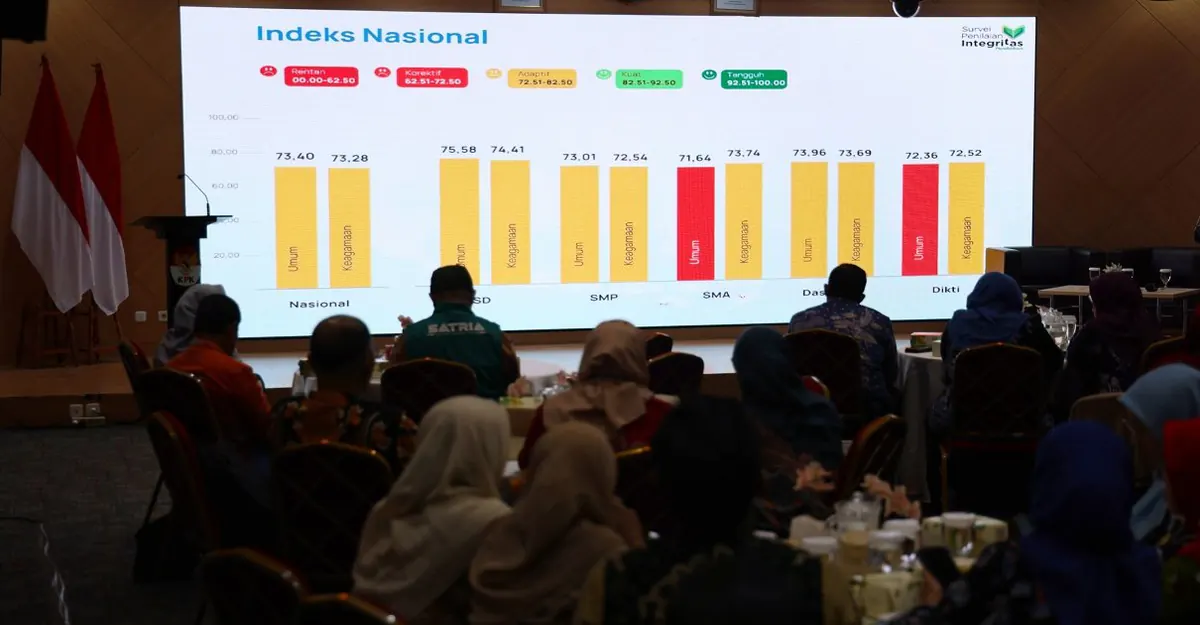
The Corruption Eradication Commission (KPK) said Indonesia’s secondary education integrity score had fallen into a corrective level after the 2026 Education Integrity Assessment Survey (SPI Pendidikan) recorded 71.92, the lowest among education levels. The KPK announced the data on Thursday, 12 November 2026, at a capacity-building event on Anti-Corruption Education (Pendidikan Antikorupsi, PAK) for principals and teachers under the Jakarta provincial government (DKI Jakarta).
In a report, the KPK said the score remained below the national Education Integrity Index (IIP) average of 73.30. Across three dimensions, character scored 72.73, ecosystem 72.45 and governance 70.57. The lowest score in governance showed that improvements must target school management, not only student behaviour.
The survey also identified 58 findings across 16 clusters, ranging from inadequate learning facilities and gratification, or illicit gift-giving, to accreditation fraud, nepotism, misuse of school operational assistance (BOS) funds and the normalisation of violations. Two indicators stood out: student disciplinary violations at 97.06 percent and teaching staff arriving late to class without giving a reason at 96.75 percent.
Dian Novianthi, director of education networking at the KPK, said the SPI results did more than capture integrity conditions and should form the basis for corrective steps. She said strengthening PAK must be targeted, measurable and sustainable, involving principals, teachers and agencies that oversee education. “Schools must make the spirit of integrity the breath of every lesson,” she said.
Head of the DKI Jakarta Education Office Nahdiana said Jakarta’s 2026 IIP reached 76.21, the highest among provinces. She said the achievement should be a foundation for sustainable governance improvements, not the finish line.
What the Education Integrity Score Means
The Education Integrity Assessment Survey captures everyday habits in schools: whether rules are enforced, whether finances are managed openly and whether school communities feel safe rejecting dishonest practices. The index score is not merely a ranking, but an early warning that learning spaces can normalise small violations that over time shape corrupt behaviour. Schools are often the first place many children see whether rules apply equally to everyone.
Secondary-school students are in a phase of identity formation and growing independence. They begin to deal with group assignments, exams, organisations and wider relationships with teachers and peers. At that stage, academic cheating, proxy attendance or tolerance of lateness can become practice in accepting dishonesty as ordinary. Integrity at the secondary level is therefore often seen as a gateway to professional habits in university and the workplace.
School governance also shapes the climate for integrity. Principals manage budgets, procurement and human resources; teachers serve as role models; school committees and education offices provide oversight. When oversight mechanisms are weak, practices such as gratification, nepotism or procurement deviations can take root. Conversely, schools that are transparent in financial information, assessment and student admissions show that accountability can be practised without adding excessive administrative burden.
Anti-corruption education in schools does not always mean a new subject. A common approach is to embed values of honesty, responsibility and courage to reject cheating into existing activities: class discussions, group projects, student councils (OSIS), scouts (Pramuka) and daily habits such as arriving on time and using school facilities honestly. In this way, integrity does not stop as a slogan but becomes a practice seen and experienced by students.
Impact for Parents and Students
For parents, the survey results matter because secondary school is where children spend much of their time before university or work. An environment that normalises lateness, exam cheating or small gratifications can form habits that continue after graduation. Parents can monitor whether schools communicate rules clearly, disclose admissions information and enforce violations without discrimination.
For policy, the low integrity score in governance indicates that oversight of school budgets and procurement needs to be strengthened. Education operational funds should improve facilities and learning, not stop at administrative reports. When schools are asked to prepare follow-up plans based on survey findings, the public can also demand that improvements be measured by visible changes: teacher attendance, financial transparency and safe complaint mechanisms.
In the long term, integrity habits in schools are linked to workforce quality. The business world needs workers who are honest about time, assets and procedures. If schools pursue only academic scores without teaching responsibility, the risk of corrupt behaviour can move from classrooms to workplaces.