Legal Expert Lists Four Conditions for Gibran’s Vice-Presidential Replacement, Sultan Enters Radar
A constitutional law expert has set out four conditions for a vice-presidential candidate to replace Gibran Rakuming Raka, with Sultan Baktiar Najamudin among the names in the radar.
Prof. Dr. Juanda, S.H., M.H., a constitutional law expert at Universitas Esa Unggul Jakarta, has set out four conditions for a vice-presidential candidate to replace Gibran Rakuming Raka, who has resigned, according to a report by Jateng Pos on Friday, 13 November 2026. The conditions include a clean track record, closeness to President Prabowo Subianto, national experience, and origin from a coalition party or through regional representation.
Juanda said a replacement candidate must be clean, qualified and possess both experience and a strong record. He also said the figure should have a working rapport and synergy with Prabowo so that the government is not disrupted by internal conflict.
Third, the candidate should have experience in politics, governance and public life at the national level, not merely at the regional level. Fourth, the candidate should come from a coalition party, whether represented in parliament or outside it, or be a figure chosen through direct regional representation by the people.
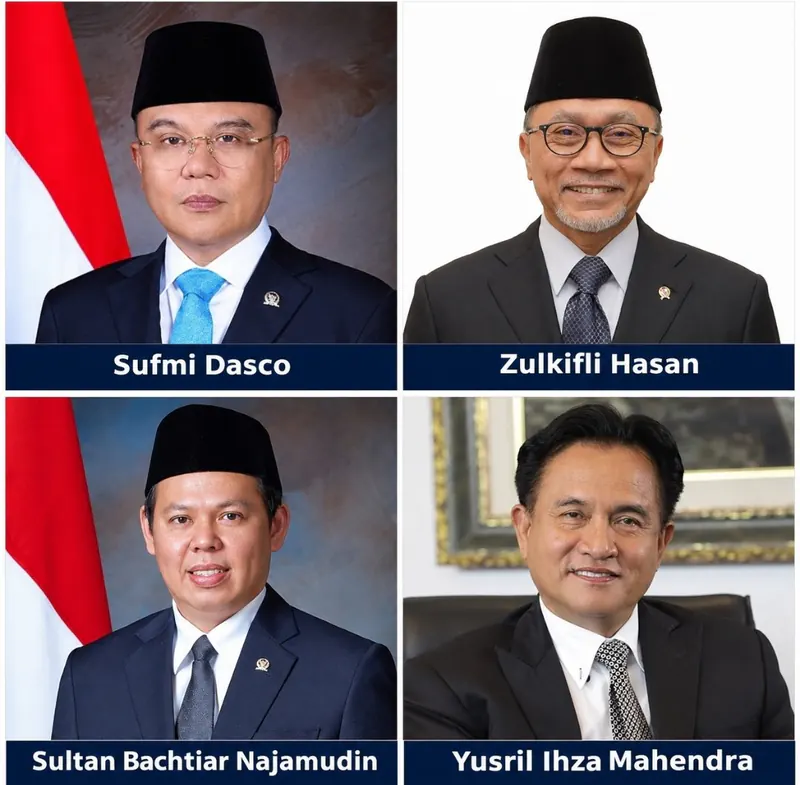
Among the names Juanda mentioned, Deputy Speaker of the House of Representatives (DPR) Sufmi Dasco Ahmad of the Gerindra Party was seen as the strongest candidate because of his party ties and experience in managing politics. Zulkifli Hasan of the National Mandate Party (PAN) was also considered suitable because of his loyalty and ministerial experience. For the Golkar Party, Juanda did not recommend Bahlil, saying he had only recently entered national-level politics; likewise, AHY of the Demokrat Party was assessed as needing another term of experience.
Juanda also noted that Ahmad Muzani still serves as chair of the People’s Consultative Assembly (MPR), while Secretary-General Sugiono is more junior. Other names he mentioned were Yusril Ihza Mahendra, from a non-parliamentary party, and Sultan Baktiar Najamudin of the Regional Representatives Council (DPD). Juanda said Sultan was young, agile, non-party, representative of the regions and close to Prabowo. Sultan previously served as vice governor of Bengkulu and as a member of the DPD for two terms. Juanda also said Puan Maharani was competent, but not from a coalition party.
How a vice-presidential vacancy is filled
In Indonesia’s constitutional system, the vice-presidential office is not merely a complementary position that can be filled by anyone without limits. The 1945 Constitution provides that if the vice-presidential post becomes vacant, the president submits two candidates to the MPR, which then chooses one within a maximum of 60 days. For that reason, talk of a replacement ultimately leads to procedure, not only public assessment.
The term ‘coalition parties’ refers to a political party or coalition that submitted a presidential and vice-presidential pair in an election. In a running government, this factor matters because the initial legitimacy of the elected pair came from the coalition configuration. Meanwhile, ‘non-parliamentary’ means a party that has no seats in the DPR but can still be part of the governing coalition.
The DPD is also often described as a route for regional representation. Its members are elected directly by voters in their provinces, but the body differs from the DPR because it is not made up of party politicians. In vice-presidential debates, DPD figures are usually read as a bridge between the center and the regions, and as a symbol that autonomy and local aspirations are not lost from the second seat.
The word ‘chemistry’ used by political commentators also needs an institutional reading. The vice president works within a clear structure: assisting the president, coordinating certain programs and taking part in the executive decision-making chain. If the two are not aligned, friction can arise in cabinet meetings, working visits or budget priority-setting. This is why track record and national experience are often used as measures so that the role is not merely symbolic.
So far, constitutional law experts’ assessments of replacement candidates usually stop at normative and political criteria. The final decision rests with the constitutional mechanism and the president’s consideration, not with surveys or the names most often mentioned in the media.
Impact on coalition and regions
For Indonesian readers, discussion of a vice-presidential replacement matters because the office helps shape the direction of national policy coordination. If the replacement comes from a coalition party, the government coalition may become more solid; if the candidate comes through the regional route, the public may place hope on issues closer to provinces, such as infrastructure, education, health and regional expansion.
The relevance is also visible in the political market. Names cited by experts can shape public conversation, but they are not yet decisions. Readers therefore need to distinguish between candidate radar, academic criteria and the official process. What remains decisive is the president’s proposal to the MPR and the assembly’s approval within the constitutional time limit.
Direct effects on prices, jobs or health may not yet be felt. But a change in the vice-presidential seat can alter program priorities, political communication style and the way the central government responds to regional aspirations. What should be watched is whether the candidates who emerge genuinely strengthen governmental stability or instead add a tug-of-war among coalition interests.