Sukoharjo regency government distributes Rp3 million death grants to 2,974 families
Sukoharjo regency government distributes Rp3 million death grants to 2,974 families while strengthening digitalization of social protection data.
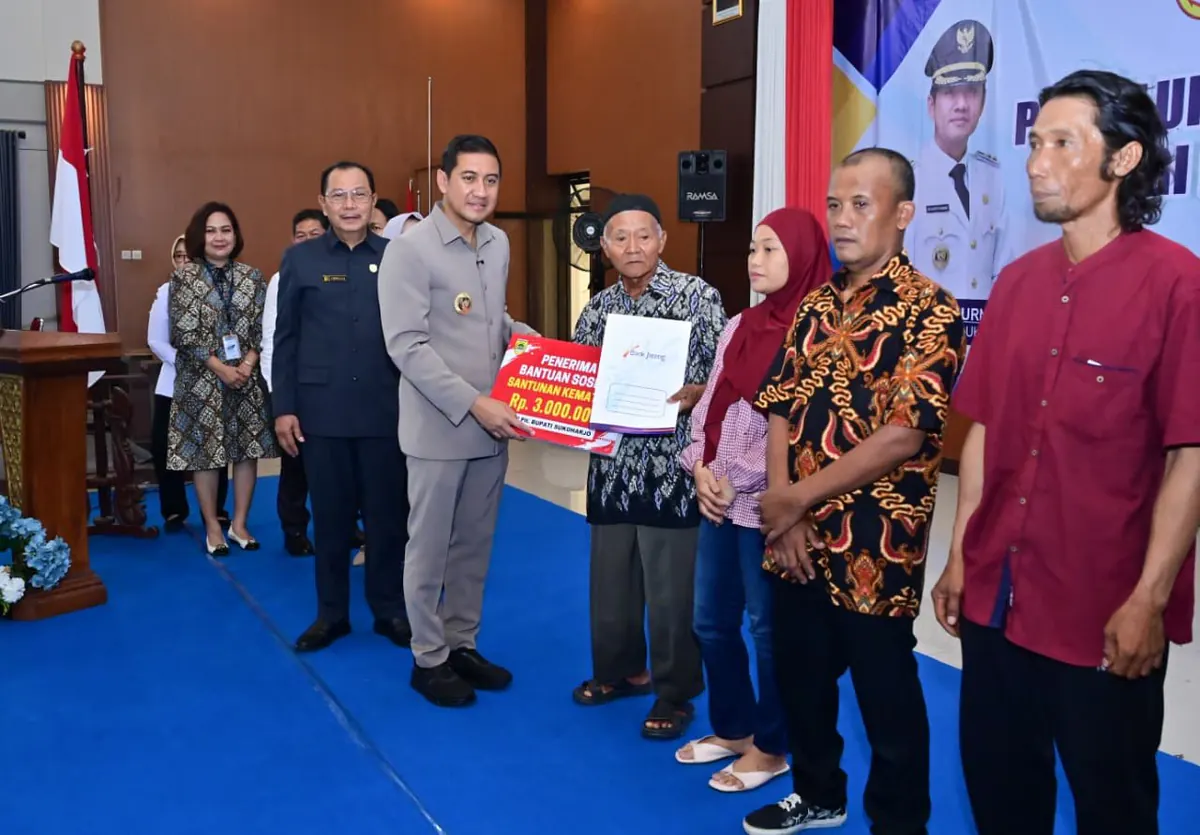
The Sukoharjo regency government has distributed Phase II of its 2026 social assistance death grants to 2,974 beneficiary families at the Graha PGRI Sukoharjo building, a venue linked to the Indonesian Teachers' Association (PGRI), on Wednesday, 18 November 2026, as reported by the Jateng Pos newspaper.
Acting Regent Eko Sapto Purnomo handed over the assistance symbolically and said the Rp3 million (about US$180) grant for each beneficiary family was a full entitlement. According to Jateng Pos, the phase disbursed a total of Rp8,922,000,000 (about US$550,000). The regency government is also working with the Sukoharjo District Attorney's Office (Kejaksaan Negeri Sukoharjo) through the State Prosecutor Legal Team (Tim Jaksa Pengacara Negara) to oversee the management of the assistance so it is clean, transparent and accountable.
The event was combined with efforts to strengthen digitalization of social protection data. Eko Sapto highlighted the role of social protection agents (Agen Perlinsos), involving civil servants (ASN), village officials, the Indonesian military (TNI) and the national police (Polri), so residents can more easily access the graduation process for the Integrated Social Welfare Data (Data Terpadu Kesejahteraan Sosial, or DTKS). Head of the Sukoharjo Social Affairs Agency Yunia Wahdiyati said data recording is now being carried out through a national movement to care for neighbors, involving integrated health posts (Posyandu), social welfare cadres, subdistricts and villages.
Digital data recording in Sukoharjo has reached 16 percent so far, according to the report. The target is for 50 percent of the population to be recorded by December 2026 so social assistance can be better targeted.
Death grants and the face of local social protection
Death grants are not routine monthly assistance but an emergency safety net for households hit by sudden economic pressure after losing a family member. In many regions, programs of this kind show that local governments do not rely only on food aid, cash assistance or regular social security. When a breadwinner dies, families often have to pay funeral costs, bills and daily needs at the same time while their main source of income disappears.
The role of death grants also needs to be read within the framework of the DTKS, which has long been the main reference for determining assistance recipients. The national database has often faced two familiar problems: poor residents are not registered, while residents who are already able to support themselves remain recorded. In social protection, graduation therefore means moving residents from a poor or vulnerable category to a more independent status, or updating their data when a household's condition changes.
Involving the district attorney's office in assistance programs is common for activities prone to irregularities, such as cash distribution, goods procurement or management of regional assets. In this context, the State Prosecutor Legal Team's role is aimed more at prevention and procedural compliance than at enforcement. Digitalization can improve targeting accuracy, but it also creates new risks: residents without internet access, people with incomplete population documents, or households whose data are judged ineligible despite hardship still need simple and fast complaint channels.
The involvement of ASN, village officials, TNI and Polri as social protection agents also marks a shift from a model in which residents must come to government offices to a proactive outreach model. However, that wider role needs clear limits: they may help with verification and reporting, but they must not become intermediaries for deductions, levies or administrative requirements that delay residents' rights.
What Sukoharjo residents should watch
For families in Sukoharjo, the program has a direct impact on economic resilience after the loss of a household member. The one-off Rp3 million cash grant can cover funeral costs, installments or short-term daily needs. But a single payment does not automatically resolve structural problems, especially if a family has lost its main breadwinner and has no savings, job or other social security.
Residents should therefore monitor data accuracy and the certainty of disbursement. If a family believes it is entitled to assistance but its digital status is recorded as ineligible, the proposal and objection mechanism should be used with clear supporting documents. Residents also need to make sure the assistance is received in full, without deductions. In the long term, expanding digital data recording toward the 50 percent target will determine whether death grants, other social assistance and further protection plans reach households that truly need them.
A plan to pay premiums for the state-run workers' social security agency (BPJS Ketenagakerjaan) for eligible residents is also worth watching for implementation. The program could shorten the time needed to respond to emergencies, but its effectiveness depends on recipient criteria, administrative compliance and coordination between agencies. Without public oversight, programs designed to protect residents must be ensured not to add administrative burdens.