Malang City Police Prioritise Friendly Warnings and E-TLE in Zebra Semeru 2026 Operation
The Malang City Police (Polresta Malang Kota) are prioritising Electronic Traffic Law Enforcement (E-TLE) and friendly warnings in the 14-day Zebra Semeru 2026 traffic operation, while limiting manual tickets to a maximum of five percent.
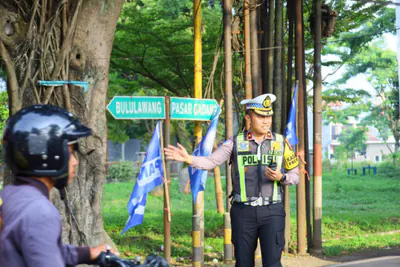
The Malang City Police (Polresta Malang Kota) have opened the Zebra Semeru 2026 traffic operation with a focus on road-user safety through friendly warnings and technology-based enforcement. The operation runs for 14 days, from 16 to 29 November 2026, as reported by public broadcaster TVRI News.
According to TVRI News, manual traffic tickets are capped at a maximum of five percent. Enforcement is directed toward Electronic Traffic Law Enforcement (E-TLE) and a persuasive approach to drivers.
Head of the Traffic Unit at the Malang City Police, Police Commissioner (Kompol) Mulya Sugiharto, said officers had not issued manual tickets since the first day. He recorded 1,646 friendly warnings for violations, while static and mobile E-TLE detected 69 violations.
For monitoring, static E-TLE cameras are placed at five points: Simpang 3 Borobudur, Simpang 4 Kaliurang, Simpang 3 Jembatan Soekarno-Hatta, Simpang 3 Kasin and Simpang Madyopuro. The word 'Simpang' refers to an intersection. The cameras target helmets meeting the Indonesian National Standard (SNI), seat belts and phone use.
Three accident-prone locations have been mapped: Jalan Bengawan Solo, Jalan Kolonel Sugiono in the Kotalama area, and the area around Jalan Raya Gadang.
Shift in traffic enforcement
Operation Zebra is widely understood by the public as a nationwide police traffic operation aimed at reducing violations. In that framework, officers are not only chasing the number of tickets but also looking for ways to make safety messages part of everyday driving habits. Persuasive approaches and electronic monitoring have therefore become two common faces of modern operations.
Electronic Traffic Law Enforcement, or E-TLE, is a traffic violation enforcement system that uses camera recordings as evidence. Cameras can be installed permanently at intersections or used by officers on mobile units. The system changes interaction on the road: drivers are not always stopped, but recorded violations can be followed up through confirmation letters or administrative procedures. For authorities, E-TLE helps reduce direct contact that can be vulnerable to transactional practices. The use of such technology also requires data accuracy, because camera recordings must be readable as valid evidence of a violation.
Meanwhile, friendly warnings operate across a broader field. Not every violation can or should be processed as a ticket, especially when the aim is to change behaviour. Officers can remind drivers who have forgotten a helmet, are not wearing a seat belt, or have stopped on the road shoulder. This approach relies on communication and example, not sanctions alone. In a two-week operation, warnings can also become a tool for mapping repeated violation patterns.
The term 'blackspot' also needs to be understood proportionally. Accident-prone locations are usually determined by incident history, traffic density, road design and user behaviour. Marking such points does not mean an entire road is dangerous; it identifies locations that require extra attention. During an operation, blackspot mapping helps officers choose when and where to monitor so that resources are better targeted. In this way, the operation is not merely a ceremonial activity but part of road safety management.
What it means for road users
For residents who travel through urban areas every day, this enforcement pattern changes how risk is perceived. Drivers can no longer simply avoid a traffic raid at one point, because static and mobile cameras can record violations at several road junctions. Awareness of wearing an SNI-certified helmet, wearing a seat belt and refraining from phone use becomes a practical need, not just an administrative formality.
For workers, students and online drivers, the operation also touches the hidden costs of traffic accidents. Accidents do not only cause injuries or lost work time; they can trigger sudden expenses for medical treatment, vehicle repairs and disrupted productivity. In high-mobility areas, such as education and trade zones, small habits like stopping in the wrong place can affect traffic flow. When enforcement takes the form of warnings, the public is reminded that prevention is cheaper than recovery.
Going forward, the key issue is consistency after the operation ends. If electronic monitoring and warnings only intensify during Operation Zebra, behavioural change may loosen again. Readers can observe whether accident-prone points continue to be managed, whether cameras are functioning, and whether repeated violations such as driving against traffic are still tolerated. From there, traffic safety can be assessed as a daily policy rather than a seasonal agenda.