East Java governor discusses investment and AI with US diplomat
East Java Governor Khofifah Indar Parawansa met US diplomat Joy M. Sakurai in Surabaya to discuss investment, education, health and artificial intelligence cooperation.
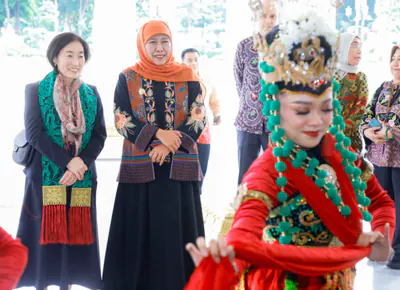
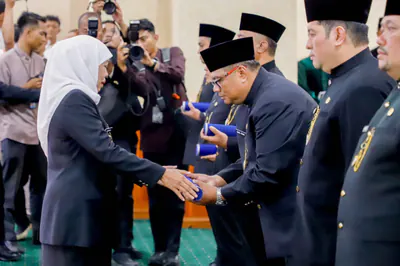
East Java Governor Khofifah Indar Parawansa received a courtesy call from Joy M. Sakurai, the United States chargé d'affaires ad interim to Indonesia, at Gedung Negara Grahadi in Surabaya on Thursday, 19 November 2026.
According to state broadcaster TVRI News, the meeting covered cooperation opportunities in investment, education, health, the creative economy, agriculture, technology and artificial intelligence. Khofifah said the United States recorded the second-largest investment value in East Java, after Singapore.
She said room for collaboration remained wide, particularly in vocational education, short-term training, digital technology and development of the creative economy. Khofifah also highlighted the creative ecosystem at Malang Creative Center and education and technology cooperation already under way in Malang Regency.
TVRI News reported that Sakurai said the meeting provided space to discuss investment opportunities for US companies in East Java. Sakurai also mentioned technology and artificial intelligence programs, as well as HIV/AIDS response donations, that could be developed jointly with the provincial government.
Role of diplomats in regional cooperation
A courtesy visit by a foreign diplomat to a regional leader is generally part of official relations, but it does not automatically produce a binding agreement. The central government retains primary authority over foreign policy, while regional governments may explore technical, academic, investment or capacity-exchange opportunities as long as they comply with national regulations. In local diplomacy, meetings such as this also serve as a way to introduce potential, not only to seek funding.
A chargé d'affaires ad interim is an official who temporarily heads a country's diplomatic mission when the ambassador position is vacant or cannot be filled. In that role, the official can open access to government programs, universities, research institutions and business networks in the home country, so meetings with regional leaders often become an entry point for more detailed discussions.
East Java holds a relevant position in Indonesia's economic map as one of the country's centers for industry, trade, agriculture and education. The province also has a metropolitan area, ports and a business ecosystem attractive to investors. Foreign cooperation at the regional level can therefore complement national programs, especially when it focuses on workforce skills, technology transfer and wider markets for local products.
In a government context, artificial intelligence usually refers to using computing systems to help analyze data, automate services or support decision-making. But the technology does not stand alone. Its success depends on data quality, human resource competence, cybersecurity and institutional readiness. In vocational education, short skills programs are often seen as useful because curricula can be adjusted more quickly to industry needs, though results still depend on certification, internships, available job opportunities and access to viable markets.
What East Java residents should watch
For residents, the impact of a meeting like this is not immediately visible as a project underway that day. Its value lies in follow-up: whether investment opportunities materialize, whether education training can be accessed by young people, and whether technology cooperation improves public services without neglecting personal data protection. Without a monitoring mechanism, discussions may remain statements of intent.
If investment and creative economy cooperation expands, the closest potential benefits for residents are jobs, internships and markets for local products. But those benefits are not automatically evenly distributed. Small businesses need to prepare product quality, digital capability and understanding of intellectual property rights so they are not merely spectators in value chains built with foreign partners.
In health and agriculture, foreign cooperation also touches daily life. Disease prevention and family sanitation programs can reduce transmission risk, while protection of farmland and production technology can affect food availability and prices. Residents therefore need to monitor whether cooperation pledges turn into measurable, targeted programs that can be used by the groups most in need, so development benefits reach those who need them most.