Central Java vice governor calls on state-owned enterprises to strengthen disaster management from mitigation to recovery
Central Java Vice Governor Taj Yasin Maimoen has called on state-owned enterprises to take part in disaster mitigation, emergency response and recovery in the province.
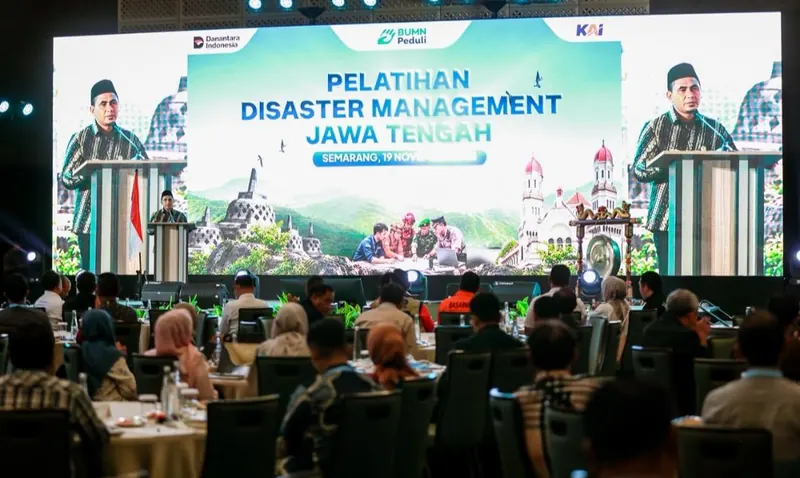
Central Java Vice Governor Taj Yasin Maimoen has called on state-owned enterprises (BUMN) to strengthen disaster management in the province, from mitigation and emergency response to recovery. He made the call while opening the Central Java Disaster Management Training organised by PT Kereta Api Indonesia (KAI), the state-owned railway company, at Padma Hotel Semarang on Thursday, 19 November 2026, as reported by Jateng Pos.
Opening the event on behalf of Central Java Governor Ahmad Luthfi, Taj Yasin said disaster management must cover three phases: pre-disaster, during a disaster and post-disaster. He said collaboration with BUMN could allow all three phases to be carried out together with local governments.
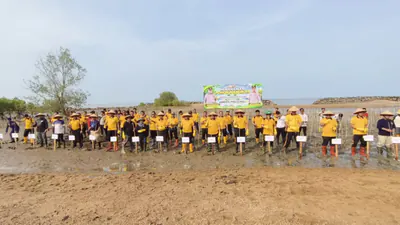
According to Jateng Pos, a key proposed form of cooperation is environment-based mitigation. BUMN have been invited to help build rorak, or infiltration pits, on mountain slopes to reduce the risk of flash floods.
The provincial government is also preparing to build infiltration wells through the 2027 regional budget (APBD) and is coordinating with the central government to strengthen disaster management along the north coast (Pantura).
PT KAI Executive Vice President for Corporate Secretary Wisnu Pramudyo said KAI holds the role of regional coordinator for the BUMN Disaster Task Force in Central Java. The company will strengthen communication with the Regional Disaster Management Agency (BPBD), the Semarang Search and Rescue (SAR) office and local governments so field needs can be met quickly.
Director of Social and Environmental Responsibility at the State-Owned Enterprises Regulatory Body (Badan Pengaturan BUMN) Edi Eko Cahyono said the BUMN Disaster Task Force had been formalised as part of the national disaster management ecosystem. He said the role of BUMN should not stop at emergency response and must help reduce risk from the outset.
The role of BUMN in the disaster cycle
Disaster management in Indonesia is commonly understood as a continuous cycle rather than simply sending aid when an event occurs. The pre-disaster phase includes prevention, preparedness and risk reduction. The phase during a disaster requires rapid emergency response, while the post-disaster phase focuses on restoring people's lives and repairing public facilities. In that framework, business involvement can complement local government capacity.
State-owned enterprises occupy a distinctive position because they sit between public interest and corporate capacity. In addition to human resources, heavy equipment, logistics and distribution networks, BUMN are also bound by social and environmental responsibility programmes. These programmes can be directed toward long-term activities such as greening, water conservation, strengthening disaster-resilient villages and community preparedness training.
Rorak and infiltration wells are examples of relatively simple mitigation interventions, but they require maintenance and community participation. Infiltration pits hold and channel rainwater into the ground, reducing surface runoff that can trigger flash floods in slope areas. In coastal areas, challenges differ: tidal flooding known as rob, coastal erosion and clogged drainage require river normalisation, settlement arrangement and integrated early warning systems.
Cross-agency collaboration also depends on a clear division of roles. Local governments usually command response in their territories, while BPBD serves as the spearhead of technical coordination. BUMN can contribute according to their expertise: infrastructure companies can provide heavy equipment, energy companies can support logistics supplies and transport companies can help mobilisation. Without coordination, aid risks piling up in one place, mismatching needs or overlapping. Written agreements and joint risk maps need to be prepared so assistance does not appear only after disasters.
Impact for residents in vulnerable areas
For residents in Central Java's mountainous and coastal areas, such collaboration can mean more time to prepare before extreme rain arrives. If BUMN are involved from the mitigation stage, benefits felt are not only basic necessities aid during evacuation but also improved waterways, planting of slope-stabilising vegetation and routine evacuation training, so residents do not depend only on emergency aid.
The practical impact also touches local budgets. When disaster risk falls, emergency response funding needs can be reduced and redirected to prevention. However, residents need to monitor whether promised programmes actually reach vulnerable points, rather than stopping at training ceremonies or cooperation signings. Transparency in the use of social responsibility funds becomes important so benefits are measurable.
Going forward, the success of this collaboration can be measured by simple things: whether residents know evacuation routes, whether warning devices work and whether BUMN assistance is clearly recorded in local plans. In that way, the call for disaster management from mitigation to recovery does not remain only a policy message but becomes more concrete protection for communities.