South Kalimantan police plant 3,000 mangrove seedlings to curb coastal abrasion
South Kalimantan Regional Police planted 3,000 mangrove seedlings on the Takisung coast in Tanah Laut to curb abrasion, protect coastal ecosystems and strengthen police-community cooperation.
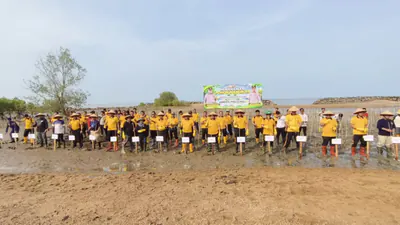
South Kalimantan Regional Police (Polda Kalimantan Selatan) planted 3,000 mangrove seedlings on the coast of Pagatan Besar village in Takisung district, Tanah Laut regency, on Thursday, 19 November 2026. The police chief of South Kalimantan, Inspector General of Police Rosyanto Yudha Hermawan, led the planting with hundreds of residents and students.
According to TVRI News, the activity was part of the Green Policing movement and implemented the priority program of the National Police Chief (Kapolri). It aimed to prevent coastal abrasion, protect the coastal ecosystem and strengthen cooperation between police and the public in maintaining security and public order. To help the seedlings survive, the police coordinated with local village authorities. Hadransyah, the village head of Takisung, said residents were ready to care for the seedlings after planting.
Mangroves as a natural shield for Kalimantan's coast
Mangrove forests grow in tidal areas, especially in tropical countries such as Indonesia. Their interlocking roots extend into mud, forming a network that can slow waves and currents, which is why mangroves are often described as a natural coastal shield. Indonesia has more than 200 mangrove species, although Rhizophora, Avicennia and Sonneratia are commonly planted for rehabilitation.
South Kalimantan has a long coastline along the Java Sea, and abrasion is a real threat in several areas, including Takisung and its surroundings. Abrasion is the wearing away of land by waves, wind and currents. Without vegetation to hold the shore, the coastline can retreat by several metres each year, endangering homes, farmland and fish ponds. Causes of abrasion on southern Kalimantan's coast generally include high waves during the west monsoon, land subsidence and the loss of vegetation cover through land conversion.
Ecologically, mangroves also serve as nurseries for fish, shrimp and crab. Their roots, submerged in mud, shelter juvenile fish from predators. When mangrove forests are damaged, fish populations in nearby waters decline, eventually reducing catches for fishers. Mangroves also filter sediment and absorb pollutants before water reaches the open sea.
The main challenge in mangrove rehabilitation is not initial planting but post-planting care. Seedlings need suitable substrate, appropriate tidal height and protection from physical disturbance. Many mangrove planting programs in Indonesia have failed because seedlings were placed in unsuitable sites, were not monitored, or were damaged by waste and human activity. Coordination with village authorities, as undertaken by South Kalimantan Regional Police, is therefore key to success.
The police Green Policing program is part of a wider approach. In recent years, government agencies at local and national levels have promoted mangrove planting as a climate change mitigation strategy. Mangroves are considered able to absorb large amounts of carbon per unit area, far more than ordinary terrestrial forests. Indonesia has about 3.4 million hectares of mangrove forest, making it one of the countries with the largest mangrove ecosystems in the world.
What it means for coastal residents in Tanah Laut
For residents of Takisung and nearby areas, mangroves are not simply greenery. Their roots provide spawning and nursery grounds for fish, shrimp and crab that sustain small-scale fishers. When mangroves grow into healthy forests, catches in surrounding waters tend to improve. Conversely, bare coasts force fishers to go farther out to sea, raising fuel costs.
Abrasion also threatens basic infrastructure. Village roads, schools and settlements near the shoreline are vulnerable to damage if land continues to erode. Planting 3,000 mangrove seedlings in Takisung, though only an initial step, can reduce that risk over the long term. The program's success depends heavily on care after planting, because mangrove seedlings can die in the first year if they are not protected from waste, waves or human activity.
For readers in other coastal areas of Indonesia, the case is a reminder that mangrove rehabilitation requires collaboration among many parties. Police, village governments and communities must work together from planting through monitoring. Without a commitment to maintenance, thousands of seedlings planted today could be lost within months.