LaNyalla Proposes Independent Route for House of Representatives Members
AA LaNyalla Mahmud Mattalitti, a member of the Regional Representatives Council (DPD), proposes independent candidates could enter the House of Representatives (DPR) through a constitutional amendment.
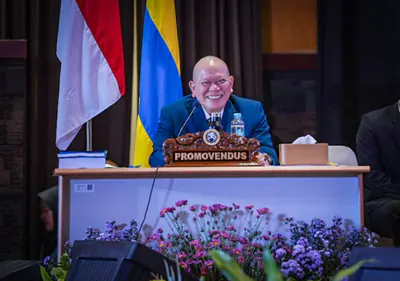
AA LaNyalla Mahmud Mattalitti, a member of the Regional Representatives Council (DPD), has proposed restructuring membership of the House of Representatives (DPR) by opening an independent route for legislative candidates, as reported by state broadcaster TVRI News from Surabaya on Thursday, 12 November 2026.
The idea is contained in a dissertation titled "Rekonstruksi Keanggotaan Badan Perwakilan Rakyat Republik Indonesia dari Unsur Non-Partai Politik" ("Reconstruction of the Membership of the People's Representative Council of the Republic of Indonesia from Non-Political Party Elements"), which LaNyalla defended in an open doctoral examination at the ASSEC Tower of Universitas Airlangga (Unair) in Surabaya. He was declared to have passed the Doctoral Program in Law and Development at Unair's Graduate School with the highest honours, Summa Cumlaude.
In his dissertation, LaNyalla argued that Article 22E(3) of the 1945 Constitution (UUD 1945) restricts independent candidates from becoming DPR members because legislative election participants are political parties. He said this has produced an aspiration deadlock, or recall bottleneck, where DPR members are more subject to faction discipline and the threat of mid-term replacement (Pergantian Antarwaktu). LaNyalla said, "This independent path is a safety valve for democracy."
As a comparison, LaNyalla cited South Africa, which has opened the possibility for independent candidates to enter the national parliament. The country's Constitutional Court in 2020 ruled that election laws prevented citizens from being elected as independents, and an amendment was enacted in 2023. Besides the independent route, LaNyalla urged strengthening the DPD so that it is on an equal footing with the DPR in legislation, budgeting and oversight, and recommended amending Article 22E(3) and Article 22D of the UUD 1945.
The DPD and DPR in the Constitution
The DPD was born from amendments to the UUD 1945 as a second chamber representing regional interests. In constitutional practice, the DPR still holds primary authority over lawmaking, budgeting and oversight of the government. The DPD can propose certain bills, participate in deliberations and give considerations, but final legislative decisions rest with the DPR together with the government. Therefore, many observers describe Indonesia's system as soft bicameralism rather than full bicameralism like the United States or the United Kingdom, where one chamber has a veto or equal power.
The issue of independent candidates is not new in Indonesian elections. Independent routes are already familiar in regional head elections, allowing voters to choose governors, regents or mayors without going through political parties. However, for elections to the DPR, provincial and district or city regional legislatures (DPRD), participants remain limited to political parties. This restriction means non-party people must join a party or form a coalition with a party if they want to become national legislators.
The debate over party dominance also relates to accountability. In a closed-list system, voters choose a party and the party determines elected candidates. In an open-list system, voters can choose specific candidates, but parties remain the gateway for nomination. Amending Article 22E(3) of the UUD 1945 would touch this foundation because the article stipulates that election participants for the DPR and DPRD are political parties. Such a change cannot be made by one institution alone; it requires a constitutional amendment mechanism involving the People's Consultative Assembly (MPR) and national political consensus.
On the other hand, strengthening the DPD is often discussed as a way to balance national policies seen as too Jakarta-centric. Regions have different needs in infrastructure, education, health, environment and spatial planning. If the DPD is given a co-legislator role, the legislative process could become longer because two chambers would need to align their views. However, if it works effectively, the mechanism could prevent regions from being merely objects of central policy.
What It Means for Voters and Regions
For voters, the idea of an independent route could change how they assess candidates. People would no longer choose only parties as political brands, but could also choose figures whose track records are seen as relevant to local problems. This is important because many policies affecting prices, jobs and public services are born from laws deliberated by the DPR with the government.
For regions, strengthening the DPD could make local aspirations more audible in laws on labour, health, environment and spatial planning. If policies are more sensitive to provincial conditions, the impact could be felt in business permits, worker protection, budget allocation and the construction of public facilities. But all of this depends on the realisation of constitutional amendments, not merely academic discourse.
Readers should note that changes to Article 22E(3) and Article 22D of the UUD 1945 would take time and require broad political consensus. As long as the old rules apply, parties remain the gateway to the DPR and DPRD. Therefore, LaNyalla's idea is better read as a long-term democratic design proposal, not a change that will immediately affect the next election.