KPK trains 49 Telkom employees as anti-corruption agents
The Corruption Eradication Commission (KPK) has trained 49 employees of state-owned telecommunications company PT Telkom Indonesia to become certified anti-corruption educators through a program in Bandung.
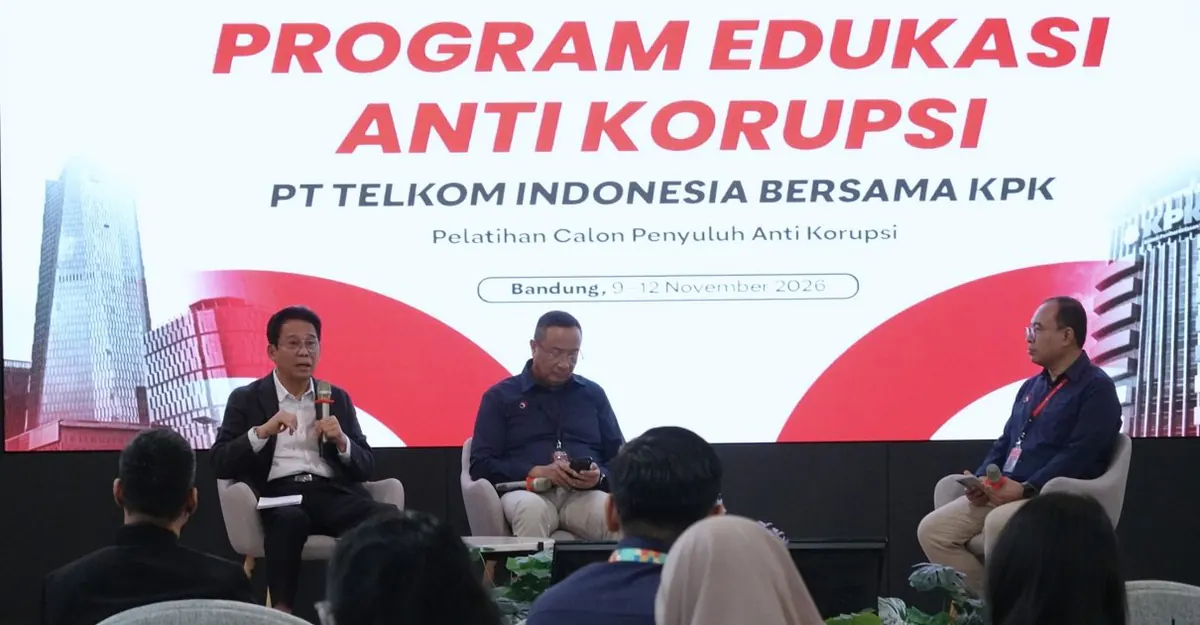
The Corruption Eradication Commission (KPK) trained 49 employees of state-owned telecommunications company PT Telkom Indonesia (Persero) Tbk in a Candidate Anti-Corruption Educators Training (PELOPOR) program at Telkom Corporate University in Bandung, West Java, from 6 to 13 November 2026. The program is designed to turn participants into drivers of integrity education inside the company.
According to a KPK report, 13 of the 49 participants are being directed toward the Integrity Builder Expert Certification (API), while all participants will take the Anti-Corruption Educator Certification (PAKSI). They are drawn from groups that drive organizational culture and from employees appointed by Telkom.
KPK Deputy Chair Johanis Tanak said corruption prevention could not rely solely on the government and law enforcement. He said the business sector also needed to be involved, through good corporate governance and individual awareness, so that business practices were transparent and accountable.
Telkom President Director Nanang Hendarno said the collaboration with the KPK was meant to produce TelkomGroup employees who could serve as anti-corruption role models in their respective work units. The training opened on Monday, 9 November 2026, attended by KPK Director of Anti-Corruption Education and Training Yonathan Demme Tangdilintin and members of Telkom’s management.
Role of educators in corruption prevention
Corruption prevention in Indonesia is generally built through three complementary paths: improving systems, cultivating values and enforcing violations. Within that framework, anti-corruption education is not limited to delivering material; it is aimed at shaping honest, disciplined and accountable work habits. Public institutions and state-owned enterprises are often targeted for integrity strengthening because they manage money, assets or services that directly affect the public. That approach matters because corruption often starts from small decisions that are treated as normal.
Anti-corruption educators act as a bridge between organizational policy and employees’ daily behavior. Their role is not simply to give lectures, but to translate corruption risks into the context of work, such as gratification, or improper gifts, conflicts of interest, nepotism or abuse of authority in procurement. In large companies, such messages are more likely to be accepted when delivered by colleagues who understand the business process, the language and the internal pressures of the workplace.
The certification of educators and integrity experts shows that corruption prevention is increasingly treated as a competency rather than a ceremonial activity. That competency includes the ability to design educational materials, map risk points and build systems that encourage employees to reject deviant practices. In corporate practice, it is closely linked to good corporate governance, because individual integrity must be supported by procedures, oversight and organizational culture. Prevention therefore depends not only on sanctions, but also on employees’ ability to recognize ethical dilemmas before violations occur.
For state-owned enterprises, integrity is also part of public trust. Telkom operates in telecommunications and digital services that reach many customers and business partners. When employees are equipped as anti-corruption drivers, the company hopes the value will appear not only in policy, but also in operational decisions, interactions with vendors and services to consumers.
What the public should watch for
For the general public, training of this kind does not directly change service tariffs or product prices. But its effects can be felt in service quality, the accuracy of procurement processes and the way employees respond to unofficial requests. In a telecommunications company, employee integrity shapes how partners are treated, how projects are carried out and how customer complaints are handled. Customers also have a stake because integrity failures can affect network quality, the speed of complaint resolution and fairness in cooperation.
The biggest opportunity in the program lies in consistency after the training. Anti-corruption values will be more meaningful if participants can explain risks simply in their work units, encourage safe reporting and reject practices that harm the company. If the activity stops at certificates, the behavior change expected by the public will be hard to see. Companies also need to provide complaint channels that are easy to access without fear of retaliation.
Going forward, the public can assess the success of corruption prevention in state-owned enterprises through more concrete indicators: transparency of information, fewer gratification practices and clear complaint mechanisms that are acted upon. In that context, employees who become internal educators can serve as a first line of defense before problems grow into state losses or a loss of public trust. That matters for maintaining the confidence of customers and investors.