Jakarta interfaith leaders unite to safeguard religious harmony
A joint statement by interfaith leaders at Masjid Istiqlal in Jakarta affirms a commitment to safeguard harmony and keep the nation calm.
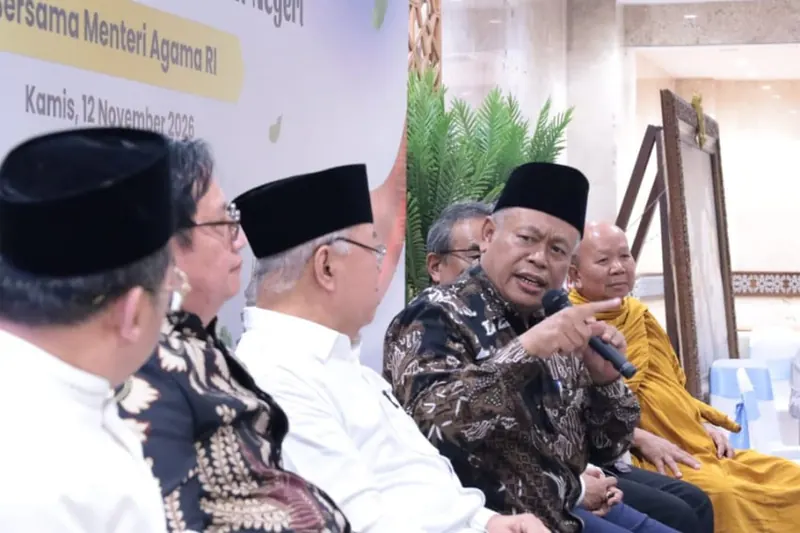
A number of religious council leaders and interfaith figures at Masjid Istiqlal in Jakarta on Friday, 13 November 2026, united in a commitment to safeguard harmony and keep the nation calm through a joint statement, as reported by SINDOnews.
The interfaith dialogue, titled 'Merawat Kerukunan, Meneguhkan Kedaulatan Bangsa' (Safeguarding Harmony, Strengthening National Sovereignty), was attended by Minister of Religious Affairs Nasaruddin Umar and Deputy Chair of the Indonesian Ulema Council (MUI) Kiai Marsudi Syuhud, along with a number of other religious leaders.
Marsudi said Muslims have 87 social organisations (ormas), including Nahdlatul Ulama (NU) and Muhammadiyah, which he said are fused through the spirit of mutual acquaintance into common rules.
He likened those differences to a spoon and a glass rubbing against each other, but producing a 'delicious national coffee'.
Traces of Harmony in Public Space
Indonesia has grown as a country with many religious, ethnic, linguistic, and ideological backgrounds. In such circumstances, harmony is not only about the absence of open conflict, but also the ability to maintain shared spaces so that differences do not turn into hostility. The motto Bhinneka Tunggal Ika is often used to refer to that principle: citizens live in one country without having to make beliefs uniform. A healthy public space requires the habit of listening, not only the habit of speaking. In a plural society, interfaith dialogue is one form of that habit: community leaders meet, align perceptions about the limits of tolerance, and affirm that differences in belief must not threaten collective safety.
Religious leaders in Indonesia usually operate in two domains at once. On the one hand, they safeguard the interpretation, rituals, and internal discipline of their own communities. On the other hand, they are seen as calming figures when sensitive issues emerge, especially when doctrinal differences, the construction of places of worship, religious activities, or friction on social media attract public attention. Therefore, meetings among religious leaders are often read as a signal that community leaders choose dialogue before tensions widen.
In that context, MUI is often one of the public references when Muslim religious issues require an official statement. But harmony cannot be built by one institution alone. Interfaith dialogue places MUI, the Ministry of Religious Affairs, and leaders of various religious traditions at the same table. This kind of meeting affirms that national sovereignty is safeguarded not only through law and security, but also through trust maintained among citizens.
The term ormas refers to social organisations active in the religious or social fields. Such a joint statement also carries a lesson in managing pluralism. When leaders acknowledge that differences are a reality, the public is given an example that religious identity need not become a reason to withdraw. The term li-ta'arafu used by Kiai Marsudi refers to the spirit of mutual acquaintance. In everyday language, that spirit means finding common ground without erasing differences, and turning meetings among citizens into a calming social habit.
What Citizens Should Watch For
For Indonesian readers, an interfaith commitment is most felt when it lowers the temperature in the surrounding environment. Residents do not always face major conflicts, but often encounter small matters: schedules for religious activities, the use of loudspeakers, event permits, or comments in messaging groups. The joint stance of leaders can serve as a reference for administrators of neighbourhood units (RT and RW), schools, campuses, and offices when differences begin to trigger misunderstandings.
Its relevance is also visible in how the public reads religious news. A harmony statement does not automatically settle disputes, but it signals that community leaders are choosing dialogue and restraining themselves from rhetoric that sharpens tensions. For readers, what to watch going forward is follow-up: whether the commitment is translated into regular meetings, a rapid mechanism when friction appears, and coordination with local governments and security forces without disregarding citizens' rights to worship and express opinions.
If the commitment stops at the statement, its benefits will fade quickly. Therefore, the public can assess the consistency of religious leaders and relevant officials in keeping their tone, especially when political or social issues heat up. In addition, residents can observe whether places of worship, schools, and social organisations take part in simple joint activities, such as communal work, bazaars, or youth forums across different backgrounds. Small actions like this make harmony easier to feel than mere slogans.