Irfan Maulana Leads JICT Workers' Union Through 2029 Port Transformation
Irfan Maulana leads SP JICT for 2026–2029 with a focus on competence, workplace safety and industrial relations.
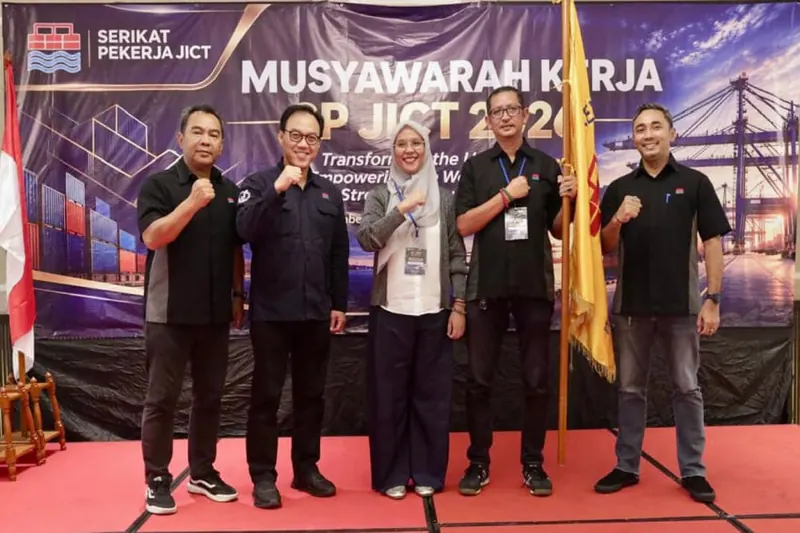
Irfan Maulana was confirmed as general chairman and Zulfansyah as vice general chairman of the Jakarta International Container Terminal Workers' Union (SP JICT) for the 2026–2029 period at a working conference in Jakarta on 10 November 2026, according to SINDOnews.
The working conference (Musyawarah Kerja, or Musker) carried the theme “Transforming the Union, Empowering the Workforce, Strengthening the Future”. The new leadership was mandated to protect workers' rights and welfare as the terminal moves toward digital systems, more modern equipment and greener operations. The organisation also highlighted the importance of human resource readiness.
Irfan Maulana, quoted by SINDOnews, said, “A strong port must be built on a strong workforce.”
The role of workers' unions in port modernisation
The change in SP JICT leadership needs to be read in a wider context. Jakarta International Container Terminal is a container terminal located in the Tanjung Priok port area, one of Indonesia's main foreign trade hubs. At terminals like this, workers deal with heavy equipment, ship loading and unloading rhythms and tight time pressures. As a result, a workers' organisation does not only handle statutory rights; it also helps determine how modernisation is carried out without sacrificing safety and job security.
In general, port transformation involves three major drives. The first is digitalisation of operational systems, from terminal operating systems and container tracking to data integration with customs and shipping lines. The second is equipment modernisation, such as cranes and handling tools that are faster but require new operator skills. The third is a green port agenda that pushes energy efficiency, emissions management and a transition to more environmentally friendly operations. In all three areas, the workers' union acts as a bridge between management and labour so that policy changes do not become layoffs or a transfer of risk to workers.
Industrial relations in Indonesia also rest on dialogue among workers, management and government. A working conference, as an organisational consolidation forum, can be used to build a common position on competence, workplace safety and members' future. The union can also help ensure that safety complaint mechanisms, bipartite committees between worker and management representatives, and collective labour agreements work effectively. Without clear channels, workers tend to stay silent when they see risks, even though accidents at a terminal can affect the whole operational chain. When ports become part of the national supply chain, the readiness of workers' human resources becomes a factor determining the smooth flow of goods, not merely a complement to technology investment.
In many ports around the world, automation triggers debates about job quality. Terminal efficiency can raise throughput, but without retraining, workers accustomed to manual methods risk being left behind. A healthy transformation therefore usually includes a competency roadmap, phased equipment trials and open complaint mechanisms.
What the public and port workers should watch
For Indonesian readers, news of the confirmation of port workers' union leadership may seem far from daily life. Yet ports are critical points in the supply chain. When container flows are disrupted, the impact can spread to raw material prices, distribution costs, availability of imported goods and the speed of consumer goods delivery. A stable industrial relations environment at a container terminal is therefore not only an internal matter for workers and management, but part of keeping the economy running smoothly.
What should be watched next is whether SP JICT's new leadership truly translates the transformation theme into measurable programmes. Indicators include improved member competence, prevention of workplace accidents, transparent dialogue with the company, and protections so that digitalisation does not become a cut to workers' rights. If that agenda is implemented, port modernisation can strengthen national logistics competitiveness without neglecting welfare. If dialogue stalls, the potential for industrial conflict can disrupt operations and ultimately harm port service users.
The public can also watch whether the workers' organisation helps promote data-based workplace safety, training for heavy equipment operators and readiness to face increasingly strict environmental standards. In the long run, the quality of human resources at ports will be a measure of whether transformation is only a slogan or truly changes work practices. In this way, internal issues at port workers' unions also help determine how reliable logistics services are for the public.