Indonesian parliamentary body pushes concrete steps to halt Israeli settlements
The chair of Indonesia's parliamentary cooperation commission urged countries to follow a UN vote with concrete measures to stop illegal Israeli settlement expansion.
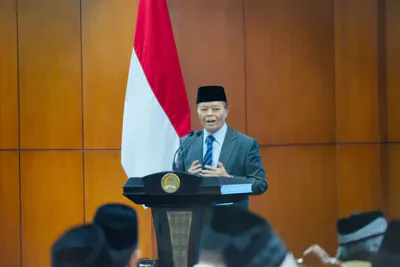
The chair of the House Commission for Inter-Parliamentary Cooperation (BKSAP) of Indonesia's House of Representatives (DPR RI), Hidayat Nur Wahid, called on countries to take concrete steps to halt the expansion of illegal Israeli settlements in Palestinian territory rather than stop at resolutions and condemnation. He made the appeal after a vote in the Fourth Committee of the UN General Assembly on 18 November 2026 reaffirmed the majority rejection by the international community of Israeli settlement activity, as reported by TVRI News.
Draft resolution A/C.4/81/L.15 received 143 votes in favour, 11 against and 17 abstentions. Indonesia has consistently backed the enforcement of international law and the protection of Palestinian rights. Hidayat said the result showed that Israel and its defenders were becoming increasingly isolated on the global stage.
In a written statement received by tvrinews.com on Saturday, 21 November 2026, Hidayat cited international organisation data recording about 750,000 Israeli settlers in the West Bank, including East Jerusalem. From June to September 2026, more than 8,000 new housing units were proposed or approved, while October 2026 recorded 467 settler attacks, the highest number since 2006. He also referred to 630 settler attacks during the UN reporting period, 343 Palestinians displaced and 49 Palestinian communities forcibly transferred since January 2023.
Hidayat noted that UN Security Council Resolution 2334 of 2016 declared Israeli settlements legally invalid, while the International Court of Justice (ICJ) advisory opinion of 19 July 2024 affirmed Israel's presence in occupied territory as unlawful. He welcomed countries that have begun restricting trade in illegal settlement products and imposing sanctions on parties involved in their construction.
Legal basis behind condemnation
The legal status of Israeli settlements in occupied Palestinian territory has long been debated under international humanitarian law. The Fourth Geneva Convention of 1949, particularly Article 49, prohibits an occupying power from transferring parts of its civilian population into occupied territory. That prohibition is the main reason almost all UN member states, except Israel and a small number of allies, regard settlements in the West Bank, East Jerusalem and the Golan Heights as violations of international law.
UN Security Council Resolution 2334, adopted in December 2016, reaffirmed that Israeli settlements have no legal validity and constitute a major obstacle to peace. The resolution passed because the United States, which for decades had frequently vetoed Israel-related resolutions, chose to abstain. Since then, almost every General Assembly vote on settlement issues has produced large majorities, but without binding enforcement mechanisms.
The ICJ advisory opinion of July 2024 strengthened that legal framework. The court said Israel's presence in occupied Palestinian territory was unlawful and that Israel must halt settlement activity and make reparation for harm caused. Although an advisory opinion is not binding in the same way as a decision in a dispute between states, it is an authoritative reference for national courts, parliaments and international bodies assessing the legality of a country's policies.
Indonesia's position on the issue has been relatively consistent since independence. The preamble of the 1945 Constitution explicitly states that colonialism must be abolished. In diplomatic practice, Indonesia has no diplomatic relations with Israel and routinely voices support for Palestinian independence in multilateral forums, including the United Nations, the Organization of Islamic Cooperation (OIC) and the Non-Aligned Movement.
Implications for Indonesian diplomacy and public debate
For readers in Indonesia, developments in the General Assembly's Fourth Committee are not merely news from a distant international forum. Palestine carries strong emotional resonance in Indonesian society, and statements by lawmakers often shape public opinion and pressure on the government to take firmer action. When Hidayat Nur Wahid described the Palestinian struggle as a constitutional mandate, he linked foreign policy to values embedded in the public consciousness.
On the policy side, concrete measures pushed by BKSAP DPR, such as restricting trade in illegal settlement products and sanctioning parties involved in their construction, could inform relevant ministries as they shape trade guidelines and foreign relations. Although Indonesia is not a major trading partner of Israel, its moral and political positions in parliamentary forums such as the Inter-Parliamentary Union (IPU) and the Parliamentary Union of the OIC Member States (PUIC) influence how Indonesia is viewed by other Muslim-majority countries and how it can build regional consensus.
What will matter in the coming period is whether the 143-vote majority in the General Assembly is translated into action with real consequences, or remains an annual political declaration without enforcement. For Indonesia, consistently raising the Palestine issue in international parliamentary forums also tests diplomatic credibility: whether the country can turn sympathy into meaningful pressure on those violating international law.