Commission X of Indonesia's House of Representatives and Higher Education Ministry Discuss Free Tuition and Accreditation
Commission X of the House of Representatives and the Ministry of Higher Education, Science, and Technology discussed free tuition at state higher education institutions and accreditation strengthening during a working visit to Semarang.
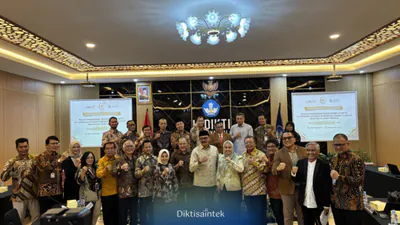
Commission X of the House of Representatives (DPR RI) and the Ministry of Higher Education, Science, and Technology (Kemdiktisaintek) discussed a free tuition scheme at state higher education institutions (PTN) and the strengthening of accreditation during a working visit to the Higher Education Services Office (LLDIKTI) Region VI in Semarang, Central Java, on Friday, 20 November 2026.
According to a report by TVRI News, the news service of Indonesia's public television broadcaster TVRI, Aisyah Endah Palupi, head of LLDIKTI Region VI, said the office oversees 210 private higher education institutions (PTS), 14,750 lecturers, 431,907 students and 1,890 study programmes; 17 PTS have already received Excellent accreditation. She projected that eight more PTS would achieve Excellent accreditation in 2026-2027.
The visit gathered stakeholder aspirations on quality, access and accreditation financing. Khairul Munadi, director general of higher education at Kemdiktisaintek, said the free tuition policy had not been finalised and was still being formulated. He presented an ideal option with comprehensive coverage, a moderate option with more targeted coverage, and an essential option with minimal coverage.
Khairul added that quality assurance had two categories: Accredited and Excellent. The state would bear the cost of meeting accreditation requirements, while applying for Excellent status was optional. Chair of Commission X DPR RI Agung Widyantoro said expanding access through PTN had to take into account the sustainability of the higher education ecosystem, including small and medium-sized private institutions.
Role of LLDIKTI and accreditation in higher education
LLDIKTI is an institution under the ministry that handles higher education in the regions. It usually serves as the national government's local extension for supervising, facilitating and overseeing university operations, especially at private institutions. Through regional services, the government can map the number of institutions, study programmes, lecturers, students and academic quality status. Such data matter because higher education policy cannot be formulated only from the central office; conditions on the ground often differ between regions.
Accreditation is an external quality assessment process. In Indonesia, it can involve the National Accreditation Agency for Higher Education (BAN-PT) and Independent Accreditation Institutions (LAM) for particular academic fields. The standards assessed generally include governance, curriculum, human resources, teaching and learning, research, community service and graduate outcomes. Accreditation status is not merely an administrative label. It affects public confidence, graduate competitiveness, access to scholarships and an institution's eligibility to run certain programmes.
The discussion of free tuition at PTN also relates to the financing structure of higher education. At present, PTN students generally pay a single tuition fee, known as uang kuliah tunggal, with state support provided through various scholarship schemes. For that reason, a free tuition policy can be interpreted in different ways: a complete waiver of fees, means-tested subsidies, or assistance for selected target groups. Policymakers typically weigh broad coverage, precise targeting and the state's budget capacity.
Beyond PTN, private institutions also sustain access to higher education, particularly in regions with few state campuses. Small and medium PTS often face constraints in funding, governance and human resources. Accreditation and financing policies therefore need to consider the ecosystem as a whole. If quality standards are raised without technical and financial support, weaker institutions risk falling behind. Conversely, if accreditation is treated as a formality, public trust in university graduates can decline.
Impact on prospective students and private institutions
For prospective students, the discussion of a free PTN tuition scheme signals possible changes in how public higher education is financed. If the final policy adopts broad coverage, families may see their cost burden fall. But if the scheme is more targeted or minimal, support may reach only certain groups. Official announcements on eligibility, subsidy amounts and registration mechanisms therefore remain to be awaited.
For private institutions, accreditation and the expansion of PTN access cannot be separated. Expensive or overly administrative accreditation can squeeze small PTS, while poor quality can erode public confidence. At the same time, graduates of private institutions remain an important part of the labour market. Policies that strengthen only PTN without improving PTS capacity risk widening the quality gap between campuses.
Key questions going forward are whether the state will truly bear the cost of mandatory accreditation, how Excellent status can be achieved without imposing excessive burdens, and whether access policies can expand learning opportunities without undermining institutional sustainability. For readers, the most tangible effects will be seen in tuition costs, enrollment capacity and graduates' competitiveness in the job market. The issue also touches on education costs, employment opportunities and social mobility for families.