Indonesian House of Representatives Pushes One Data Bill to Integrate Citizen Protection and Public Information
Rieke Diah Pitaloka pushes the One Data Indonesia bill to unify resident databases, personal data protection and public information transparency.
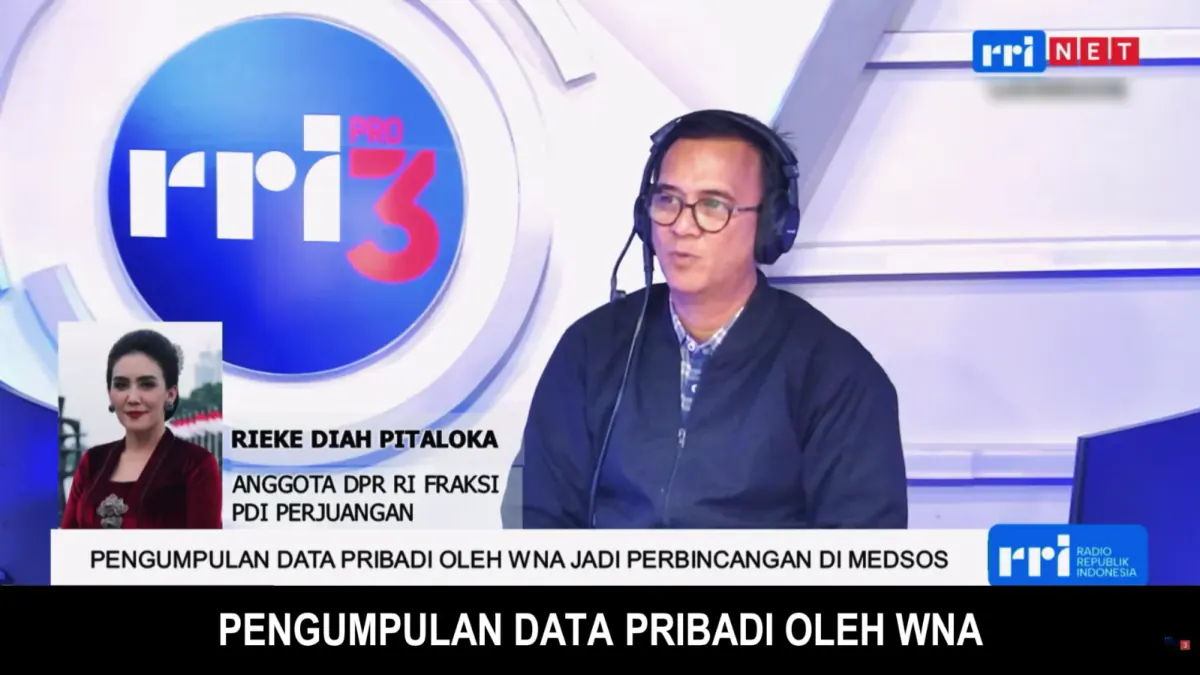
Indonesian House of Representatives (DPR RI) member Rieke Diah Pitaloka said in Jakarta on Thursday, 12 November 2026, that the government and parliament should swiftly pass the One Data Indonesia bill to unify resident databases from the central to regional levels, as reported by Radio Republik Indonesia (RRI).
She said fragmented data across many agencies remained an obstacle to public policy. The bill was designed so that data interoperability would operate on a federative model, keeping agencies connected without removing their respective authority.
“The One Data law integrates data on citizen protection, personal data protection and public information transparency,” Rieke Diah Pitaloka said in an interview on RRI Pro3’s Indonesia Menyapa program.
She added that the national data orchestrator was planned to sit under the president, while system security would be supported by cryptographic infrastructure overseen by the National Cyber and Crypto Agency (Badan Siber dan Sandi Negara, BSSN).
Indonesia’s One Data policy trail
Data integration is not new to Indonesia’s bureaucracy. For years, ministries, agencies and local governments built their own information systems. As a result, one resident could be recorded with different names, addresses or statuses across several databases. That made it difficult to verify the accuracy of planning for social assistance, health services, education and tax collection.
The One Data Indonesia policy emerged as an answer to that problem. In the general framework, population data is usually managed by the Ministry of Home Affairs (Kementerian Dalam Negeri), basic statistics are coordinated by Statistics Indonesia (Badan Pusat Statistik, BPS), while geospatial data involves the Geospatial Information Agency (Badan Informasi Geospasial, BIG). Each agency retains its authority, but standards, metadata and data exchange are directed so systems can read one another.
Federative interoperability should be understood as a model that does not move all data into one giant warehouse. Data remains with the source agency, but can be lawfully used through technical rules, reference codes and system-to-system exchange. The model is considered more realistic in a country with many institutions because it reduces the risk of overlapping mandates and speeds synchronization without removing each agency’s role. Without regular updates, one data could instead become an expensive digital archive that does not reflect reality.
In the current context, data governance also intersects with two major agendas: privacy protection and cyber resilience. The personal data protection law provides the legal basis that citizens’ information must not be collected, processed or shared without clear mechanisms. Meanwhile, cyberattacks on state systems have increased the need for stricter encryption, audits and oversight. Metadata and reference codes also make data traceable to its source, allowing the public to more easily test government claims. One data is therefore not only a matter of administrative efficiency, but also of information sovereignty.
What it means for everyday public services
For residents, well-managed one data could change how public services work. When population records, social assistance, health, education and employment information are linked, people would not need to submit the same documents repeatedly. Its use also touches daily habits, such as handling civil administration, accessing the Social Security Organizing Agency (BPJS) programs, or seeking jobs through employment systems. Data errors that cause eligible people to miss assistance, or ineligible people to appear on recipient lists, would also be easier to correct.
The impact would be felt in state budget efficiency. Accurate data helps the government target programs, reduce duplicated spending and narrow the room for misallocation. If data is not synchronized, residents can lose entitlements to subsidies, assistance or services that should be available. In the long run, better-quality policy can touch staple prices, jobs and access to basic services, though the effects are not immediate and depend on implementation on the ground.
On the other hand, readers should consider privacy risks. Data integration means one breach could have a wider impact. Residents should actively check personal data held by agencies and request corrections if there are discrepancies. Local governments and ministries also need easy-to-use complaint channels when recording errors occur. Oversight, the right to correct data, transparency over intended use and sanctions for misuse are therefore as important as building the system. One data will only be valuable to the public if citizens feel safe that their identities are not traded or used beyond authority.
Related news
Prabowo reminds of the meaning of a Javanese proverb at NasDem Party anniversary
Ministry of Protection of Indonesian Migrant Workers (Kementerian P2MI) strengthens readiness of workers to break into Japanese job market
Prabowo mentions wiretapping at NasDem Party’s 15th anniversary in Jakarta