Indonesia stresses just climate transition at COP31
Indonesia said net-zero emissions targets must go hand in hand with climate resilience and people’s welfare at COP31 in Antalya.
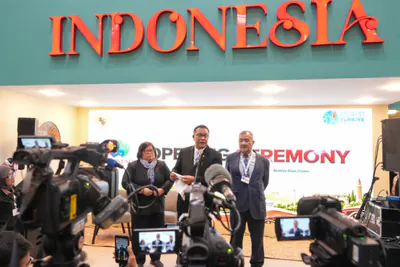
The Indonesian government said the net-zero greenhouse gas emissions target must not be separated from climate resilience and people’s welfare. Environment Minister Moh Jumhur Hidayat made the remarks in a ministerial dialogue at the Indonesia Pavilion at COP31 in Antalya on Monday, 9 November 2026, as reported by TVRI News.
According to TVRI News, Jumhur said the transformation toward a low-carbon economy must open jobs, expand energy access and guarantee social inclusivity. He said climate resilience needed to be built into development planning, budget allocation, implementation in the regions and monitoring. That way, ecological vulnerability would be taken into account in spatial planning, infrastructure, agriculture, water management and health.
Climate adaptation, he said, must not operate in isolation from the national development framework. One instrument he cited was Program Kampung Iklim, or ProKlim (Climate Village Programme), which gives residents space to initiate local mitigation actions. Indonesia also highlighted cross-sector collaboration, from central and local bureaucracies to industry, academics and civil society.
Jumhur said, “Net-zero must not mean zero economic opportunity.” He added that social justice and gender equality were pillars of the green transition, ensuring women, young people, indigenous communities and coastal communities receive equal benefits. The government also promoted nature-based solutions, such as forest rehabilitation, peatland and mangrove restoration, and sustainable land use.
On carbon markets, Indonesia stressed trade integrity and transparency in climate finance. Referring to the Article 6 framework of the Paris Agreement, it said international carbon trading mechanisms must produce credible verification of emission reductions and be free from double counting. The government also called for expanded access for developing countries to concessional finance, blended finance and technology transfer.
COP31 and just climate diplomacy
The COP forum is the annual meeting of parties to the United Nations Framework Convention on Climate Change (UNFCCC). There, governments, international institutions, businesses and civil society negotiate emission reductions, climate finance, carbon market rules and adaptation mechanisms for the most vulnerable countries. Because major decisions usually emerge from compromise, moral messages such as a just transition become a diplomatic tool to prevent climate targets from being read as a one-sided burden on developing countries.
Climate justice is usually linked to the principle of common but differentiated responsibilities. This means all countries face the same threat, but their historical contributions to emissions, technological capabilities and fiscal capacities differ. As an archipelagic country with tropical forests, Indonesia occupies a dual position: it is vulnerable to sea-level rise, floods, droughts and land fires, but also holds a key lever for global mitigation through the protection of forests, peatlands, mangroves and land governance.
Article 6 of the Paris Agreement is a set of rules that allows cooperation between countries or parties to reduce emissions, including through carbon trading. Integrity is important because a single emission reduction must not be claimed more than once. Double counting can make climate reports appear better than reality, causing carbon markets to lose public and investor confidence. Verification, transparency and oversight are therefore prerequisites for the mechanism to drive real action.
At national level, what is called a just transition is usually tested by simple questions: whether workers in legacy sectors get training pathways, whether energy prices do not squeeze poor households, whether green projects open access to electricity and clean water, and whether spatial planning decisions involve affected residents. Participatory village-level programmes are important because climate action often fails if it remains only in ministry documents, while field practice requires incentives, mentoring and clear responsibility for local governments.
What Indonesian readers should watch
For readers in Indonesia, statements at COP31 are more than forum diplomacy. The direction of climate policy will touch local budgets, project permits, spatial planning, public health and business opportunities. If the net-zero emissions target is pursued only through restrictions without social support, the impact can be felt by workers, farmers, fishers and energy consumers. Conversely, if the transition is designed with jobs, energy access and clear financing, it can become a new source of growth.
What needs to be watched going forward is consistency between promises made in international forums and implementation at home. The public should see measurable quantitative targets, performance evaluation mechanisms and a division of authority that does not overlap. In carbon markets, communities and investors need to ensure that projects being sold genuinely reduce emissions, rather than merely shifting claims. Transparency in climate finance is also important so adaptation funds reach vulnerable areas, rather than stopping at administrative reports.
For general readers, the practical message is that climate now enters daily decisions: air quality, flood risk, food prices, energy access and green job opportunities. Therefore, climate policy needs to be read together with welfare issues, rather than separated as an environmental matter alone. If the principle of building together with communities is implemented, a just transition can strengthen public trust in government and the private sector.