Indonesia's coordinating security minister leads Heroes' Day sea flower-laying ceremony
Coordinating Minister for Political and Security Affairs (Menko Polkam) Dudung Abdurachman led a sea flower-laying ceremony aboard KRI Sriwijaya-100 in Teluk Jakarta to mark Heroes' Day 2026.
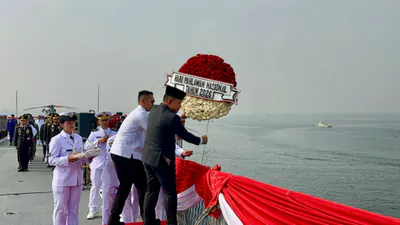
Coordinating Minister for Political and Security Affairs (Menko Polkam), retired Indonesian National Armed Forces (TNI) General Dudung Abdurachman, led a sea flower-laying ceremony on the flight deck of the Indonesian Navy warship KRI Sriwijaya-100 in the waters of Teluk Jakarta on Tuesday, 10 November 2026, to mark Heroes' Day (Hari Pahlawan). TVRI News, Indonesia's state broadcaster, reported that the event paid tribute to national heroes, particularly ocean fighters.
The ceremony, themed 'Pahlawanku Teladanku: Melangkah Bersama, Melanjutkan Perjuangan' - 'My Heroes Are My Role Models: Moving Forward Together, Continuing the Struggle' - opened with a tribute to ancestral spirits, a moment of silence and the committing of the main wreath to the sea, led by Dudung. It closed with a collective scattering of flowers from the deck and a prayer.
Also present were Chief of Staff of the Navy, TNI Admiral Dr. Muhammad Ali; representatives of the Army and Air Force chiefs of staff; and a representative of the chief of the Indonesian National Police (Polri). Former Chiefs of Staff of the Navy, senior TNI and Polri officials, several deputy ministers, officials of Jalasenastri, the Indonesian Navy wives' association, members of the regional coordinating forum of government, military and police (Forkopimda), historical actors and heirs of national heroes also attended.
Dudung said he hoped the younger generation would emulate patriotism, integrity and selfless devotion to support government programmes toward the Indonesia Emas, or Golden Indonesia, vision. "Today I directly led the sea flower-laying ceremony as part of Hari Pahlawan 2026 aboard KRI Sriwijaya-100," he said.
Sea flower-laying tradition and Hari Pahlawan
Sea flower-laying is a common tribute ritual performed by navies in many countries. In Indonesia, the tradition is usually held from the deck of a warship or state vessel, with a wreath committed to the sea and flowers scattered on the water as a sign of respect for fallen naval personnel. The ritual combines military, religious and state elements, including a tribute, a moment of silence, collective prayer and the presence of heroes' families.
The choice of 10 November is tied to the 1945 Battle of Surabaya, an event that became a symbol of popular resistance to attempts to retake control of Indonesia. Since then, Hari Pahlawan has been commemorated every year to nurture awareness that independence was born from sacrifice, not only political victory. The ceremony at sea underscores that the nation's struggle also took place in its waters, safeguarding sovereignty from Sabang in the west to Merauke in the east.
KRI Sriwijaya-100 is one of the warships that can be used for state activities because its flight deck can accommodate a ceremony. The location in Teluk Jakarta makes the event easily accessible to central government officials, while the attendance of various TNI branches and Polri carries a message of unity. In that context, the term ocean fighters refers to sailors and maritime combatants who fell in naval defence operations, including those whose names were rarely recorded but whose service forms part of Indonesia's maritime history. A warship, in this sense, is not only a defence tool but also a symbolic space for preserving the nation's collective memory.
The presence of organisations such as Jalasenastri and the heirs of heroes also has social significance. Jalasenastri is an association of the wives of Indonesian Navy personnel that helps maintain the continuity of values of devotion within the naval family environment. By including historical actors and heroes' families, the state seeks to ensure that the commemoration does not stop at an annual ceremony but becomes a link between generations.
Values the public can draw
For Indonesian readers, the sea flower-laying ceremony is not merely protocol news. It recalls that the sea is part of national identity: a source of food, a trade route and a sovereign space that must be protected. The example of ocean fighters can be translated into greater awareness of protecting the marine environment, respect for the seafaring profession and support for maritime safety in everyday life.
The message of patriotism, integrity and selfless devotion is also relevant to workers, students and state officials. Those values need not be realised on a battlefield; they can appear in honesty in public service, hard work in pursuing aspirations and courage to defend the common interest. Hari Pahlawan is a reminder that development toward the Indonesia Emas vision requires character, not only infrastructure.
What matters going forward is consistency in living up to those values. The public can give meaning to Hari Pahlawan by remembering heroes' contributions in their own regions, taking part in history education activities or supporting maritime programmes that favour fishermen and sea workers. Ceremonies like this can also prompt public discussion of maritime history in schools and media. In that way, the ceremony in Teluk Jakarta should not stop at being a photo of officials, but become a moral impetus for ordinary citizens.