Indonesia Passes Asset Forfeiture Law as Benny Utama Highlights Rights of Bogus Investment Victims
Benny Utama says the new law allows the state to forfeit criminal assets even if defendants die or flee, and could open the way for returns to victims of bogus investments.

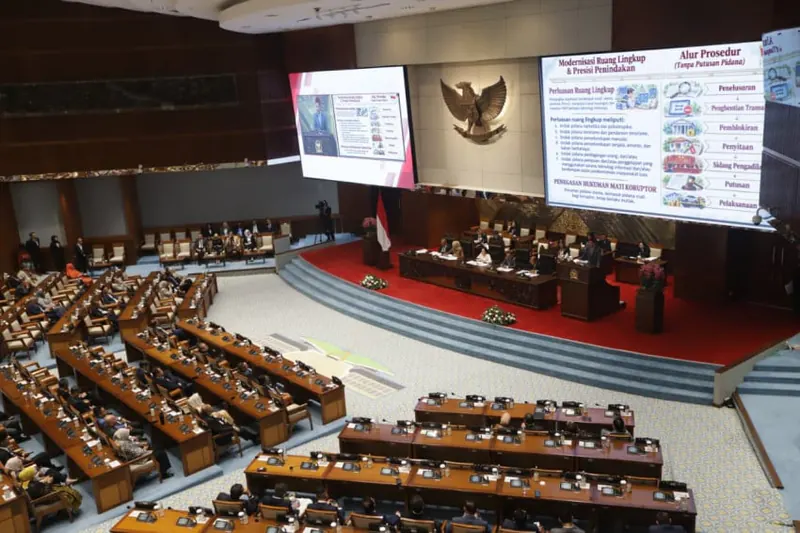
Before a plenary session of the House of Representatives (DPR RI) at the parliamentary complex in Senayan, Jakarta, on Thursday, 19 November 2026, Benny Utama, a member of DPR Commission III, which oversees law, human rights and security, said the Law on Asset Forfeiture Related to Corruption Crimes and Other Criminal Acts, which was passed, opens opportunities for returning assets to victims of fraud and bogus investments, as reported by BeritaParlemen.
According to the report, Benny said the law allows the state to forfeit proceeds of crime even if defendants die, flee, or criminal proceedings cannot continue. He stressed that all criminal proceeds must be traced so they are not enjoyed by other parties. Benny also said many bogus investment complaints brought to Commission III had previously ended in forfeiture to the state, even though the public was harmed. He said legal mechanisms and special procedural law are regulated to prevent abuse of authority. He asked that the management of forfeited assets be carried out by an independent institution and expressed hope that implementing regulations would be issued soon.
The Road to the Asset Forfeiture Law
The Asset Forfeiture Law is part of an effort to close gaps in Indonesia's legal system. Until now, many criminal proceeds have been difficult to forfeit when defendants die, become fugitives or criminal proceedings stop for legal reasons. Within that framework, asset forfeiture can stand alone as a civil or special mechanism, so the state does not always depend on a criminal conviction against one person. In some countries, this approach is known as non-conviction based forfeiture, but applying it requires clear evidentiary standards so that citizens' rights remain protected.
In enforcement practice, assets derived from corruption, money laundering, fraud or bogus investments often change form: land, vehicles, shares, bank accounts or property registered in other people's names. That makes asset tracing key. Institutions involved usually include investigators, prosecutors, courts, financial intelligence agencies and asset registration offices. Without coordination, forfeited goods can lose value or become difficult to enforce. In bogus investment cases, losses are often spread across many regions, so victim and asset data must be managed centrally. If assets have been sold or transferred, the state must prove whether the new holders acquired them in good faith or as receivers of criminal proceeds.
The law also touches on special procedural law, the rules for proving an asset's connection to a crime. The term matters because the public often equates forfeiture with ordinary seizure, although the two differ in stage and legal effect. In a system that respects the presumption of innocence, forfeiture must still go through a court process and must not be used as punishment without a basis. Therefore, mechanisms for objections, proof and the restoration of the rights of good-faith third parties are an important part of the regulation.
The Asset Forfeiture Law can be read as a complement to the Corruption Crimes Law (UU Tipikor) and the Money Laundering Law (UU TPPU). If UU Tipikor ensnares defendants and UU TPPU traces disguised criminal proceeds, asset forfeiture focuses on the fate of forfeited goods. It answers a classic question: after assets are seized, where does the money go, and who is entitled to receive it when losses affect many people. That question becomes important because victims often come from large groups with varying loss amounts.
What Investment Victims Should Watch
For members of the public who have been victims of fraud or bogus investments, the Asset Forfeiture Law raises hope that successfully traced assets will not automatically go to the state treasury. If implementing regulations and an asset management institution are formed, mechanisms for returning assets to victims can become clearer. But that hope becomes an enforceable right only after official procedures, standards for proving losses and accurate asset data exist.
For general readers, the most noticeable change may be in prevention. When those enjoying criminal proceeds know that assets can be traced in the form of land, vehicles, shares or accounts, the temptation to hide fraud proceeds becomes a risk. The public still needs to be careful: check permits, keep transfer records and report losses early. Without reports and asset trails, forfeiture mechanisms are difficult to operate.
The impact on prices of goods or services is indirect. However, public trust in law enforcement can increase if forfeited assets are managed transparently. Conversely, if management is slow, victims continue to wait and assets lose value. Therefore, implementing regulations, audits and complaint channels will determine whether the law brings real benefits to victims in Indonesia.
Related coverage
Pasopati urges the Pati regional legislature (DPRD Pati) to follow up alleged ethics violations by council members.
Defense Minister Sjafrie meets House of Representatives (DPR) leaders to discuss improvements to the State Defense Law.
Defense Minister Sjafrie says there are no plans to replace the commander of the Indonesian National Armed Forces (TNI).