Indonesia launches three blue carbon projects at COP31
Indonesia launches three blue carbon projects at COP31 in Antalya, covering mangroves and seagrass, with funding and targets for restoring coastal ecosystems.
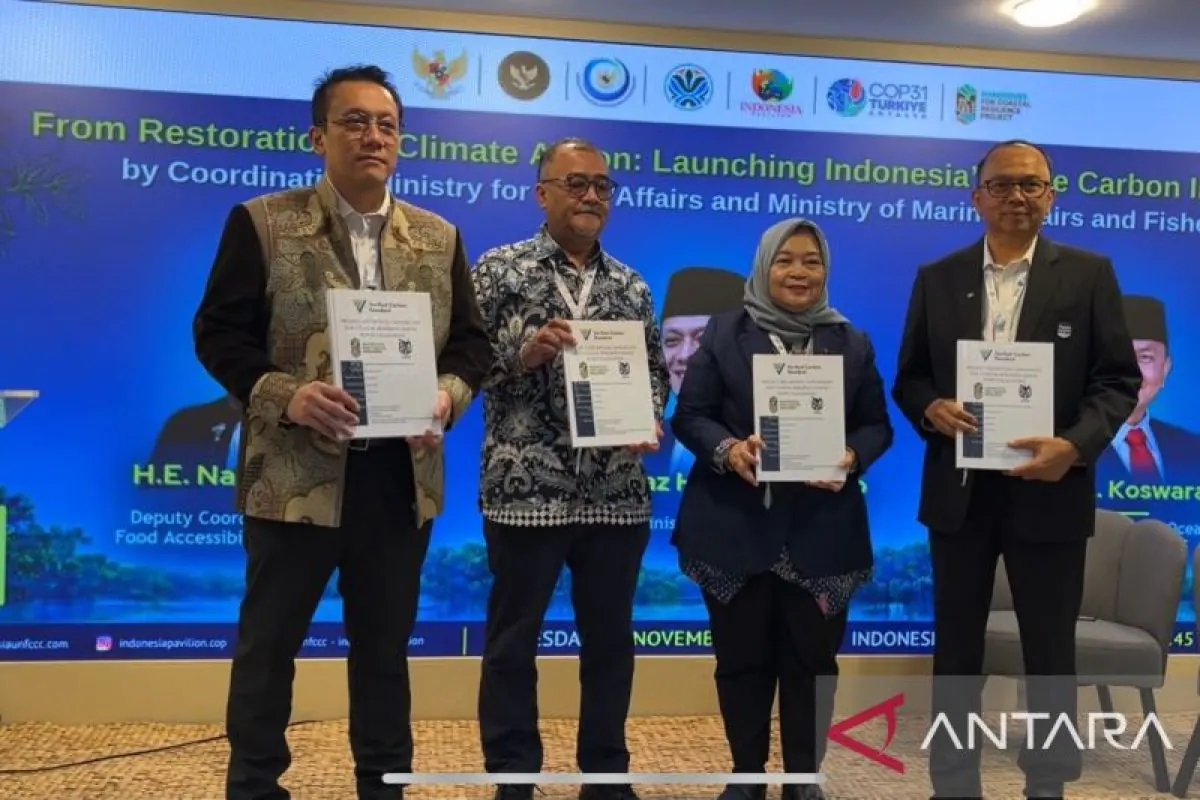
The Indonesian government launched three blue carbon projects on the sidelines of the 31st UN Climate Change Conference, or COP31, in Antalya, Turkey, on Tuesday, 17 November, according to the Antara state news agency.
The projects involve the Ministry of Environment, the Ministry of Marine Affairs and Fisheries and the Coordinating Ministry for Food. Deputy Environment Minister Diaz Hendropriyono said their locations are in North Kalimantan, the north coast of Java and East Belitung.
The North Kalimantan project is funded with about US$4 million through the M4CR scheme, which involves the World Bank and Danish donors, and covers capacity building and field activities. Its land area is 43,000 hectares, with a potential carbon yield of 5.5 million tonnes of carbon dioxide equivalent under the Verra scheme.
The other two projects are managed by the Ministry of Marine Affairs and Fisheries, covering 81,000 hectares on Java's north coast and 14,000 hectares in East Belitung. The East Belitung project combines mangroves and seagrass beds. Nani Hendiarti, deputy for food affordability and security coordination at the Coordinating Ministry for Food, said nearly 50 percent of the economic value of blue carbon would return to communities.
What blue carbon means
Blue carbon is a term for coastal and marine ecosystems, especially mangrove forests, seagrass beds and tidal marshes. These ecosystems absorb carbon dioxide from the atmosphere and store much of that carbon in biomass and sediment. Because coastal sediments can hold carbon for long periods, these areas are seen as important for climate change mitigation.
Programmes such as M4CR usually do not stop at tree planting. Associated activities include land governance, ecosystem restoration, monitoring and strengthening community capacity. In carbon trading, absorption or emission reductions can be verified to become carbon credits. These credits can be used by countries, companies or other parties as part of climate commitments, although mechanisms and standards differ.
In Indonesia, mangroves have strategic value because they are spread across many coastal areas and support community livelihoods. Besides absorbing carbon, mangroves help hold back coastal erosion, dampen waves and provide nursery grounds for marine life. For that reason, blue carbon projects are often linked to ecosystem restoration, coastal protection and new income sources for coastal residents.
COP31 is part of the UN climate negotiation process. The conference serves as a forum for countries to announce partnerships, funding and new initiatives. To ensure credits are not double counted, countries and institutions usually use registries. In Indonesia, the carbon unit registry system records ownership and transfers of carbon units. International standards such as Verra also apply verification and monitoring rules so each credit can be traced. For coastal projects, the main challenges are measuring absorption accurately, protecting forests from conversion and ensuring communities share in the benefits, rather than leaving them as numbers on paper.
Benefits for coastal communities
For readers in Indonesia, the most immediate meaning of blue carbon projects is change in coastal areas. If mangroves and seagrass recover, residents can benefit from better coastal protection, more stable fisheries yields and economic activities such as ecotourism and non-timber forest product businesses. When part of the carbon economic value is returned to communities, such projects can provide additional funding for ecosystem care.
The direct impact on prices of basic goods or household bills is likely to be limited in the short term. However, the policy is important for local labour markets, environmental governance and Indonesia's position in climate negotiations. For consumers, the change is more likely to be felt as an option for green products than as a daily price increase. Transparent and verified projects can attract green investment, while weak projects risk creating land conflicts or claims that cannot be accounted for.
What needs attention going forward is long-term monitoring. Blue carbon benefits do not come from launching projects alone, but from keeping plants alive, preventing land conversion and ensuring benefits are shared fairly. For the general public, this information is relevant as a reminder that climate issues are not only about emissions, but also about the sea, coasts and livelihoods.
Related news
Related coverage includes: government strengthens capital market reform to protect public assets; Lalu Hadrian asks school revitalisation to prioritise frontier, outermost and disadvantaged (3T) areas; and Sekolah Rakyat planned on University of Indonesia land, with the Ministry of Social Affairs and Jakarta Provincial Government working together.