Home Affairs Minister urges local governments to accelerate digital social protection registration
Home Affairs Minister Muhammad Tito Karnavian has urged local governments to accelerate the digital registration of social protection services so that social assistance is better targeted.
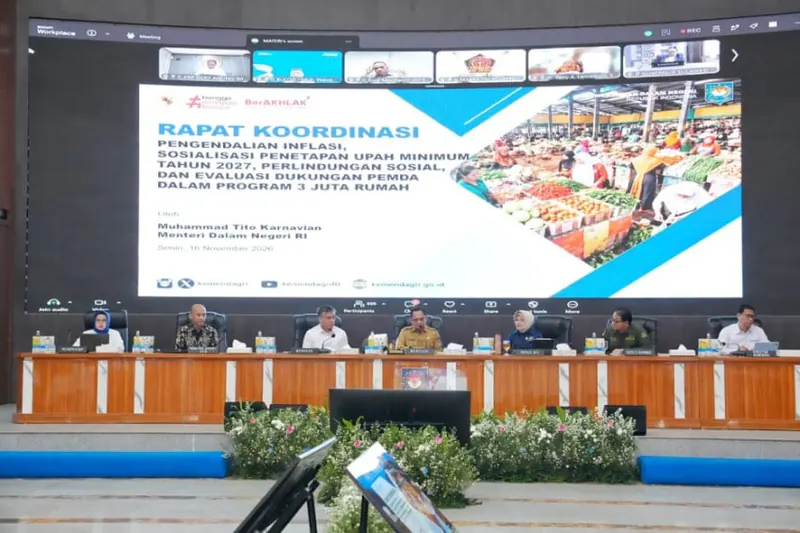
Home Affairs Minister Muhammad Tito Karnavian has urged local governments to accelerate the digital registration of social protection services (Perlinsos) so that social assistance (bansos) is better targeted, according to SINDOnews on Monday, 16 November 2026.
A coordination meeting (Rakor) on regional inflation control at the Sasana Bhakti Praja Building in Jakarta was combined with outreach on the setting of the 2027 minimum wage and social protection.
Tito said the digitalization of social protection was part of President Prabowo Subianto's e-government agenda. The first stage is verifying and validating social assistance recipient data across ministries.
He said some well-off residents were still receiving aid, while people in need had not been recorded.
Tracing the shift to digital social protection
Social protection in Indonesia is not run by a single ministry. The Ministry of Social Affairs (Kementerian Sosial) manages programmes such as the Family Hope Program (Program Keluarga Harapan) and food assistance, while other ministries operate their own protection schemes. As a result, scattered recipient data have long been a problem. One household can be listed in several programmes, yet some poor residents remain off the register. Local governments usually help verify field conditions, including addresses, occupations, family dependents and assets.
The digital registration of Perlinsos aims to unify verification and validation through electronic systems. The national identity number (NIK) is the central key because population data are used as a reference for many public services. When the NIK is linked to income, assets, health status or social security coverage, the government can more easily check whether aid recipients are eligible. Integrated social welfare data (Data Terpadu Kesejahteraan Sosial) are also often used as a reference, but their accuracy depends on updates from the ground.
The effort is also linked to the electronic-based government system (SPBE), which encourages ministries, agencies and local governments to use interconnected platforms so that services do not operate in silos. In social assistance, local governments have an important role because they are closest to field conditions, from village offices (kelurahan) and subdistricts (kecamatan) to social service offices (dinas sosial). Regional parliaments (DPRD) can also oversee social budget allocations. Without local involvement, data collected centrally can easily become outdated or out of step with reality.
The main challenge is not only technology. Socioeconomic data change quickly because of births, deaths, relocation, job losses and changes in family status. Without routine updates, digital systems can still produce inaccurate lists. Central and regional coordination will therefore determine whether Perlinsos registration succeeds. Residents also need to understand that social assistance is not an automatic right for all residents, but a programme with specific criteria. Open explanations of objection mechanisms and data updates can help reduce social resentment and maintain public trust in fair, accurate and sustainable policies. At the same time, personal data must be protected, because citizens' economic information is sensitive.
What it means for local social assistance recipients
For the public, the digital registration of Perlinsos can change how people access assistance. Residents will no longer have to rely entirely on manual announcements or notification letters that may arrive late. If their data are valid and connected to the system, their status as aid recipients can be checked more easily. Conversely, residents without internet access or who are unfamiliar with digital procedures risk being left behind, so support from village offices and social service offices remains necessary. In areas with limited internet networks, field officers still play an important role. This matters for many residents.
The impact also reaches local budgets. Local governments need to prepare staff, data infrastructure and complaint mechanisms so that updates can proceed. If the system succeeds, mis-targeting of social assistance can decline and social spending becomes more efficient. Greater efficiency in social budgets can reduce local fiscal burdens, but only if recipient data are genuinely updated. However, if data are inaccurate, the same programme can trigger local conflict, for example when residents feel entitled to aid but are not listed. Regional parliaments can demand explanations if social assistance data prove problematic.
For general readers, the key issue is data confidentiality. Household economic information should be used only for clear purposes and under oversight. Residents also need to actively update their population data, report changes in employment or family members, and follow official local government channels. Open complaint channels are important so overlooked residents can file objections without resorting to informal routes. With that, social assistance is not only delivered, but also made more accountable.
Related news
- Commission X of the House of Representatives (DPR) supports senior high school specialisation with an in-depth study
- Irfan Maulana to lead SP JICT (the JICT workers' union) for 2026-2029 with a focus on port transformation
- Prabowo at ASEAN summit: Global challenges require regional unity