Hendri Satrio Names Three Potential Vice Presidential Candidates to Replace Gibran
According to Jateng Pos, Hendri Satrio names three professional-track candidates who could replace Vice President Gibran Rakabuming Raka.
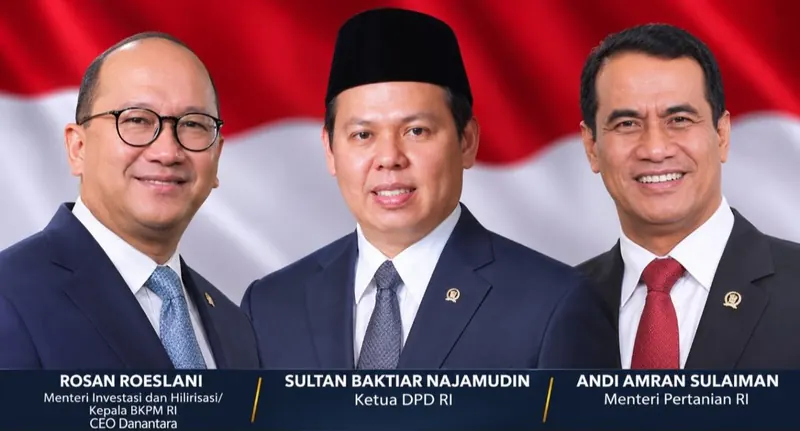
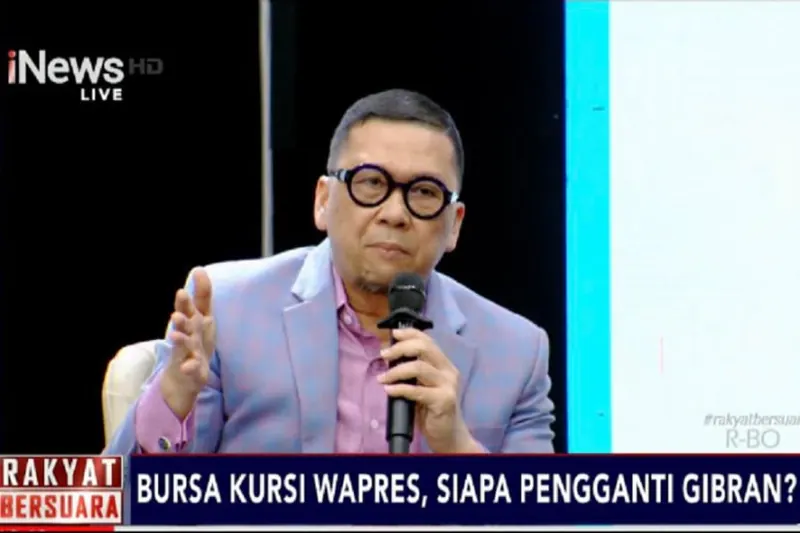
In a dialogue session at CNN Indonesia in Jakarta, political communication analyst Hendri Satrio named three professional-track candidates to replace Vice President Gibran Rakabuming Raka: Rosan Perkasa Roeslani, Sultan Baktiar Najamudin and Andi Amran Sulaiman, according to Jateng Pos.
According to Jateng Pos, the three professional-track names are Rosan Perkasa Roeslani, Minister of Investment and Downstreaming; Sultan Baktiar Najamudin, Chairman of the Regional Representative Council (DPD RI); and Andi Amran Sulaiman, Minister of Agriculture.
As reported by Jateng Pos, Hendri mapped three clusters of vice presidential candidates: the Indonesian Democratic Party of Struggle (Gerindra) and its coalition, non-coalition parties, and a professional or civil society group that includes ministers. In the party cluster, he named Sufmi Dasco Ahmad, Sugiyono and Prasetyo Hadi.
Hendri assessed figures from Gerindra as relatively safe because they do not provoke resistance from other parties. He also urged President Prabowo not to choose a vice president from the military, saying the president already has a military background and the vice president should be a civilian.
In the discussion, he delivered one message: “I apologize, and with all due respect, please do not choose someone from the military again.”
Hendri listed three criteria for a replacement vice president: sharing the president’s vision, having no ambition to run in 2029, being able to strengthen the coalition and the president’s position over three years, and being administratively competent. He argued that a development paradox arises when the government is working but public satisfaction and electoral popularity decline.
Rules for Filling the Vice Presidency
Discourse about a replacement vice presidential candidate should be read as part of political discussion, not as an official announcement. In Indonesia’s constitutional system, the president and vice president are elected as a single ticket in general elections. Therefore, the term “replacement” usually appears when there is speculation about a vacancy, a political reshuffle, or a need to build a more stable coalition.
Constitutionally, a vice presidential vacancy is governed by a special mechanism. The president submits two vice presidential candidates to the House of Representatives (DPR), and the DPR then chooses one of them within a prescribed time limit. This mechanism differs from the direct election of the president and vice president, so the process depends heavily on the balance of forces in parliament.
Mentioning names from the professional track also reflects a common practice in Indonesian politics of balancing the backgrounds of a leadership pair. Ministers, heads of state institutions and bureaucratic figures are often seen as bringing administrative capital and access to policymaking. However, names circulating in discussion forums do not automatically carry a political ticket, because candidacy still requires the approval of parties, coalitions and authorized institutions.
The distinction between party and non-party clusters also matters. Parties usually prioritize loyalty, seat numbers and the distribution of posts, while the professional track is often promoted as a marker of competence, a technocratic image or market acceptance. In practice, the two tracks are not always separate, because ministers can come from parties, while heads of state institutions can be close to certain political forces.
The DPD RI, for example, represents regional interests, but its authority in the legislative process is more limited than that of the DPR. A chairman of the DPD can therefore be read as a symbol of regional representation and institutional ethics, not automatically as a candidate with strong parliamentary support. A name that is powerful in public debate is not necessarily as powerful at the negotiating table.
What the Discourse Means for the Public
For Indonesian readers, the idea of a replacement vice presidential candidate matters because the office can influence policy direction, government communication and coalition stability. If a named figure comes from the investment or agriculture ministry, the public may look for policy signals on downstreaming, food and the business climate. But as long as there is no official process, readers should refrain from concluding that a particular name will definitely hold the post.
Another issue closer to daily life is government communication. When development proceeds but public satisfaction declines, citizens often judge policy by the ease of information, the consistency of messages and officials’ ability to explain economic impact. A vice president considered a capable communicator can help explain programs, reduce misunderstandings and maintain market confidence.
What needs to be watched going forward is whether the discourse turns into an official proposal, whether coalition parties reach an agreement, and whether the constitutional mechanism is carried out. Without such clarity, circulating names are better read as observers’ opinions, not political decisions. That distinction is important so the public does not judge hastily.