Gibran vice-presidential replacement race: party comfort or regional representation
A Diponegoro University analyst says the vice-presidential replacement race for Gibran Rakabuming Raka could turn on party comfort or regional representation.
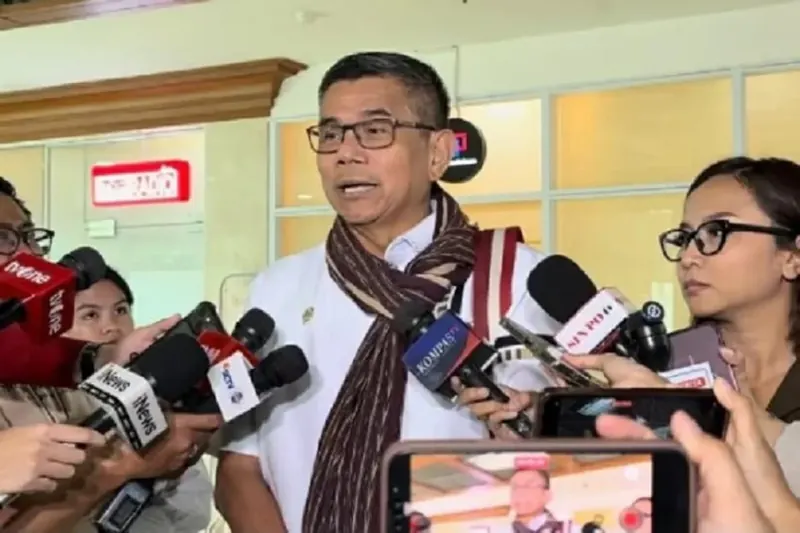
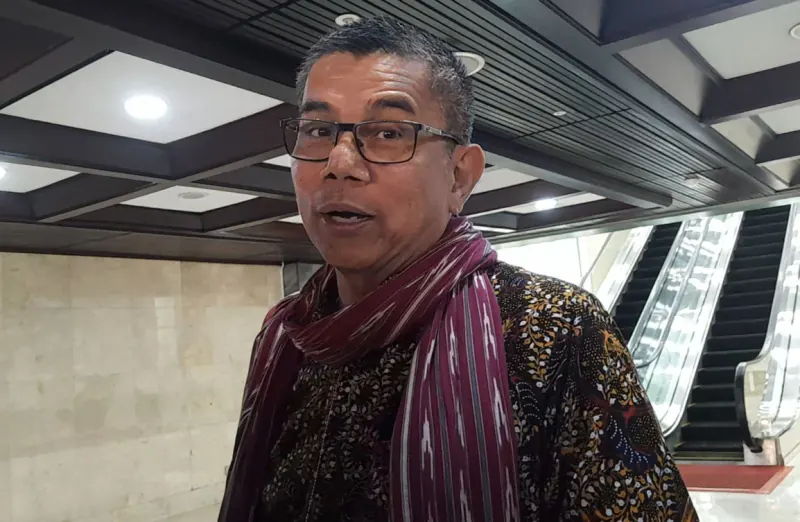
Political analyst at Diponegoro University (Undip) in Semarang, Prof. Dr. Drs. Teguh Yuwono, M.Pol.Admin., said the race to replace Gibran Rakabuming Raka as vice president is caught between two pulls: political comfort through parties and governance rationality through professionals or regional representation. Citing a report by Jateng Pos, he said the party option was safer, while the rational choice would fall on a non-party figure or a regional element.
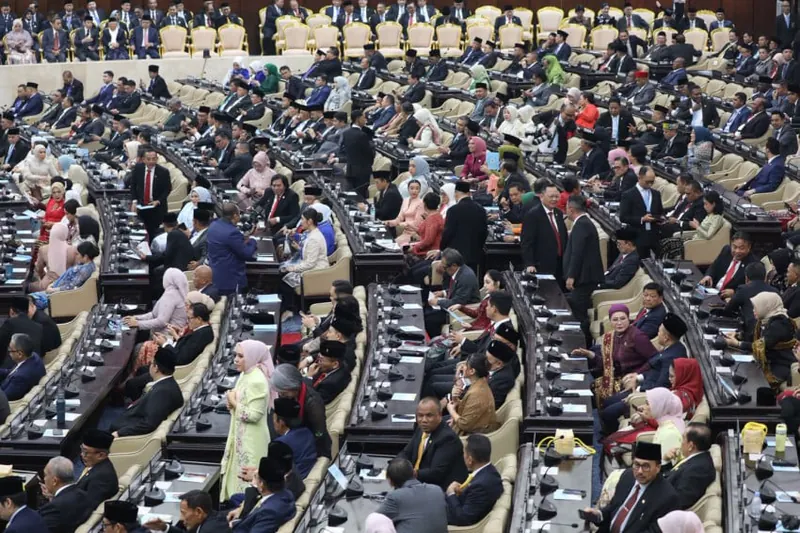
Teguh, who is also dean of Undip's Faculty of Social and Political Sciences (FISIP), said the president would send two vice-presidential candidate names to the People's Consultative Assembly (MPR) on 25 November 2026. He described the mechanism as the president's prerogative when the vice-presidential post is vacant, as regulated in Article 8, paragraph 2, of the 1945 Constitution.
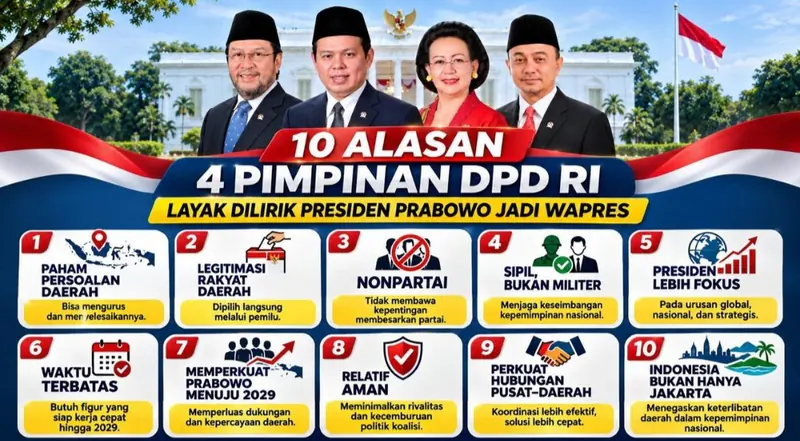
He said the pool of possible candidates could come from three clusters: supporting parties or the coalition, non-coalition parties, and non-party figures, including members of the Regional Representative Council (DPD), governors or other figures. He named four DPD leaders as representatives of the regions: Sultan Baktiar Najamudin, GKR Hemas, Yorrys Raweyai and Tamsil Linrung. On the non-coalition track, he mentioned Pramono Anung and Puan Maharani, but noted that the Indonesian Democratic Party of Struggle (PDIP) had said it would remain outside the government.
Teguh said Prabowo would not rush to choose a candidate from within the Great Indonesia Movement Party (Gerindra). He saw the president as weighing many possibilities while listening to inputs, because the decision concerned coalition stability as well as government performance until 2029.
How the vice-presidential post is filled
The discussion of a vice-presidential candidate race does not stand alone. It is tied to the rules for filling the office when the vice-presidential seat is empty. The president cannot directly appoint one person, but proposes two candidates to the MPR. The MPR then chooses one of them. For that reason, the two names said to be sent on 25 November 2026 become a political entry point and a measure of the government's direction. The process also has a timing dimension: names that emerge earlier can shape public perception, while names that have not yet appeared remain a space for speculation.
In that context, political parties and regional representation offer different logics. The party option is usually read as a way to maintain coalition solidity, ease communication in parliament and reduce the risk of internal friction. The non-party or regional option is more often linked with a technocratic image, closeness to local problems and the ability to bridge the centre and the regions. They are not merely names, but signals of the government's priorities.
The DPD is often described as a symbol of regional representation because its members are elected from provinces. Although its constitutional authority differs from that of the House of Representatives (DPR), the DPD leadership position carries symbolic capital: it is known as an institution that carries regional aspirations. Therefore, when the names of four DPD leaders appear in the race, the public can read it as an effort to present figures seen as understanding regional problems, not merely parliamentary strength.
Meanwhile, the names of the PDIP, Gerindra and the figures mentioned by Teguh show that the race also concerns the coalition map. Choosing a candidate from a supporting party could strengthen coalition discipline, but risks being seen as closing the door to non-party groups. Conversely, choosing a professional or regional figure could widen the support base, but requires political communication skills to avoid triggering jealousy among parties.
What the race means for regional publics
For readers in Indonesia, especially in the regions, the vice-presidential race is not only an elite affair. The office carries functions of assisting the president, coordinating programmes and becoming the face of government beyond the centre. If the chosen figure is seen as close to regional problems, the public can hope for smoother policy communication, for example in infrastructure, basic services or inter-regional inequality. That hope is reasonable, but it still depends on the authority exercised.
The choice of a party or professional figure can also affect public trust in the government. When society sees a vice-presidential candidate chosen for their track record and representation, the process can be read as strengthening legitimacy. Conversely, if the public considers the choice to be merely a distribution of posts, trust may decline. Therefore, the two names to be sent to the MPR will become material for public assessment: whether they can work, understand the regions and maintain governmental stability.
What needs to be watched going forward is consistency between statements and actions. The public can wait for official explanations about the mechanism, criteria and schedule, not only name speculation. On regional issues, a figure alone is not enough; what matters is a commitment to carry out policy coordination down to the provincial and regency/city levels.
Related coverage
- Sukoharjo police headquarters deploys 760 personnel to secure village head elections
- Customers of rural bank BPR IAS Ambarawa demand return of Rp1.1 billion
- Central Java regional secretary closes the 2026 provincial sports games of the Indonesian Civil Servants Corps (Korpri) in Semarang