Sleman election watchdog launches Integrity Zone and WIGATI work culture
Sleman Bawaslu launches an Integrity Zone and the WIGATI work culture to strengthen a clean, professional and accountable institution.
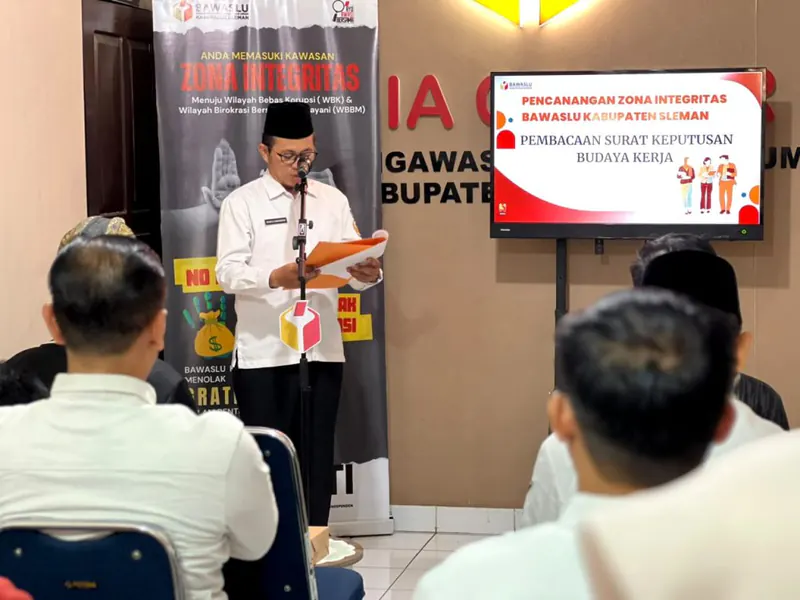
The Sleman Regency branch of the General Elections Supervisory Agency (Bawaslu) launched the development of an Integrity Zone and the strengthening of the WIGATI work culture on Thursday, 19 November 2026, in the Media Center Room, as reported by the government public information portal InfoPublik. The move is aimed at shaping clean, professional, transparent and accountable institutional governance.
Sleman Bawaslu chair Arjuna Al Ichsan Siregar said the Integrity Zone must become a work culture, not merely a program for assessment or a particular designation.
The event was accompanied by the signing of an Integrity Pact and a Joint Commitment, the reading of a decree, and the strengthening of the six WIGATI values: Waskita, Integritas, Gotong Royong, Akuntabel, Tepat and Independen.
Sleman Bawaslu secretariat head Suparno said the success of the Integrity Zone required consistency across all elements of the organization, not just administrative documents.
Bawaslu chair for the Special Region of Yogyakarta (DIY) Moh. Najib stressed that institutional integrity rests on individual integrity to maintain public trust.
What the Integrity Zone means for election supervisors
In Indonesian bureaucratic reform, an integrity zone is understood as a work area that carries a commitment to prevent corruption, collusion and nepotism while improving the quality of public services. The designation is usually linked to building a corruption-free area and a clean, service-oriented bureaucracy. Therefore, a regional-level declaration is not merely an internal ceremony but a signal that an institution wants to change its working methods, discipline standards and oversight mechanisms over its own staff.
For election supervisory institutions, integrity is a key asset because their authority touches sensitive political processes. Bawaslu at regency level works on preventing violations, supervising election stages, handling findings or reports, and maintaining the neutrality of election administrators. When the public judges election supervisors to lack independence, trust in election results is also eroded. The integrity zone can be read as an effort to strengthen internal safeguards so that institutional decisions are not easily influenced by the interests of candidates, parties or particular groups.
The WIGATI values mentioned in the event show that Sleman Bawaslu is trying to formulate a more concrete work culture. Its six elements—Waskita, Integritas, Gotong Royong, Akuntabel, Tepat and Independen—cover professionalism, honesty, collective work, accountability, timeliness and independence. In bureaucratic practice, such values need to be translated into procedures: how reports are handled, how conflicts of interest are avoided, how information services are made accessible, and how internal violations are acted upon.
The challenge of building an integrity zone usually lies in sustainability. Documents, pacts and commitments can be drawn up quickly, but behavioral change requires routine supervision, performance assessment and safe complaint channels for staff and the public. Without that, an administrative designation risks becoming only a signboard, while public complaints about slow handling of reports or suspected non-neutrality continue to appear and erode the organization's legitimacy.
What it means for voters and public services
For residents of Sleman, the declaration will be most felt if it leads to clearer services: violation reports are not left unresolved, oversight information is easy to access, and staff neutrality can be accounted for. Election supervisors are the entry point for public complaints when election stages are seen as problematic. Therefore, the institution's internal integrity directly affects the speed, fairness and transparency of complaint handling. Especially for voters who want to understand their rights, the existence of an accountable institution makes the complaint process independent of personal connections or group pressure.
The impact also extends to bureaucratic habits in the regions. When an institution signs an integrity pact, the public can assess whether the commitment is followed by internal sanctions, budget transparency and complaint mechanisms that protect complainants. In the regions, such administrative practices are often tested by local political pressure, so procedural consistency determines whether the institution stands on the rules or shifts to follow interests. Without monitoring, the declaration of an integrity zone becomes only an administrative routine. Conversely, if implemented consistently, it can promote a more disciplined work culture and reduce room for interest-based transactions.
What needs to be watched going forward is evidence of implementation: whether the WIGATI values appear in report handling, whether stage supervision operates independently, and whether the public feels served without discrimination. In the context of local democracy, trust is born not from a designation but from repeated experience that the supervisory institution acts cleanly and firmly. The public can also help monitor by preserving evidence, reporting suspected violations and demanding explanations when handling seems questionable.
Related news
Gubernur Lampung Ajak Warga Jaga Toleransi dan Keberagaman Budaya; Wagub Jateng Ajak BUMN Perkuat Mitigasi hingga Pemulihan Bencana; Polda Kalsel Tanam 3.000 Bibit Mangrove di Takisung untuk Cegah Abrasi.