Gerindra Says Gibran Impeachment Proposal Needs Serious Follow-Up
Gerindra's parliamentary faction has not decided whether to use the House of Representatives' constitutional rights, but said the proposal to impeach Vice President Gibran Rakabuming Raka must be followed up seriously.
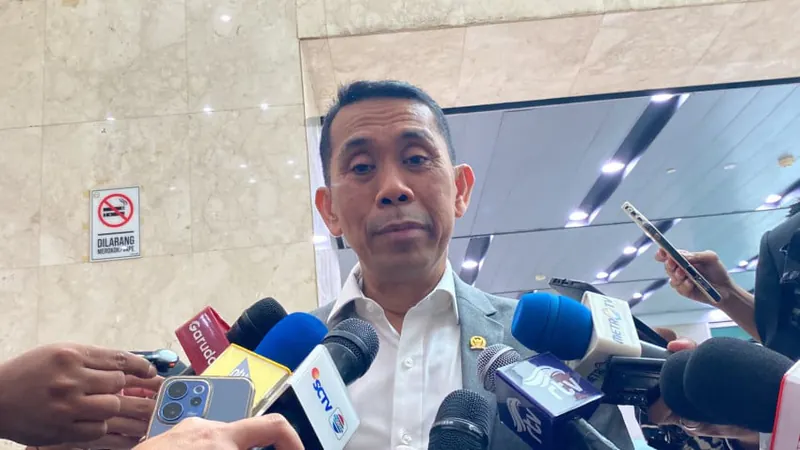
Gerindra has not yet decided its position on a proposal to impeach Vice President Gibran Rakabuming Raka, but said the call should be followed up seriously through parliamentary mechanisms. According to a report by SINDOnews, Gerindra spokesperson Kamrussamad made the remarks at the parliamentary complex in Senayan, Central Jakarta, on Tuesday, 10 November 2026.
He said Gerindra's parliamentary faction would hold an internal meeting before using the constitutional rights of the House of Representatives (DPR). Kamrussamad, as reported by SINDOnews, said the proposal was “important to be addressed seriously”. He said Gerindra respected moves by other factions to use the DPR's right to express an opinion or its right to conduct an investigation over Supreme Court (MA) and Constitutional Court (MK) rulings on the equivalency certificate for Gibran's senior high school education. Gerindra would also watch the DPR's plenary session this morning.
Constitutional Mechanism Behind the Impeachment Proposal
A proposal to impeach a vice president cannot be separated from Indonesia's constitutional architecture. In a presidential system, the president and vice president receive a direct mandate from voters through a general election. Their removal therefore cannot be carried out by a single institution; it must pass through a process involving the DPR, the Constitutional Court (MK) and the People's Consultative Assembly (MPR), in line with constitutional rules.
The DPR has three main oversight rights: the right of interpellation, the right to conduct an investigation and the right to express an opinion. The right of interpellation is used to seek clarification from the government on a particular policy. The right to conduct an investigation is used to examine government policies suspected of violating legal provisions. The right to express an opinion is used when the DPR believes there are serious allegations of violations by state officials or government policies.
In the case of a vice president, the right to express an opinion can become an initial gateway before the MPR makes a major political and legal decision. The process does not end in Senayan. After the DPR delivers its opinion, the Constitutional Court is tasked with examining, adjudicating and ruling on the alleged violations. The MPR then decides whether the proposal for removal is accepted. This chain makes impeachment a weighty constitutional event, not merely a political expression or street pressure. Each stage requires evidence, legal argument and sufficient political support. The statement that the proposal must be handled seriously can therefore be read as a call for parliament not to rush, but also not to ignore public aspirations.
On the other hand, rulings by judicial institutions that have become part of public discourse should be read as part of an ongoing legal dynamic. In Indonesian politics, differing interpretations among judicial institutions can spark debate over a person's legal status, particularly when it concerns eligibility for office. Gerindra's cautious stance can therefore be understood as an effort to prevent the issue from turning into political friction beyond the constitutional path. The MD3 Law, which governs the DPR and other legislative bodies, provides a framework for the DPR to set procedures, deadlines and the parliamentary bodies handling the proposal. The law also underscores that legal politics cannot be separated from constitutional ethics.
What Readers Should Watch
For Indonesian readers, the issue is not simply an elite drama. The vice president is part of a pair elected by the people. If the position is disrupted by an impeachment process, the effects can reach the operation of government, executive-legislative relations and certainty for businesses and the public awaiting policy decisions. In the short term, reactions in financial markets and the political cost of governing could rise, although that depends on how seriously the process in the DPR develops.
What matters is not only who has proposed impeachment, but also the legal basis and evidence being used. The right to conduct an investigation or the right to express an opinion does not automatically mean a vice president will be removed. The public can watch whether DPR factions form parliamentary bodies, whether testimony is collected and whether the steps comply with the MD3 Law, which sets out parliamentary procedures. If the mechanism is carried out, every party mentioned must still be treated according to constitutional norms and must not be presumed guilty before a final ruling.
The most tangible impact on society usually appears when political uncertainty drags on. Legislative agendas can be delayed, communication among state institutions can become tense, and public attention can be diverted from economic, health, education and basic service issues. Readers therefore need to avoid quick conclusions before the constitutional process runs its course. At the same time, the public can assess whether parties prioritise resolving the issue or turn it into a tool for political bargaining.
Related coverage
- Government Says DIM on Broadcasting Bill Protects Creators and Micro, Small and Medium Enterprises (MSMEs) (/pemerintah-sebut-dim-ruu-penyiaran-lindungi-kreator-dan-umkm/)
- Ministry of Population Development and Family Planning (Kemendukbangga) and DPR Socialise Bangga Kencana in Depok (/kemendukbangga-dan-dpr-sosialisasikan-bangga-kencana-di-depok/)