East Java Police Chief Meets LDII to Strengthen Public Order
East Java police chief Inspector General of Police Dekananto Eko Purwono met the regional leadership board of the Indonesian Islamic Propagation Council (LDII) in Surabaya on 11 November 2026 to strengthen cooperation on security and public order.
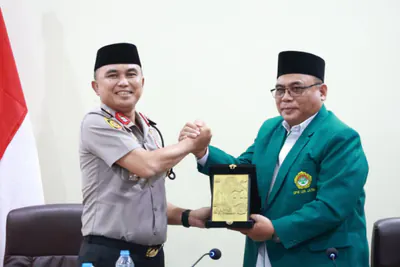
The East Java police chief, Inspector General of Police Dekananto Eko Purwono, visited the Surabaya office of the East Java regional leadership board (DPW) of the Indonesian Islamic Propagation Council (LDII) on Wednesday, 11 November 2026, to strengthen communication with religious organizations in maintaining security and public order (kamtibmas).
TVRI News, the news service of Indonesia's public broadcaster, reported that the visit was part of efforts to strengthen cooperation between police and the public, including the “Police Together with the Community” (Polisi Bersama Masyarakat) program.
Dekananto urged LDII to support harmony, tolerance, drug abuse prevention and information sharing for early detection of security disturbances. Moch. Amrodji Konawi, chairman of LDII's East Java regional board, called the visit an honor and an opportunity to strengthen ties with the police.
A history of police partnerships with religious organizations
Meetings between security officials and religious organizations are not new in Indonesia's management of security and public order. In modern policing, the approach falls under community policing: police not only enforce the law but also build relationships with social groups so that information, grievances and potential conflicts can be detected more quickly. In diverse regions, religious leaders and organization officials often serve as bridges between authorities and residents because they regularly interact in religious gatherings, schools, social activities and public spaces. The approach also helps police understand local norms, because heavy-handed measures that are insensitive to social context can trigger new resistance.
LDII is known as an Islamic propagation organization with networks across regions and is active in religious development, education and social activities. Because its base is broad, organizations like LDII can become important partners when police need communication channels that are not only formal. A religious approach is also relevant for messages on drug prevention, tolerance and resolving social friction, because many residents are more receptive to moral appeals from familiar worship environments.
The “Police Together with the Community” program expands the role of authorities from law enforcers to security facilitators. In that model, residents are not objects of operations but subjects who help maintain their environment. Meetings such as the East Java police chief's can be read as both symbolic and operational strengthening: symbolic because they show the state's presence among the public, and operational because they open information channels that can be used for dialogic patrols, public education, or prevention of brawls and drug abuse.
In East Java, interaction between police and religious organizations is also important because the province has major cities, industrial areas, Islamic boarding schools and dense urban communities. Security and public order disturbances often arise from small matters: misunderstandings, social conflicts, illegal drug trade or rumors on social media. When religious networks are involved, police gain local context not always visible in official reports, while residents get contacts that are easier to reach. In the social media era, false information can trigger suspicion between groups. Religious networks that regularly deliver sermons and religious study sessions have a chance to calm provocative narratives with more reassuring messages, as long as the messages are consistent with law and tolerance values.
What it means for residents of Surabaya and East Java
For readers in Indonesia, especially residents of Surabaya and East Java, the visit does not automatically change daily security. Its impact will be felt more if meetings continue into clear working mechanisms: responsive complaint channels, drug education activities in mosques and schools, joint patrols in hotspots and fast communication when social friction emerges. Without follow-up, agendas like this become little more than photo opportunities. Residents can also assess program success from the speed of response to small reports, not only from ceremonial visits.
What needs attention is whether cooperation addresses residents' needs: a sense of safety while going about daily life, prevention of drug abuse among youth, and space for dialogue when misunderstandings occur between groups. LDII has access to communities that can be used to spread official information rather than rumors. Conversely, residents need to see police present fairly, not only when major events occur but also in daily services.
In the long term, partnerships like this are relevant because security and public order are not only police matters. They depend on trust. When residents feel included, they are more likely to report problems, help prevent them and calm conflicts. For regions, such social capital can reduce the cost of handling security disturbances and keep the economic climate stable.