BNPPDT pushes to accelerate Sebatik border crossing operations in Nunukan
The National Border Management and Remote Areas Agency (BNPPDT) is seeking cross-ministry coordination so the Sebatik State Border Crossing Post in Nunukan, North Kalimantan, can begin operating soon.
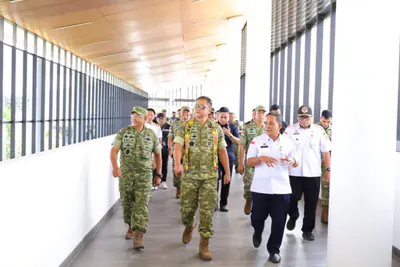
Maruli Simanjuntak, a general in the Indonesian National Armed Forces (TNI) who heads the National Border Management and Remote Areas Agency (BNPPDT), said efforts to accelerate operations at the Sebatik State Border Crossing Post (PLBN) in Nunukan Regency, North Kalimantan, still awaited coordination across ministries and agencies, as reported by TVRI News on Friday, 13 November 2026.
Maruli said several steps needed to put the post into operation could not yet proceed independently because they fell under the authority of multiple institutions. He said he hoped the president's policy would smooth inter-agency discussions so the operational process could be completed soon.
During a visit to Sebatik Island, Maruli also reviewed the readiness of infrastructure, the command post of the Indonesia-Malaysia Border Task Force (Satgas Pamtas RI-Malaysia), State Border Marker 2 in Aji Kuning village, and the Indonesian Navy (TNI AL) post at Sei Pancang. The findings from the visit would be used by BNPPDT to shape measures for managing border areas.
Maruli said BNPPDT's mandate now covers not only border areas but also remote regions. He said the expanded mandate includes improving residents' welfare, so programs must be mapped together with local governments and stakeholders. He also stressed the importance of local wisdom, communication with residents, and public service facilities that are inclusive and accessible for persons with disabilities.
Border management and the role of PLBN
A State Border Crossing Post is the main hub for people and goods entering and leaving border areas. In government practice, a PLBN is not a single building but a point where immigration, customs, quarantine, health, transport and security services meet. Decisions to operate a PLBN therefore usually involve ministries and agencies with different authority, covering human resource preparation, oversight systems, inspection procedures and supporting facilities in the field.
The Indonesia-Malaysia border has a distinct character. Sebatik Island lies in Nunukan Regency, North Kalimantan, and shares a direct border with Malaysia. Local residents' activities are often inseparable from family movement, trade in basic goods, seasonal work and long-established sea and land travel. In such places, a PLBN becomes more than an official checkpoint; it also links economic, social and security interests.
As the manager of border and remote areas, BNPPDT is in a strategic position to bring development and public service agendas together. The agency needs to bridge national policy with local conditions because border issues often cut across sectors, including road infrastructure, electricity supply, communication networks, security, education, health and market access for residents. Without accurate mapping, national programs can be implemented in areas with different needs.
Local wisdom matters in this context because border residents do not only wait for state services; they also follow social practices that have long been established. An overly administrative approach risks making policy feel distant from daily needs. Open communication, by contrast, can help local governments, national authorities and communities agree on more realistic priorities, especially on safety, order and cross-border economic activity. Field reviews are therefore important to ensure that national decisions are based not only on reports but also on road conditions, service posts and residents' habits at vulnerable points.
What it means for border residents
For residents of Nunukan and nearby areas, faster operation of the Sebatik PLBN could mean more orderly official travel options. If border services are complete, residents traveling, working or trading across borders could gain clearer routes for inspections, import duties, quarantine and security checks. That would also help the state distinguish official activity from unofficial routes that are harder to monitor.
The economic impact would be most felt by small businesses and daily workers who depend on cross-border movement. A well-run PLBN could make the flow of goods more predictable, reduce uncertainty in travel and create space for more inclusive public services. But those benefits would only materialize if supporting facilities, personnel and inter-agency coordination were truly ready; without them, the push to accelerate operations would remain an administrative plan.
For readers outside border areas, the issue remains relevant because it reflects how the state serves remote regions. Border policy often becomes a benchmark for the success of equitable development: whether residents in the country's farthest regions have economic access, security and services on par with those in other areas.