Asahan meets Ber-Aksi anti-corruption pilot indicators, but KPK flags implementation gaps
Asahan completed the final stage of the Ber-Aksi 2026 assessment, with indicators met but implementation gaps in schools, public services and wealth reporting flagged by the KPK
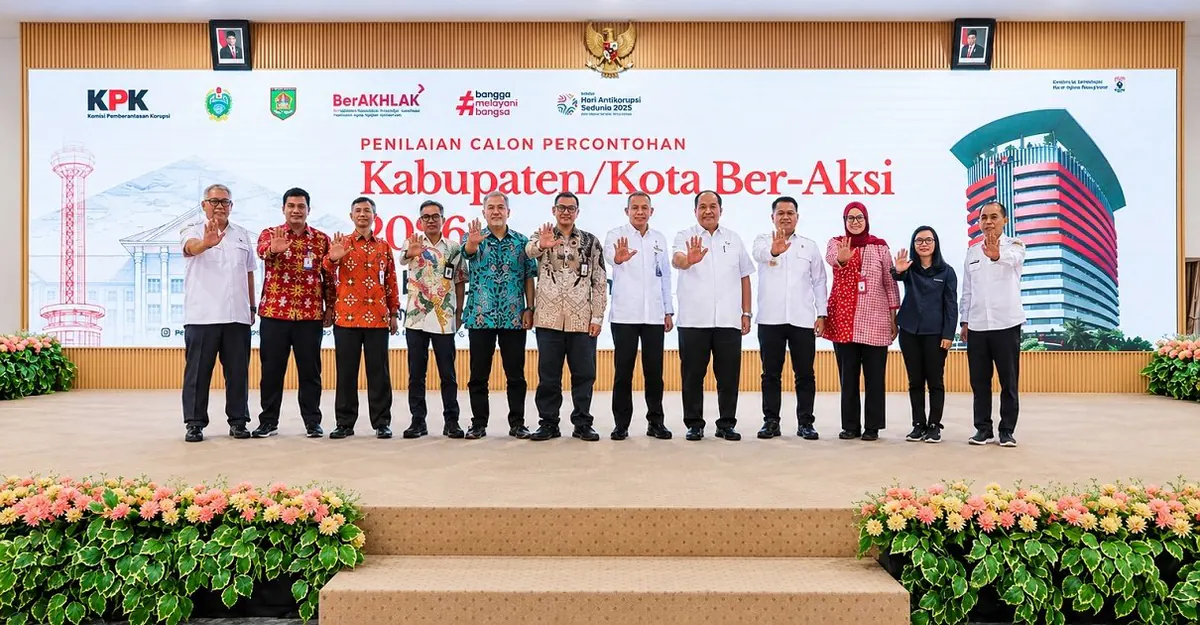
Asahan Regency completed the final stage of the Pilot Assessment of Districts and Cities with the Courage to Eradicate Corruption (Ber-Aksi) for 2026 on 4–5 November 2026. The assessment involved the Corruption Eradication Commission (KPK), the Ministry of Home Affairs, the Ministry of Administrative and Bureaucratic Reform (PANRB), the Ministry of Finance, the Government Internal Audit Agency (BPKP), the Ombudsman and the North Sumatra provincial government.
Andhika Widiarto, head of Task Force I of the KPK's Directorate of Community Participation, said in the commission's report that Asahan had fulfilled five components and 15 indicators after an observation period of about four to five months. He said the result still had to be tested against evidence submitted by the local government.
Andhika highlighted gaps in implementation, especially the translation of policies from regional government agencies to lower-level service units. He cited the Education Office's socialization of gratification rules that had not yet been felt in schools, and urged stronger compliance with the State Officials' Wealth Report (LHKPN) and prevention of gratification in public services and education.
The report said two state officials failed to comply with LHKPN reporting in 2024, and the number rose to 11 in 2025. Andhika said sanctions were needed for non-compliant officials. He also referred to findings about gifts in schools and class dues that he said should not be charged even if presented as voluntary.
Asahan Regent Taufik Zainal Abidin Siregar said he was committed to strengthening clean governance. The regency government plans to expand complaint channels through the National Public Complaints Management System (SP4N-LAPOR), establish a Gratification Control Unit and strengthen a whistleblowing system. He said 85 public reports were received from January to July 2026 and 62 had been completed.
He added that the implementation score for the Gratification Control Program rose from 38.20 in 2025 to 80.75 in 2026. The local government also relies on a Public Service Mall with 23 service outlets, digital services, a ban on middlemen and cashless payments to curb transactional practices.
Ber-Aksi as a test of local governance
The Ber-Aksi program, as its full name suggests, frames the assessment not as an administrative competition but as a test of whether anti-corruption values are actually alive in local bureaucracy. In prevention work, a program is usually measured on two fronts: whether policies exist and whether they are carried through to the service units closest to residents.
In many regions, the obstacle is not the issuance of decrees, but the transmission of rules to schools, community health centers, civil registry offices and service counters. When outreach stops at the agency level, residents and front-line staff may still face old practices, such as gifts, levies considered reasonable or the use of middlemen. Implementation therefore distinguishes formal compliance from behavioral change.
The State Officials' Wealth Report, or LHKPN, is a prevention instrument often misunderstood. It is not a tool to punish individuals, but a way to expose potential conflicts of interest and encourage transparency. Gratification sits in a different category from bribery: gratification can be a gift or payment linked to an official's position, while bribery requires an agreement or the intent to influence a decision. In public services, the boundary between the two must be explained so that residents do not normalize gifts that could affect officials' neutrality.
Regional anti-corruption programs also rely on complaint channels, gratification control units and internal reporting mechanisms. These three function as early-warning sensors. But they only matter if residents know how to use them, complaints are followed up and staff are not afraid to report. This is where local assessments become relevant: they force regional governments to prove that integrity systems are not only on paper. Without follow-up, a rating can become a ceremonial achievement.
What residents should watch for
For Indonesian readers, the results of such assessments are most visible when residents access schools, community health centers or population administration services. If anti-corruption values remain only in documents, people may still face small levies, gifts considered polite or middlemen who speed up matters. Conversely, when rules are enforced at the counter, service costs become more predictable, waiting times clearer and residents do not need to seek unofficial channels.
Stronger complaint channels and digitalization also matter because they change daily habits. Cashless payments and online services reduce face-to-face contact that can invite transactions, but they do not automatically remove problems if the systems are hard to use or complaints are slow to be processed. The issue going forward is therefore not only whether more indicators are met, but whether schools, community health centers and service offices actually apply the same rules.
For a region such as Asahan, the most practical impact can be measured by three things: whether teachers and service staff understand the limits on gifts, whether residents know where to report, and whether sanctions for compliance violations are applied consistently. Without that, the Ber-Aksi assessment risks becoming an annual report that does not change residents' experience when they seek basic rights.