KPK and MIND ID integrate whistleblowing system to strengthen mining corruption detection
The Corruption Eradication Commission (KPK) and state-owned mining holding PT Mineral Industri Indonesia (MIND ID) signed an agreement on 5 November 2026 to integrate their whistleblowing systems and strengthen early detection of corruption risks across the group.
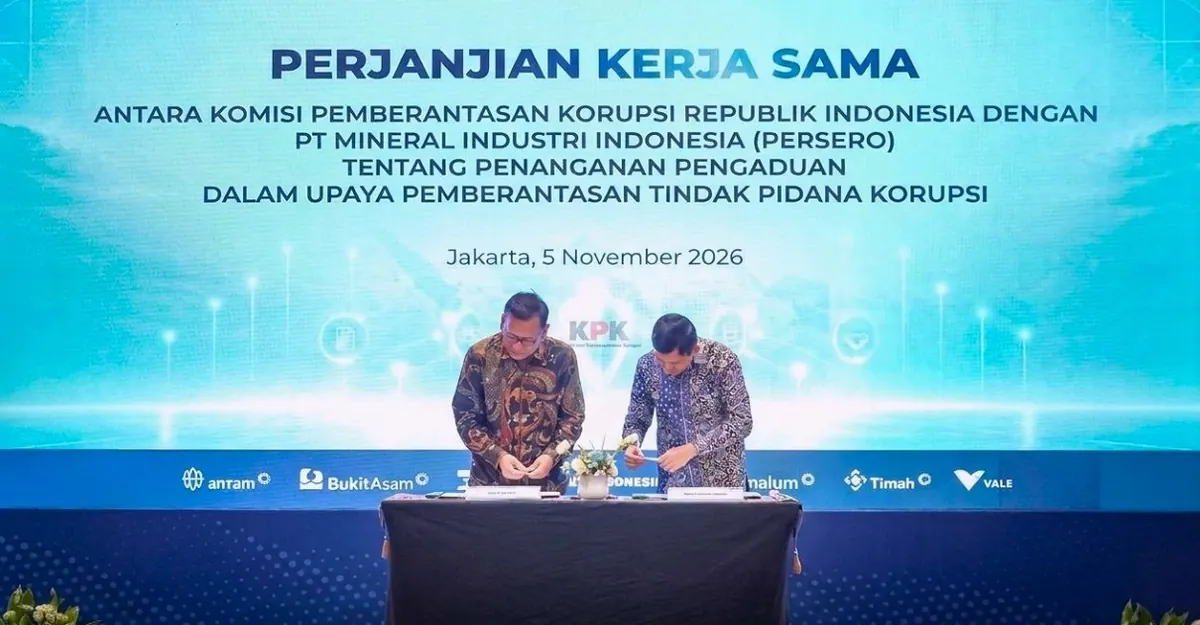
The Corruption Eradication Commission (KPK) and PT Mineral Industri Indonesia (MIND ID) signed a cooperation agreement in Jakarta on Thursday, 5 November 2026, to integrate their Whistleblowing System (WBS) channels, according to the KPK. The move is intended to strengthen early detection and mitigate corruption risks across the MIND ID Group.
Integrating the complaint channels is meant to widen access for reports from company insiders and external parties. Eko Mardjono, Deputy for Information and Data at the KPK, said the cooperation was important because MIND ID is the national mining holding company and manages large state assets with complex business chains. Maroef Sjamsoeddin, President Director of MIND ID, said strengthening integrity was part of the mandate to manage mineral and coal resources. The cooperation continues a partnership that began in 2021, when MIND ID was still named PT Indonesia Asahan Aluminium (INALUM), with an extension of the cooperation agreement (PKS) for 2026-2031.
Protecting state assets across the mining chain
A whistleblowing system is not simply a complaint box. In corporate governance practice, it is a formal route for employees, partners or outside parties to report alleged violations without having to go through superiors who may be involved. Its main value lies in protecting reporters, keeping identities confidential and providing a clear follow-up mechanism. Without those three elements, reporting channels often remain symbols of compliance. In many organisations, reporters instead face pressure because their complaints are seen as disruptive to careers or to the reputation of a work unit that should be jointly protected.
For MIND ID, the need for a stronger reporting route is linked to its role as the holding company of the mining industry. The change of name from PT Indonesia Asahan Aluminium to MIND ID marked an expansion of its mandate from an aluminium operator to a mining holding company. That transformation brings a challenge: one holding company must align the compliance culture of companies with different business backgrounds. The sector touches permits, procurement, relations with local governments, environmental management and long supply chains. Such complexity means a small irregularity can spread across several business lines and cause losses that are difficult to estimate.
As an entity that manages mineral and coal wealth, MIND ID also sits at the intersection of commercial interests and the public interest. Upstream decisions, such as exploration and processing, affect state revenue, employment and the price of raw materials for downstream industries. Internal oversight therefore cannot rely only on routine audits; it also needs an early radar to capture risk patterns before they become major cases.
Linking the WBS with the KPK's complaint channels signals that corruption prevention at state-owned mining companies (BUMN) is no longer viewed as merely administrative. When internal reports and state mechanisms are connected, the company gains broader access to verify alleged violations, while the public gains assurance that complaints do not stop at management desks. Cross-channel cooperation can also reduce duplicated handling of reports and speed up the identification of recurring patterns across subsidiaries.
Impact on the public and the investment climate
For readers, strengthening a whistleblowing system at a state-owned mining company may seem distant from everyday life, but mineral and coal products touch many areas: building materials, vehicles, electronic devices, energy and downstream industries. When state assets are managed cleanly, potential cost leaks can be reduced. In the long term, that relates to price competitiveness, supply certainty and state revenue that returns to the public through development.
The investment climate also takes note of such reporting systems. Investors tend to have more confidence in companies with credible complaint channels and a willingness to open themselves to state oversight. For workers, a system that protects reporters can reduce the fear of reporting violations. For communities around mines, an accountable mechanism becomes a control tool so that social and environmental promises do not remain documents.
What matters now is implementation. Integrating channels will only be meaningful if reports are followed up, whistleblowers are protected and results are reported periodically without revealing identities. Without evidence of execution, the cooperation risks becoming a ceremony. The public therefore has the right to monitor whether the system truly changes how state-owned mining companies manage corruption risks. The success of a whistleblowing system is measured by action, not by the number of agreements. Transparency in results, such as a summary of the number of reports processed without naming individuals, can be a marker that the system is working.
Related news
- KPK appoints seven strategic anti-corruption officials
- KPK strengthens global cooperation to drive corruption asset recovery
- KPK strengthens oversight of South Sulawesi regional budget (APBD), scrutinising Pokir and procurement