Arun Urges Commission III of Indonesia's DPR to Fast-Track Asset Forfeiture Bill
Advokasi Rakyat untuk Nusantara (Arun) asked Commission III of the House of Representatives (DPR RI) to accelerate deliberations on the Asset Forfeiture Bill during a public hearing in Jakarta.
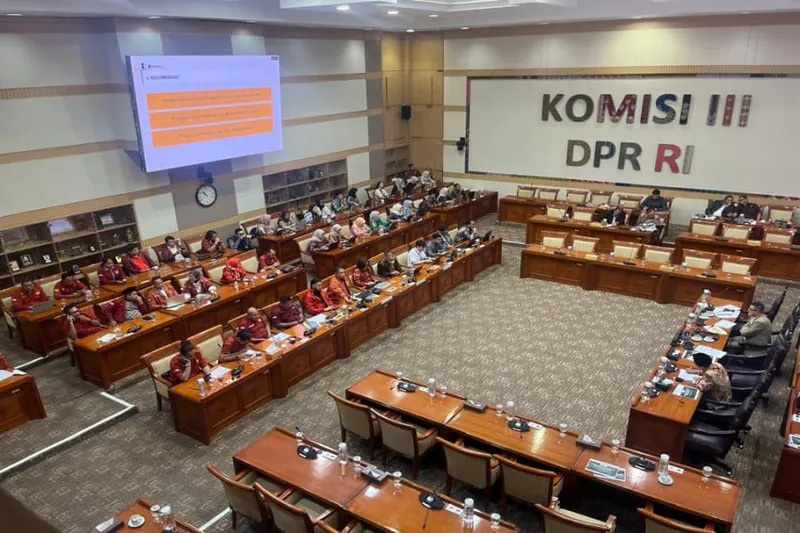
The Central Executive Board of Advokasi Rakyat untuk Nusantara (Arun), a civil society organisation, asked Commission III of Indonesia's House of Representatives (DPR RI) to accelerate deliberations on the Asset Forfeiture Bill, according to a SINDOnews report on Wednesday, 11 November 2026. The request was made during a public hearing in the Commission III meeting room in Jakarta.
Yudi Rijali Muslim, head of Arun's law division, said the bill was important not only for the state but also for the public. In a statement quoted by SINDOnews, he said, "The Asset Forfeiture Bill is a necessity for the people."
Arun also welcomed the passage of the Agrarian Reform Law and supported transparent law enforcement over allegations of wiretapping and treason. Yudi cautioned that legal proceedings should not hamper development programmes launched by President Prabowo Subianto.
He said the recommendations came from internal research and public aspirations.
The long history of the Asset Forfeiture Bill
The Asset Forfeiture Bill is not a new item on Indonesia's legislative agenda. The idea has gained traction because economic crimes, corruption and money laundering often leave behind assets that cannot be recovered through imprisonment alone. In legal practice, a prison sentence can reach the convicted person, but it does not always return wealth that has been transferred, hidden or tied to other parties.
For that reason, asset forfeiture has often been discussed as a tool for recovering state losses and protecting public interests. Mechanisms designed in bills of this kind generally require clear definitions of what can be seized, procedures for proof and safeguards so that legitimate owners are not harmed. Technical issues usually arise over assets held by families, corporations, third parties and items that serve as evidence. Without detailed rules, enforcement in the field could generate new disputes.
In the parliamentary context, a civil society organisation's call for faster deliberations is usually read as public pressure on legislative priorities. Commission III has an important role because its remit covers law, human rights and security. But speeding up is not only about meeting schedules; it also involves harmonisation with other laws, the readiness of implementing agencies and oversight mechanisms. If a new law is passed without a strong technical foundation, its aims may be met on paper but not necessarily in practice.
The bill's position is also often compared with major corruption cases that have exposed patterns of asset concealment. In many cases, parties suspected of involvement no longer hold assets related to alleged crimes in cash, but in property, shares, vehicles or business entities. As a result, debate in the DPR usually touches the boundary between the state's interest in recovering losses and citizens' rights to a fair legal process. The presumption of innocence remains a key reference. Supervision of seized assets also needs to be separated from the criminal proof process to avoid confusion in court.
What readers need to understand
For readers in Indonesia, the Asset Forfeiture Bill does not directly change the price of staple goods or electricity tariffs. Its impact is closer to legal governance and state finance: whether assets linked to suspected crimes can be traced, seized and recovered without waiting for a prolonged process. If the mechanism works well, the public can benefit indirectly through recovered budgets, stronger law enforcement institutions and greater trust in justice.
The key issue is the balance between accelerating deliberations and protecting citizens' rights. In cases that have not acquired final legal force, persons suspected of involvement must still be treated as innocent. Implementing regulations and court practice will therefore determine whether asset forfeiture truly reaches assets linked to suspected crimes, rather than assets belonging to third parties who are not proven to be involved. Transparency in asset lists, owners' rights to respond and judicial oversight need to be tested in public.
For general readers, the main point is that calls from civil society organisations such as Arun reflect hope that the DPR will not delay an issue with broad consequences. But faster deliberations alone are not enough. What matters more is whether the law that emerges has clear procedures, accountable implementing agencies and recovery mechanisms that can be audited. In the long run, the quality of this law will shape how well the state can return public losses without sacrificing justice.
Related news
Habiburokhman highlights alleged illegal wiretapping as DPR pushes bill; Surabaya crowd urges DPR to impeach Vice President Gibran; Rokhmat Ardiyan asks students in Kuningan to monitor the Climate Change Bill.