Wendy Aprilyanto runs for PB HMI chair with Yusril Ihza Mahendra's support
Wendy Aprilyanto, deputy secretary general of PB HMI, has become a candidate for the 2027-2029 chairmanship ahead of HMI's 33rd congress, with backing from coordinating minister Yusril Ihza Mahendra.
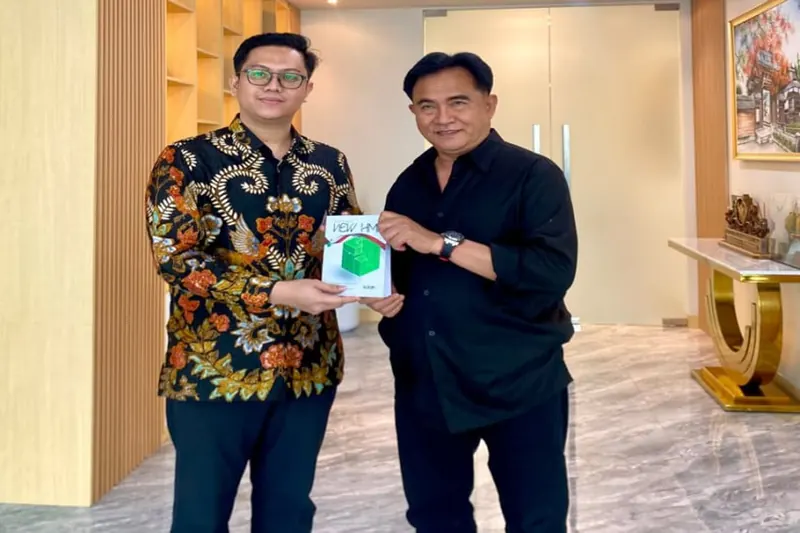
Wendy Aprilyanto, deputy secretary general of the national board of Himpunan Mahasiswa Islam (HMI, the Indonesian Islamic Student Association), known as PB HMI, for 2024-2026, has formally become a candidate for PB HMI chairman for the 2027-2029 period. His candidacy has drawn the support of Yusril Ihza Mahendra, the Coordinating Minister for Law, Human Rights, Immigration and Corrections (Menko Kumham Imipas), SINDOnews reported.
Yusril voiced his support as Wendy presented the book 'New HMI: 33 Gagasan Transformasi HMI Adidaya untuk Indonesia Raya' at the office of the Coordinating Ministry for Law, Human Rights, Immigration and Corrections (Kemenko Kumham Imipas) in Jakarta on Monday, 16 November 2026. The PB HMI chairman will be elected at HMI's 33rd congress in Bandar Lampung from 28 November to 5 December 2026.
In a video message, Yusril said he backed Wendy to win an honest election. The book, more than 450 pages long, contains 33 transformation ideas across eight chapters, in line with the eight missions Wendy has offered.
Role of the congress in HMI succession
HMI is one of Indonesia's oldest Islamic student organisations. For a long time it has been known as a network for shaping young elites across campuses. It was founded in the early years of the republic and grew into a campus network that spans generations. In the organisation's structure, PB HMI is the national level, while regional branches serve as bases for cadre development. The change of chairman is therefore not merely an internal matter, but a marker of the direction of the student movement for one term.
The HMI congress is usually the highest forum for electing the chairman, setting the broad programme outline and reviewing the previous leadership's accountability. At many congresses, issues discussed have included cadre development, organisational independence and HMI's position toward state policies. The mechanism resembles national deliberations in many student organisations: candidates present ideas, supporters gather votes and congress participants make a choice. In campus politics, congresses also become arenas for competing networks, among alumni, regions and ideological groups.
HMI alumni are often associated with KAHMI, a body that links former members across professions. From campus, those alumni have spread into the bureaucracy, political parties, mass organisations, universities and the legal profession. The influence of such alumni networks means the election of a PB HMI chairman is often read as part of elite regeneration. Candidates usually bring proposals for renewal: digitalising cadre development, strengthening policy advocacy or reorganising the system.
For readers, terms such as chairman candidate, congress and PB HMI should be understood as organisational processes, not state offices. A candidate's status does not confer formal legitimacy until the congress elects. Support from public figures can be a political signal, but it does not automatically decide the result. This distinction matters so readers do not assume a prominent figure's endorsement means victory. The outcome still depends on the votes of congress participants and the organisation's procedures.
Why a public figure's endorsement matters
For the Indonesian public, the contest for a student organisation's chairmanship may seem remote from daily concerns. The question is relevant because students are often the subject of government policy. Yet organisations such as HMI serve as cadre development channels that produce alumni in the bureaucracy, parties, campuses and professions. When a candidate is backed by a senior national official, readers may focus on two issues: whether the support strengthens a political network, or whether it raises questions about the boundary between state office and a student organisation.
The process to watch is the congress in Bandar Lampung. Participants will assess candidates' ideas, their records in cadre development and their ability to safeguard organisational independence. For students, the outcome may shape campus advocacy, the themes raised and relations with the government. For alumni, a change of chairman can shift priorities for consolidating networks. At the regional level, the congress may also generate new advocacy agendas, such as education, jobs or academic freedom.
Yusril's support also shows that the contest has entered a wider public space. Readers still need to distinguish personal endorsement from an organisational decision. Until the congress ends, Wendy Aprilyanto's status is that of a candidate, not an elected chairman. Such news is most useful when read as an internal political process, not as an announcement of an official office. If the process is open, the result is likely to be more credible to members and the public.