Vice Minister for Human Rights Warns Children Should Not Be Targets of Parents’ Political Grudges
Mugiyanto said children should not become targets of hatred arising from their parents’ political conflicts after alleged bullying of a political figure’s child surfaced around World Children’s Day.
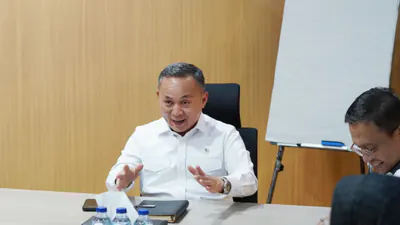
Vice Minister for Human Rights Mugiyanto urged the public not to make children targets of hatred arising from their parents’ political conflicts, after alleged bullying of a political figure’s child surfaced around World Children’s Day on 20 November. He made the statement in a press release on Saturday, 21 November 2026, as reported by state broadcaster TVRI News.
“No sin is inherited by a child,” Mugiyanto said in the press release. He stressed that every child has their own rights and should not bear the consequences of their parents’ political choices. Society may criticize public officials harshly, he said, but that hostility must not drag children into it.
Mugiyanto cited Article 2, paragraph 2, of the United Nations Convention on the Rights of the Child (CRC), which prohibits punishing children because of their parents’ beliefs or actions, and Article 28B, paragraph 2, of Indonesia’s 1945 Constitution, which guarantees that children are free from violence and discriminatory treatment. According to TVRI News, he noted that similar incidents have recurred in recent years, from negative comments about Jan Ethes, the grandson of President Joko Widodo, to insults directed at the child of comedian Pandji Pragiwaksono in early 2026.
Child Protection in Indonesia’s Legal Framework
The CRC is the world’s most widely ratified international human rights instrument. Indonesia ratified it through Presidential Decree No. 36 of 1990, meaning the state is legally bound to ensure every child within its territory receives protection without discrimination. The convention’s non-discrimination principle includes a ban on punishing children for their parents’ actions, opinions or beliefs, a provision that has rarely been tested in electoral politics.
At the national level, child protection is governed by Law No. 23 of 2002, amended by Law No. 35 of 2014. The law obliges the state, local governments and society to protect children from violence, exploitation and discrimination. The Ministry of Women’s Empowerment and Child Protection is the technical agency coordinating implementation of the policy, while the National Commission on Human Rights (Komnas HAM) oversees the fulfillment of children’s rights as part of its institutional mandate.
Bullying in digital spaces falls under a more complex legal area. The Electronic Information and Transactions Law (ITE Law), particularly Article 27, paragraph 3, and Article 29, prohibits defamation and threats of violence through electronic media. Enforcement is often hindered by difficulty identifying anonymous perpetrators, the volume of content and the absence of complaint channels that are accessible to children and victim families. In practice, many cyberbullying cases involving children of public figures end with perpetrators issuing apologies without further legal proceedings.
In Indonesia, responses to cyberbullying against children remain spread across multiple institutions without a single coordinated service point. Victims’ families often have to pursue layered steps: reporting content to digital platforms, contacting police cyber units and lodging complaints with relevant ministries. This fragmentation slows the process and exhausts child victims, especially when perpetrators use anonymous accounts or operate across borders.
What Parents and Educators Should Watch
For Indonesian parents active in public life — as officials, journalists or media figures — the vice minister’s statement marks an important shift: child protection is now positioned as a standalone human rights issue rather than merely a supplement to family policy. When a child becomes a bullying target, the victim’s family therefore has a stronger legal basis to demand accountability from perpetrators and from platforms that facilitate attacks.
The message is also relevant for educators because schools are often the first place where children of public figures interact with peers exposed to their parents’ political narratives. Teachers and school counselors need to understand that bullying beginning on social media can continue in classrooms, and that internal school complaint mechanisms must be able to recognize attack patterns rooted in students’ parents’ political or religious identities.
Going forward, the key question is whether the call to strengthen human rights-based digital literacy will be translated into operational policy, such as revised reporting guidelines on digital platforms or the integration of anti-bullying modules into the curriculum. Without concrete steps, protecting children from hatred inherited from their parents will remain a moral appeal rather than an enforceable obligation.